I began a Master’s degree program in September of 2019 with the University of St. Boniface. Having completed the coursework in 2020, I met with my new director of research and two committee members and when they asked how long I thought it would take me to complete the thesis, I answered breezily, “two years.” They approved. I liked writing, and I had already begun research. In fact, the main reason why I enrolled in the program, was to be able to conduct research and produce a creditable piece of writing; why not get a diploma at the same time?
The fact that I completed the program six years later, taking five years to write a thesis rather than two, is something I wanted to write about here. In particular, I wanted to seize the chance to discuss what it feels like to write a thesis, now that it is done, and why I felt I couldn’t do so in the middle of writing it. Indeed, I tried… I created a category on the blog called “Student dispatches” and figured I’d regularly write about my progress. This was the first mistake: thinking that this process could fit a word with the definition of “onward movement following a prescribed course.” (OED) Far from being the road trip I imagined, research and writing felt more like a parenthetical period in which I left the road, bushwhacked a path in the forest and set up a cabin off-grid where I drank tea every morning and hailed homing pigeons for messages. Hattie Crisell in one of her newsletters quotes David Bayles who writes “the artist’s life is frustrating not because the passage is slow, but because he imagines it to be fast.” To which she adds, “I write every day, but it takes me so long for an idea to crystallize and become substantial.” Therefore, spending so much time working on the process of producing something substantial, I could not then spend more time trying to explain that, let alone trying to understand and distill it at the same time.
Nevertheless, I did try, especially at the beginning. I quoted authors, particularly when I felt a kind of convivial reassurance. (An example here and here). Perhaps the blog-post that now feels most apt to describe the early period of research is one in which I use horse-riding as a metaphor. I’m not sure it’s the first metaphor that comes to mind now, but the feeling rings true.
One of the main reasons it took me so long to research and write, was that I prioritized my parenting responsibilities over my student role, and incidental to this were the events surrounding the Covid-19 pandemic. For a period of time, I was home with three children for the length of school-online protocols. There’s a little snapshot of that here, a humorous post about the archives being closed here, and then what it looked like when they re-opened here. Pandemic aside, if I had to cut back on time consecrated to research or writing in favour of childcare, or the regular duties of meal-planning, cooking, entertaining, and – eventually – care-giving, I refused to stress over it. Sure, I wished I could work faster and mark tangible progress, but being a student was its own pleasure and it could feel like a privilege to be able to take a break from typical stay-at-home roles to spend time at the library.
More, more, more research
What felt most challenging about writing a thesis was being confronted with my own ignorance. I can’t help but think of Donald Rumsfield’s “unknown unknowns”. For all the mockery he received, the words describing the amorphous thing I felt I was battling against ring true. In Understanding Ignorance Daniel DeNicola writes:
Ignorance devastates. Every one of us – however intelligent and knowledgeable – is bedevilled by our ignorance.
I began this project as a pretty good essay-writer. On the strength of that, I was hired as a writing tutor for undergraduate students. I thought a thesis was like writing four or five long essays. Disabusing myself of that preconception, when, for example, I would submit a draft of a chapter to my director, only to realize that I hadn’t gone deep enough in the research, felt really hard. I prided myself on research and detail, and yet, after submitting those first drafts, the director’s remarks – kind as they were, I hasten to add! – felt like I was being turned in my chair, and pointed in the direction of a curtained window I didn’t even know existed, and being asked, “have you considered opening the curtain and taking in the view over there?” This happened devastatingly at first for drafts 1-2-3 of the first chapters. I got better as I tackled later chapters (I checked for more curtains in advance!) and feedback felt less devastating.
What I now know was happening between those drafts of chapters was what Daniel DeNicola calls cogitation. He writes:
our curiosity can lead to cogitation – identifying, associating, classifying, inquiring, researching, computing, assimilating, comprehending, explaining – activities that render the unknown, known.
Thinking is hard. For me, it goes hand in hand with writing: I write to understand what I think. And it can be deceiving to suppose that all you have to do is to sit down and write… Often sitting down to do so lead to what Julia Ioffe describes:
Sometimes, just the act of banging your head on the blank page, of starting, failing, deleting, restarting, helps you figure out where the writing needs to go. Sometimes, it makes you realize that you just don’t have what you need yet, that you need to read or research more—which can easily turn into procrastination.
The frustration of being unable to simply produce 500 words on a page would lead to fumbling around for clues… “What am I not understanding? What am I missing here? Where do I go?” I found it very comforting to understand that this was normal, thanks to Virginia Valian’s essay “Learning to Work”. I wrote a short blog post on the subject in April of 2024.
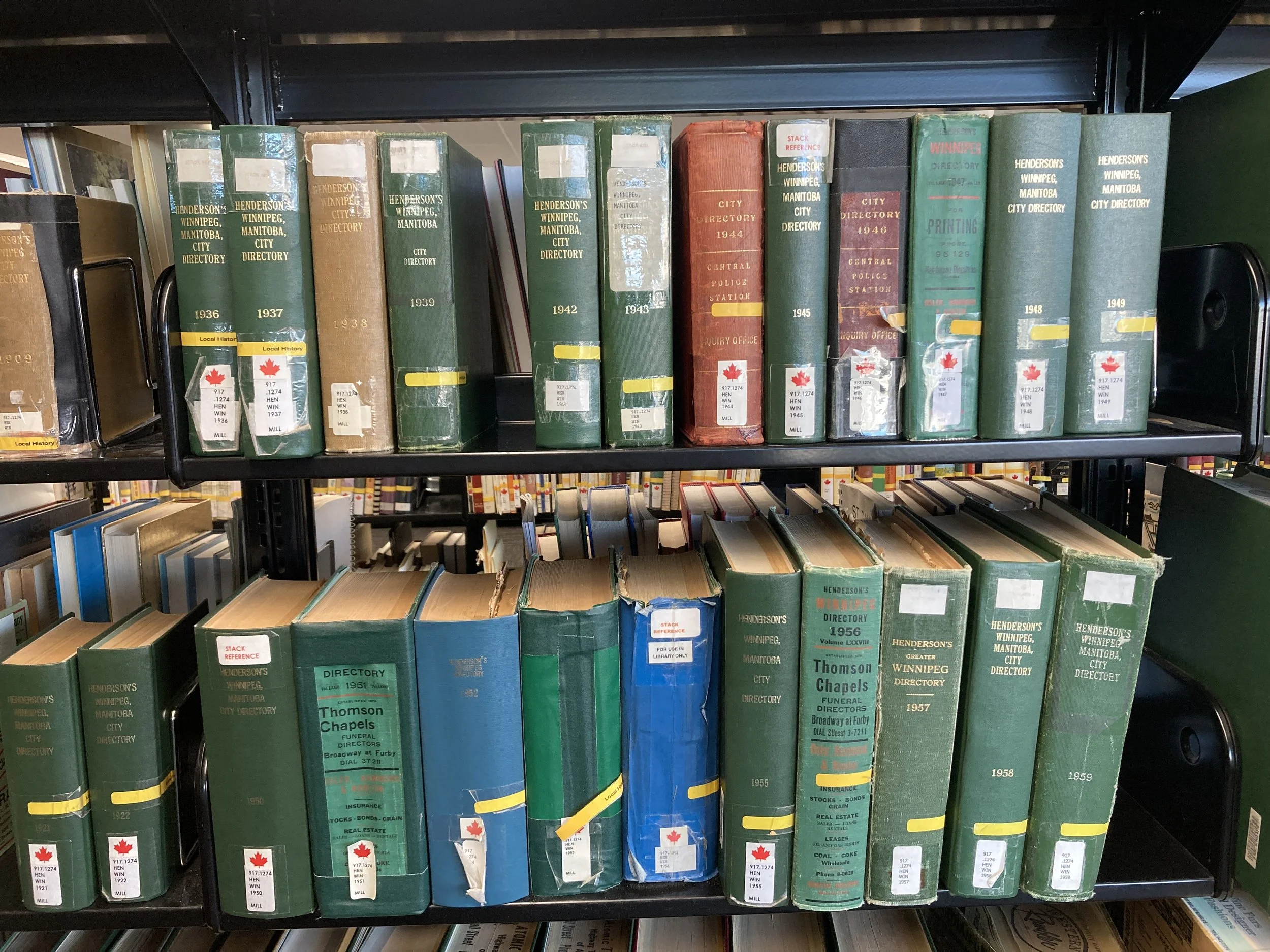
Here’s an example. I had gathered a list of family names and decided to divide them into categories. One of the categories was the Métis families. In tracing their history (when they came to the area of Aubigny, how many families there were…) I looked through Federal census data and found their names. I saw that when it came to declaring their origin, the census indicated “Métis French”. I couldn’t understand the strikethrough. Why was it there? What did it mean? In a first draft of the chapter I referred to another research paper that noted the same thing in another parish and I quoted other research on Métis identity. It was vague. My director’s comments encouraged more specificity. Basically, my first draft sounded like: “look, I noticed this, and, uh… maybe it means this?” I had to dig more. I had to find more research on the subject of federal censuses and how Métis were identified in them. Time spent reading a variety of sources and analyzing census instructions to the enumerators lead to a better understanding of the context and, consequently, confident paragraphs.
Organizing an argument over multiple drafts
Another example is something Robert Caro mentions in the documentary Turn Every Page. He describes all the time spent in the archives, and how, as a project progresses, an item that was previously dismissed can turn out to be important at second glance. It wasn’t so much that I overlooked something that became useful, but rather that I had something useful but didn’t know how to demonstrate its importance.
I had already started doing research into Aubigny’s history in 2014 and I was determined to find something that would explain how the town got its name. I found a letter by bishop Langevin who writes that he gave the parish its name to associate it with a French nobleman – Jacques d’Aubigny. It felt like I had made a significant discovery, but I was unable to communicate why it was significant. A blog post from 2015 narrates the facts, but does not provide their significance. In one of my thesis drafts I thought more detail was the answer, and so I wrote Jacques’ biography. He became a monk, and I included the chronology of events in the development of the Trappist order in Manitoba. It was a quagmire and my director wanted it to be entirely cut from the thesis. However, I couldn’t let go of the chance to correct the record on the origin of the town’s name. What did it mean to Aubigny’s pioneers that their parish name was associated to that of a once nobleman, now Trappist monk? Finally I understood… All these letters detailing costs of church building, the articles describing fundraising outcomes, the evidence of the priest’s efforts to make a decent salary and Langevin’s forceful defence of the construction of the new cathedral in St. Boniface all point to the precarity of small parishes. That Langevin named the new parish after a personal acquaintance in the French community shows a roll of the dice for a chance of favouring the new foundation.
How writing is thinking
Writing drafts of chapters often followed this pattern… I would organize the facts, or explain the chronology of events and have a nagging feeling that something was lacking. Feedback would confirm it, I would momentarily feel awful, and then it was time to get back to work. It’s reassuring when writers like Elizabeth Day admit similar sensitivity. In an interview she says: “I am really quite thin skinned. I’ve worked hard on that. I try not to be, but I think a lot of writers are extremely sensitive – you have to be to let the world in.”
The lack of control is another aspect of writing that can be diagnosed in the “bushwhacking a path” metaphor used earlier. A plan was required before I could begin writing and I found this very challenging. It is what is so disconcerting about books like Doing Your Master’s Dissertation: From Start to Finish by Larry Euris Everett and Inger Furseth. Useful as a guide to analysis -
You are expected to always do your reading in a critical manner. A literature review consists of more than just a summary or a description of other people’s work. It is an analysis in the sense that you are required to extract different forms of information from the literature and assess it by asking questions and critiquing it. (p 77)
- the tips on writing are deceptively simple, like the following, “it is important that you practice writing.”
Later, I found Writing Without Teachers by Peter Elbow. He writes:
If the main advice people need to help their writing grow is to start writing and keep writing, their main experience in trying to follow this advice is the feeling of chaos and disorientation. (p 30)
Published in 1973, his book is perhaps one of the best at describing the work of writing...
[…] the ability to write is unusually mysterious to most people. After all, life is full of difficult tasks: getting up in the morning, playing the piano, learning to play baseball, learning history. But few of them seem so acutely unrelated to effort or talent. (p 12).
And,
The commonsense, conventional understanding of writing is as follows. Writing is a two-step process. First you figure out your meaning, then you put it into language. Most advice […] follows this model: first try to figure out what you want to say; […] make a plan; use an outline; begin writing only afterward.
Elaborating on this, he writes:
This idea of writing is backwards. That’s why it causes so much trouble. Instead of a two-step transaction of meaning-into-language, think of writing as an organic, developmental process in which you start writing at the very beginning – before you know your meaning at all – and encourage your words gradually to change and evolve. Only at the end will you know what you want to say or the words you want to say it with. You should expect yourself to end up somewhere different from where you started. Meaning is not what you start out with but what you end up with. Control, coherence, and knowing your mind are not what you start out with but what you end up with. […] Writing is, in fact, a transaction with words whereby you free yourself from what you presently think, feel, and perceive. You make available to yourself something better than what you’d be stuck with if you’d actually succeeded in making your meaning clear at the start. What looks inefficient – a rambling process with lots of writing and lots of throwing away – is really efficient since it’s the best way you can work up to what you really want to say and how to say it. The real inefficiency is to beat your head against the brick wall of trying to say what you mean or trying to say it well before you are ready. (p 15).
Although his argument coincides with my experience, I suspect that research directors in academic programs would be reluctant to forgo the planning stage with their students.
A nice realization at the thesis defense
In September of 2025, I defended my thesis. The University of St. Boniface is small and family-like given its place in the French community. I gave a summary of my thesis to a handful of people besides the program director, the director of research and two committee members. My favourite question was one I didn’t expect, and when it was asked, I had the strange sensation of feeling like I was a guest on a podcast… “Did anything surprise you in the course of this research and thesis writing?”
What surprised me most about the research I had done was discovering an appreciation for francophone culture. I didn’t grow up with this appreciation. I went to a bilingual school from kindergarten to grade eight and then attended l’École Canadienne-française for high school. If French was touted as an advantage for finding a job in elementary school, it was something of a moral obligation in high school… You spoke French because it was part of you (to be admitted as a student, you had to have French ancestry) and you were proud to belong to the French culture. That was an idea my mom poo-pooed with typical regularity. My dad, who was Irish, seemed more proud of having married a “French” woman and I remember him crediting my maternal grandmother for our eligibility to attend the only francophone school in Saskatoon. But we didn’t lean in to the French culture any more than that. At home, we spoke English.
Having spent years immersed in tracing family genealogies and the vagaries of immigration at the beginning of the 20th century, I’ve come out on the other side with a deep respect for the enterprise they undertook, the actors involved, and the development that unfolded. Perhaps the greatest gift historical research can bequeath are moments when people who have shaped the present don’t feel as absent as their gravestones would indicate. Finishing this program I think I feel both humbled and elated at the same time…