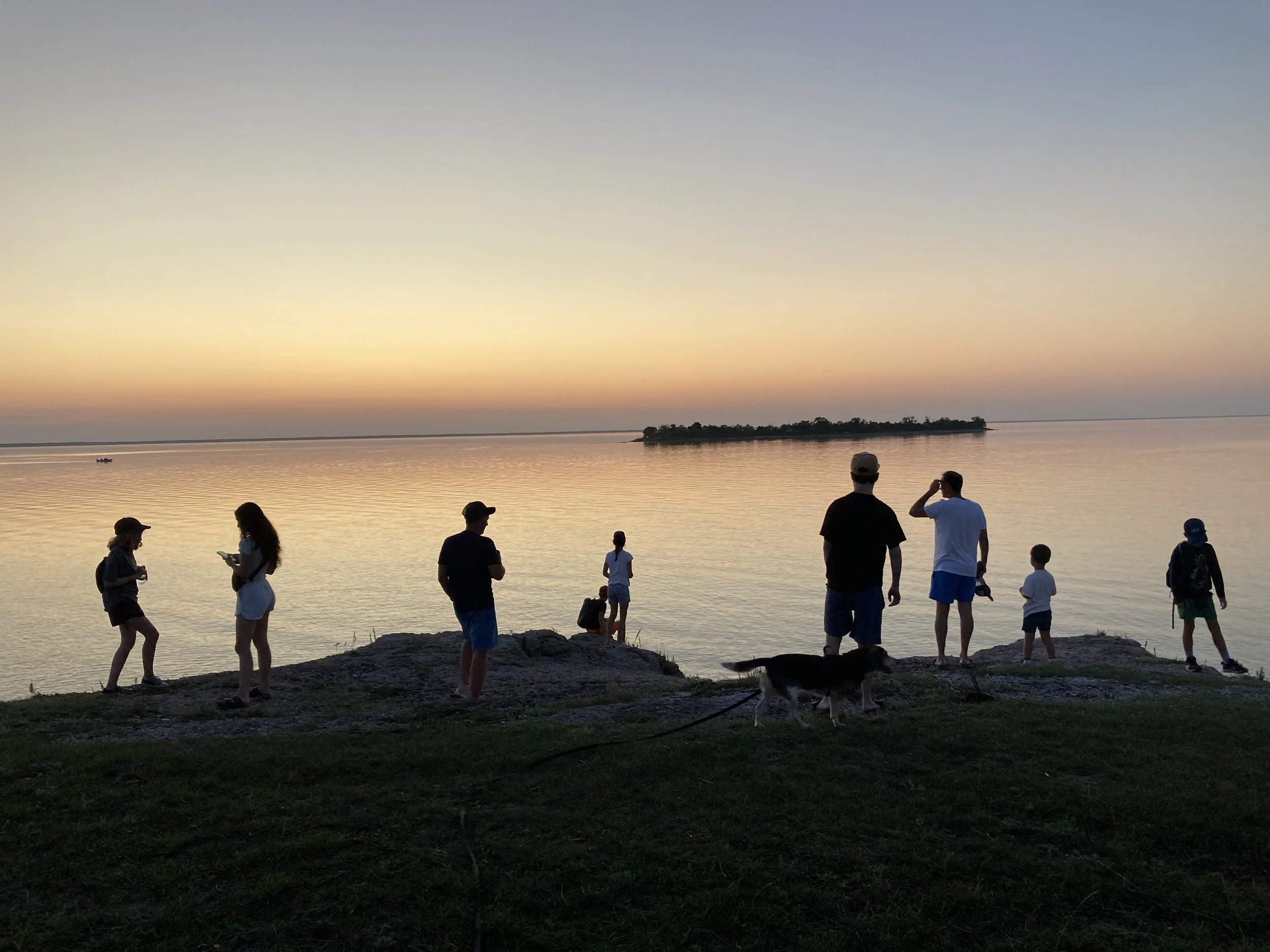
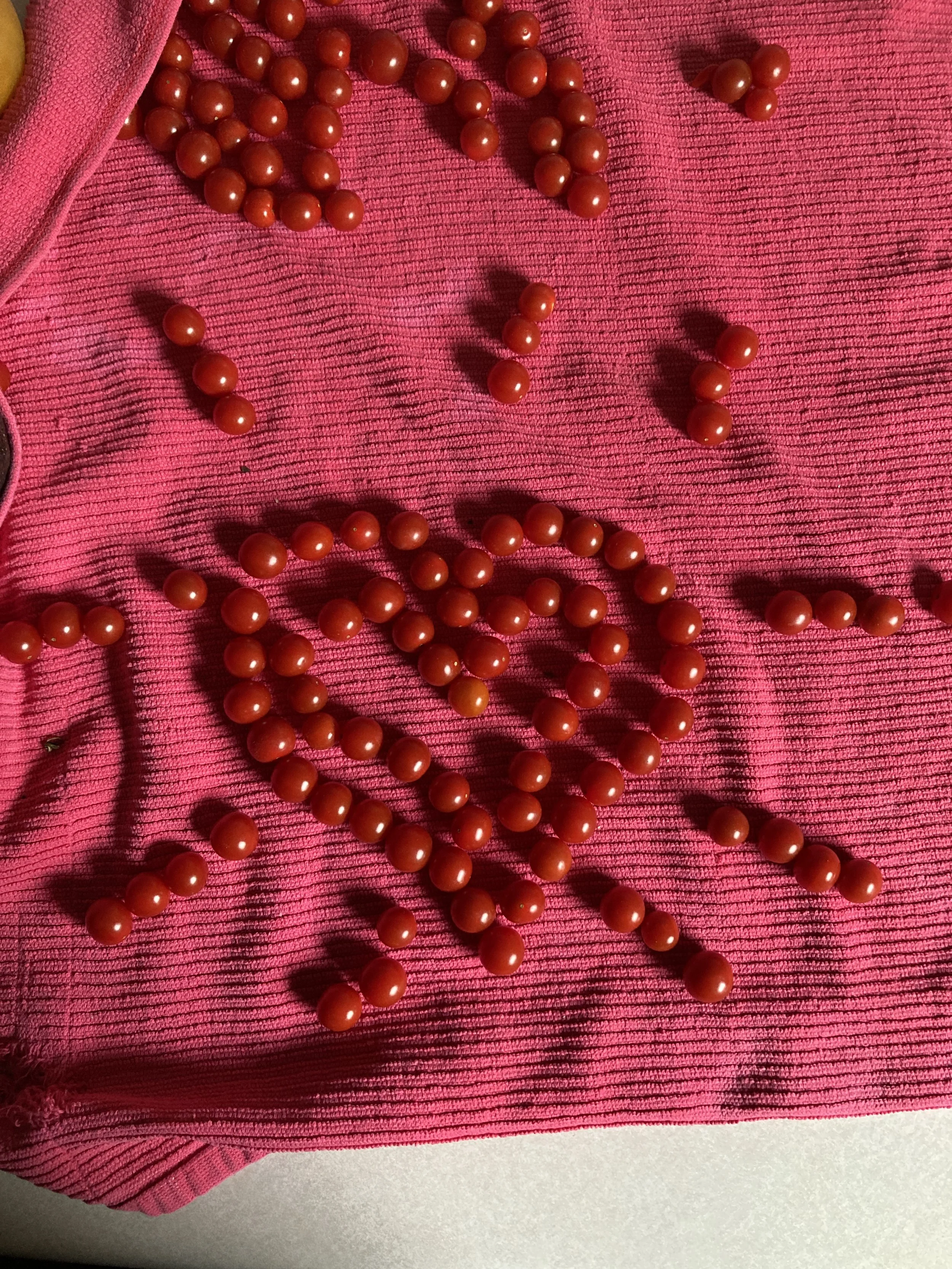
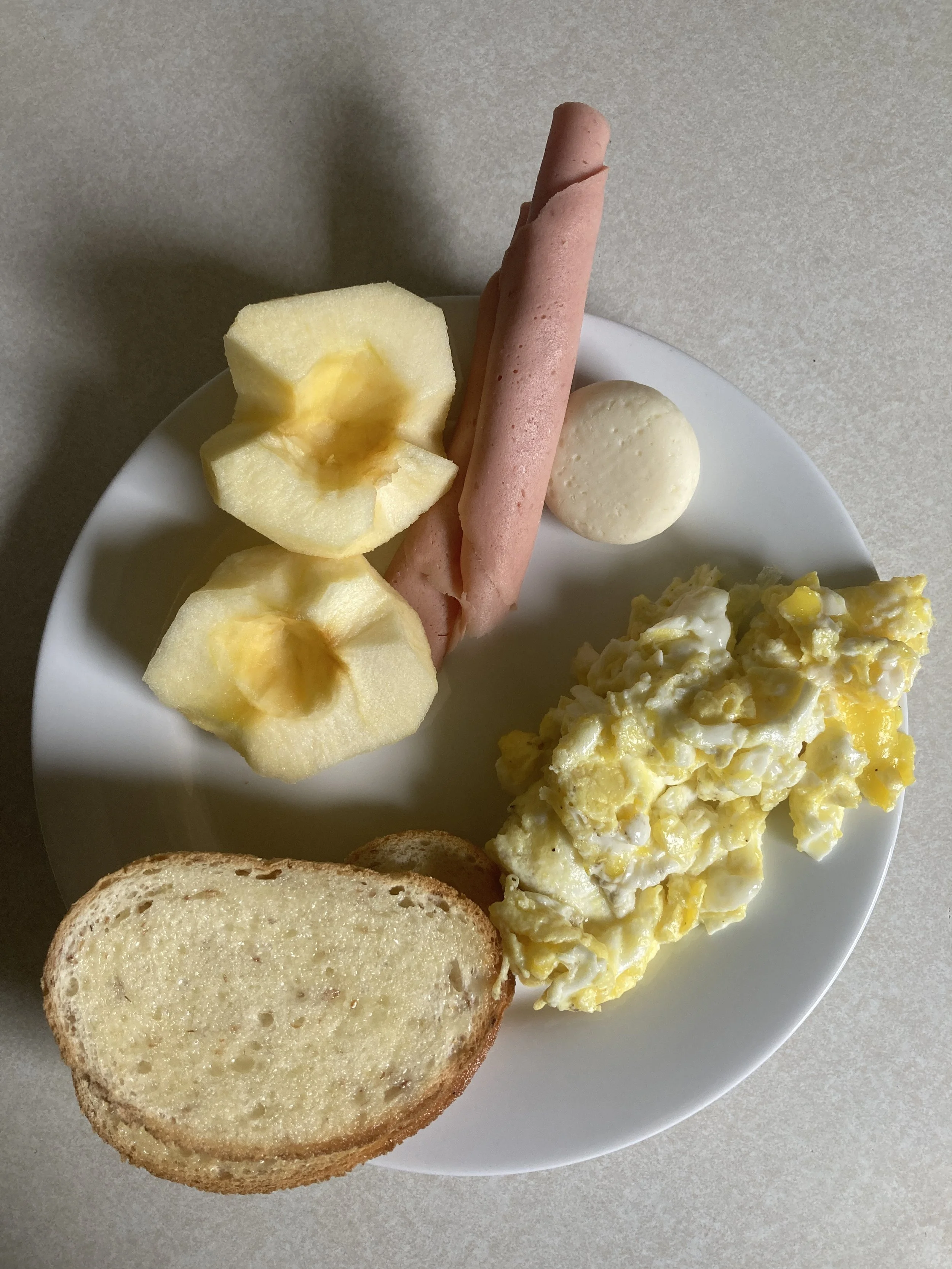
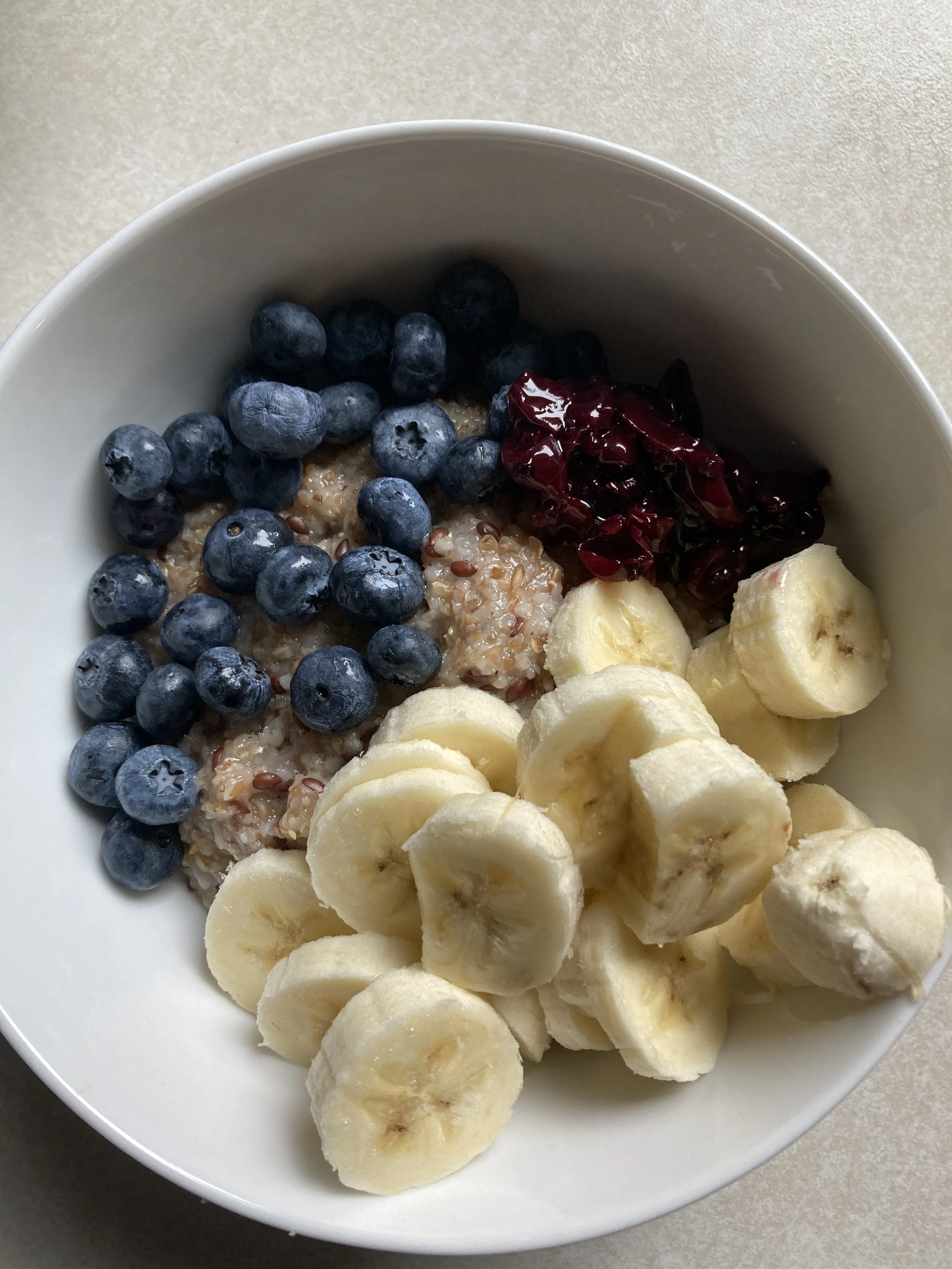
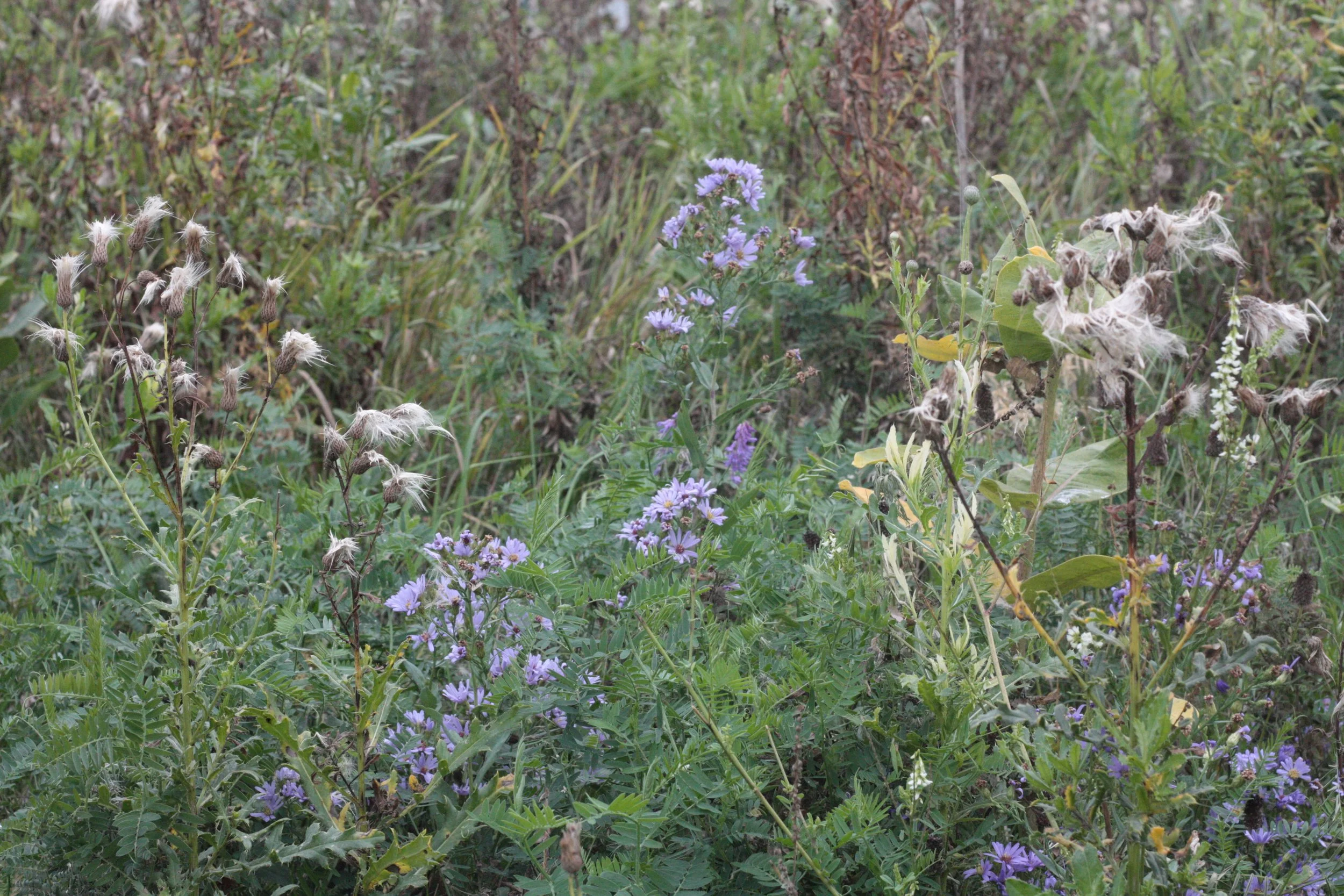
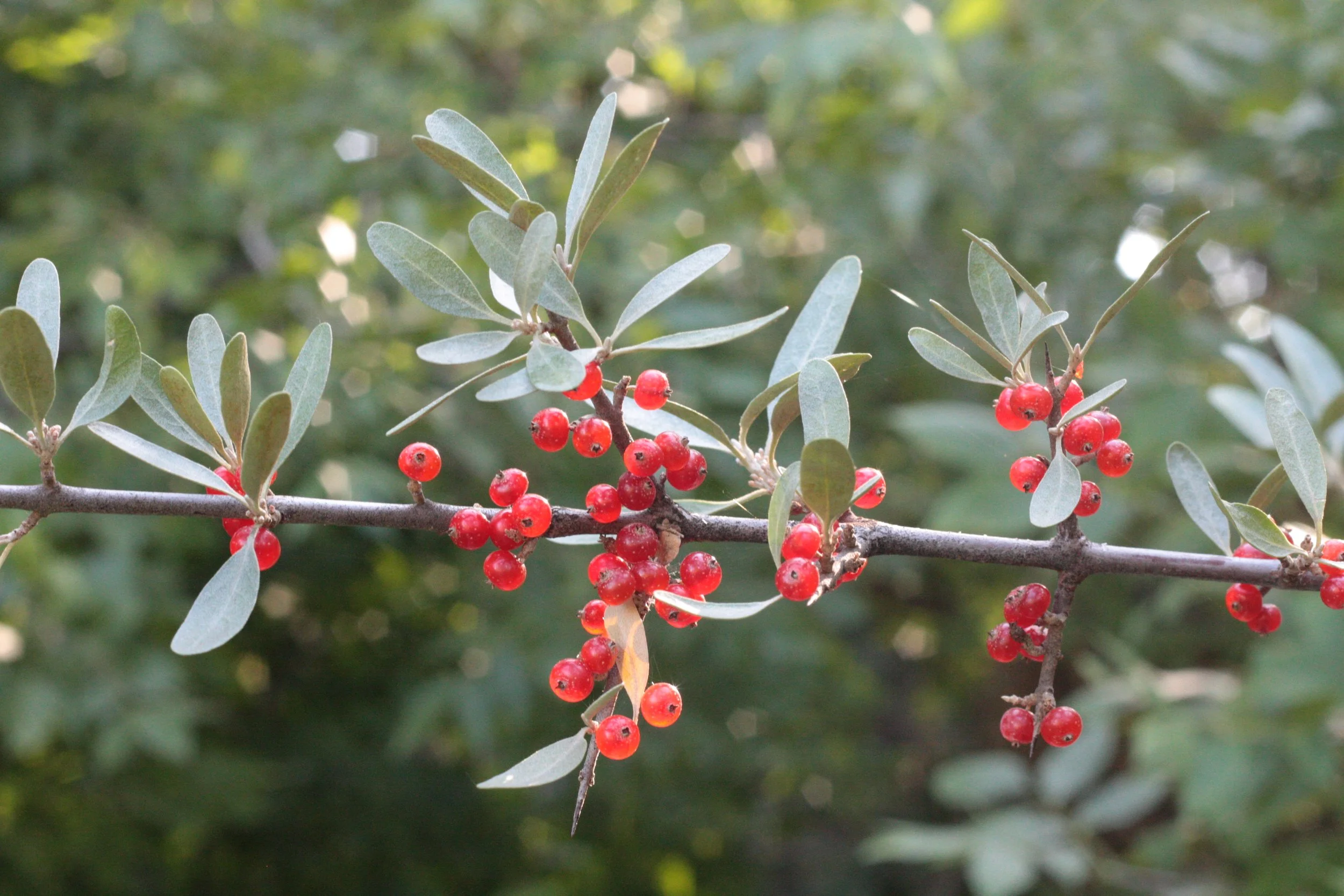
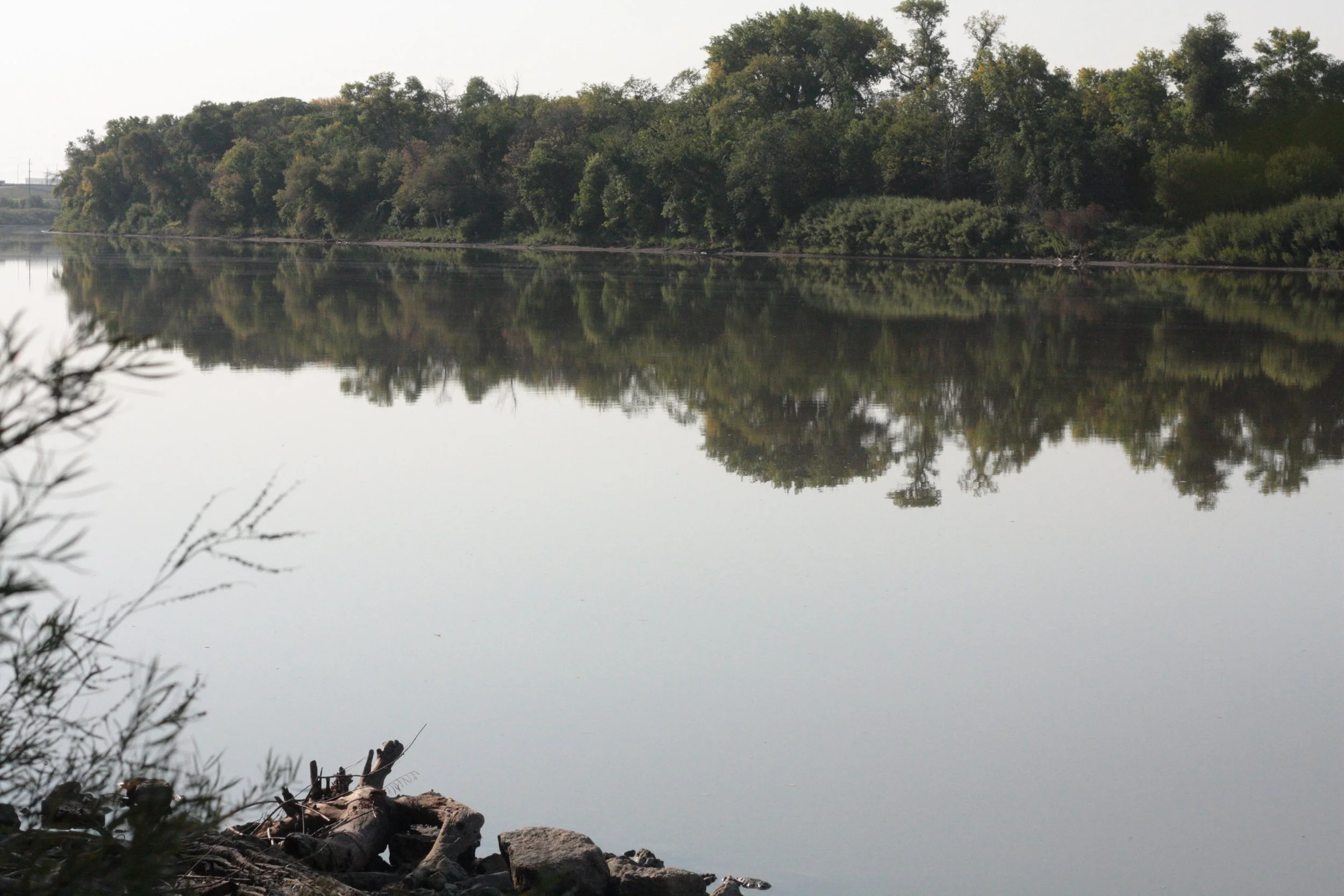
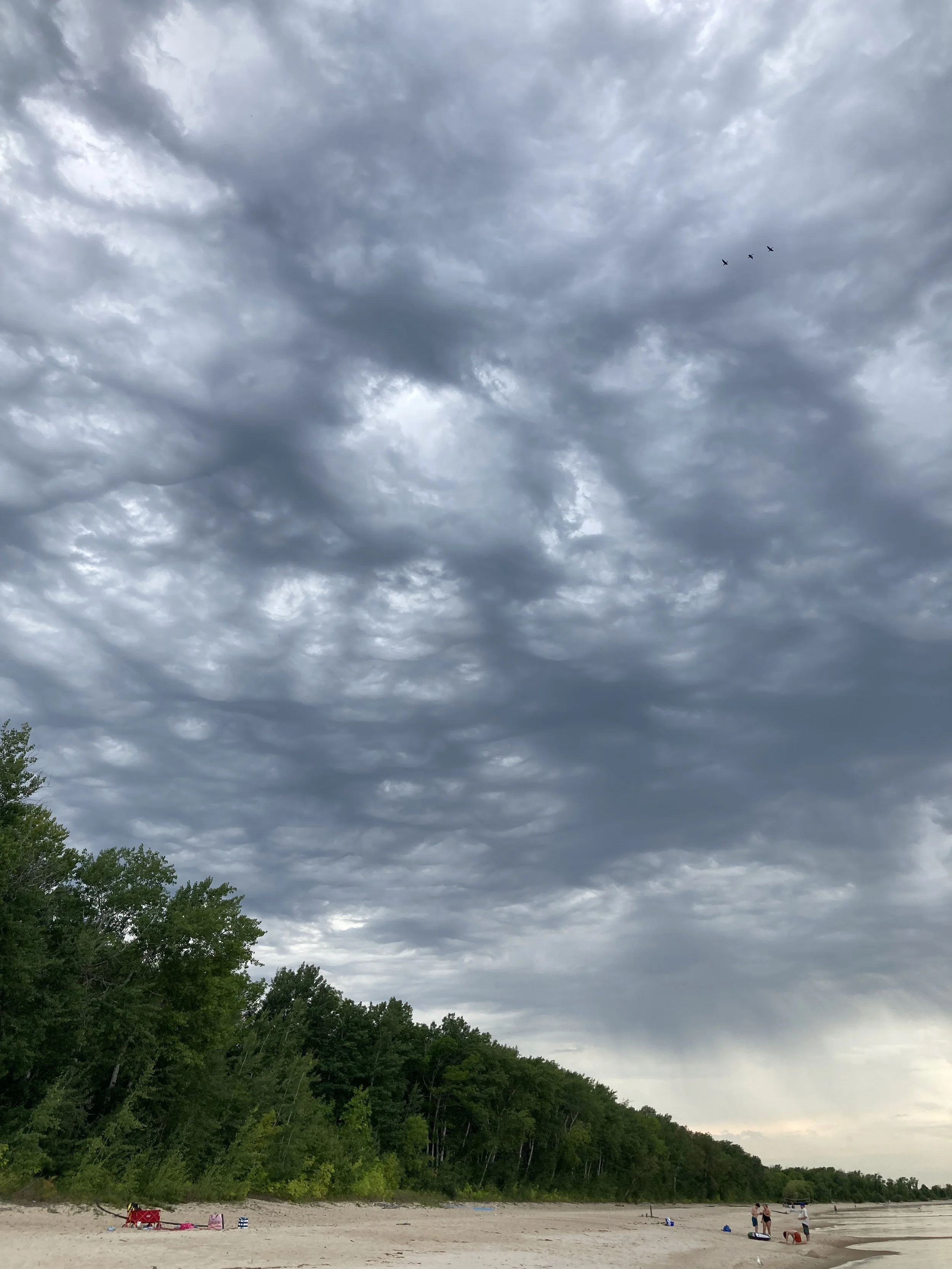
A week on Sunday 5/52

Postcards

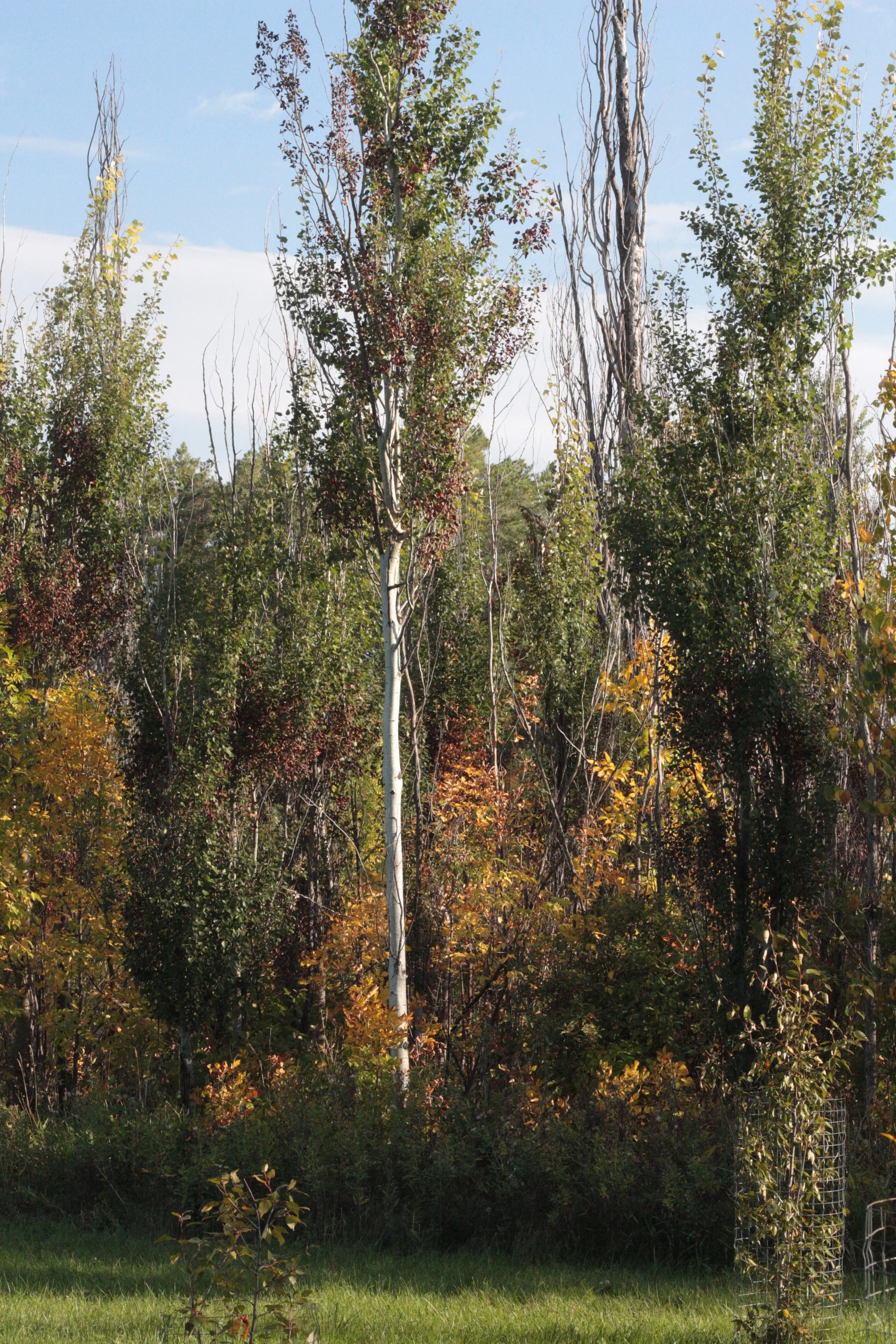
In that wonderful way that one thing can lead to another, an Instagram post from the World of Interiors account lead to a virtual perusal of titles from among the eye-catching stacks of books. Tom Phillips’ Postcard Century then happened to be available for borrowing from the library. It has taken some time to get through his collection… (I took a picture of the book outside in September when I’d started it…) but the fact that this tome exists delights me.
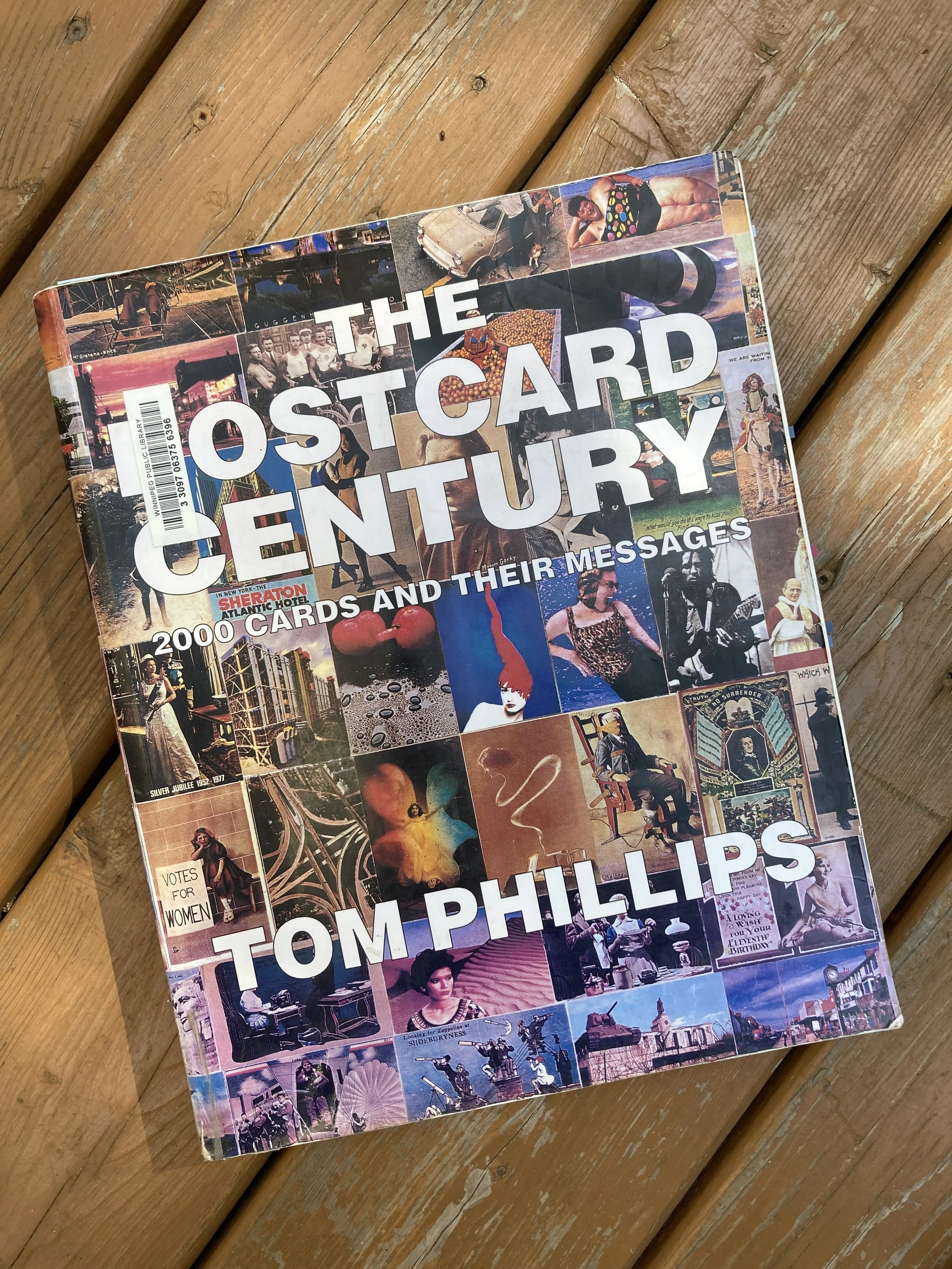
First, that collecting postcards is called deltiology and that Philipps takes some time to describe postcard attributes is an inviting window on a previously unknown world. Second, that Philipps is an artist, and therefore freely comments on the style and design of the postcards he has curated for this book. But third, and most significantly to me, he uses postcards as a lens for viewing history. He writes: “Postcards provide the world’s most complete visual inventory.” Thus, with the caveat that “My own interests and predilections (not to speak of prejudices) play a part in my choice yet I have also tried to keep a special watch on certain themes…” among which leads that of feminism. He writes:

Women were of course invented before the beginning of the century but the realization of the proper role in society and their acquisition of rights has been perhaps its most important single development. From a voteless, socially subjugated and legally disadvantaged condition in 1900 to the ambiguities of the post-feminist state in the 1990’s it has been an epic take that here, inevitably, has to be conjured from a sequence of telling fragments. Needless to say it is not only the images that tell the story but the content and style of the messages which speak, in sum, so eloquently of the relations between women. (p 18)

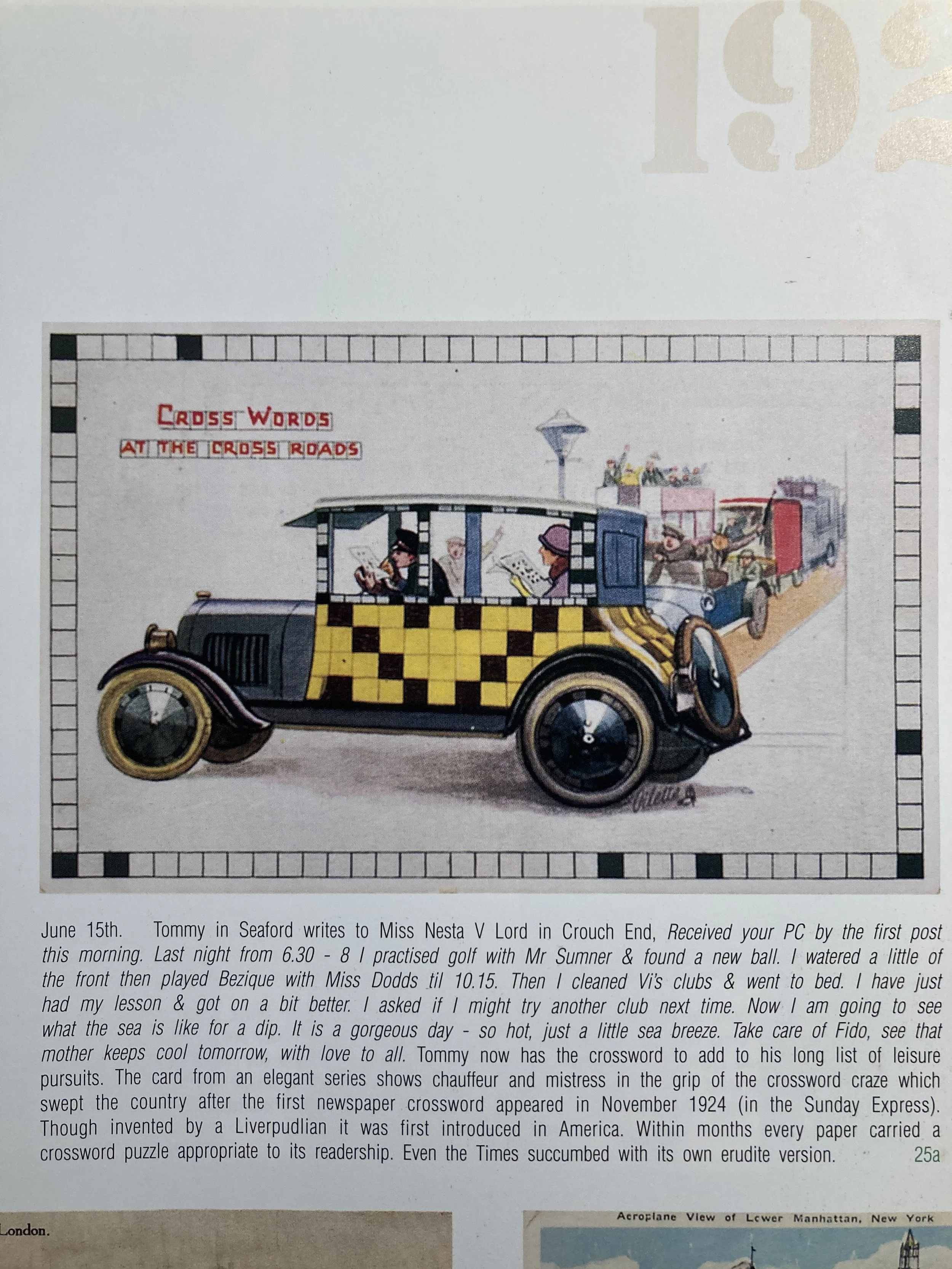
There are moments artfully captured, like the “crossword craze”:
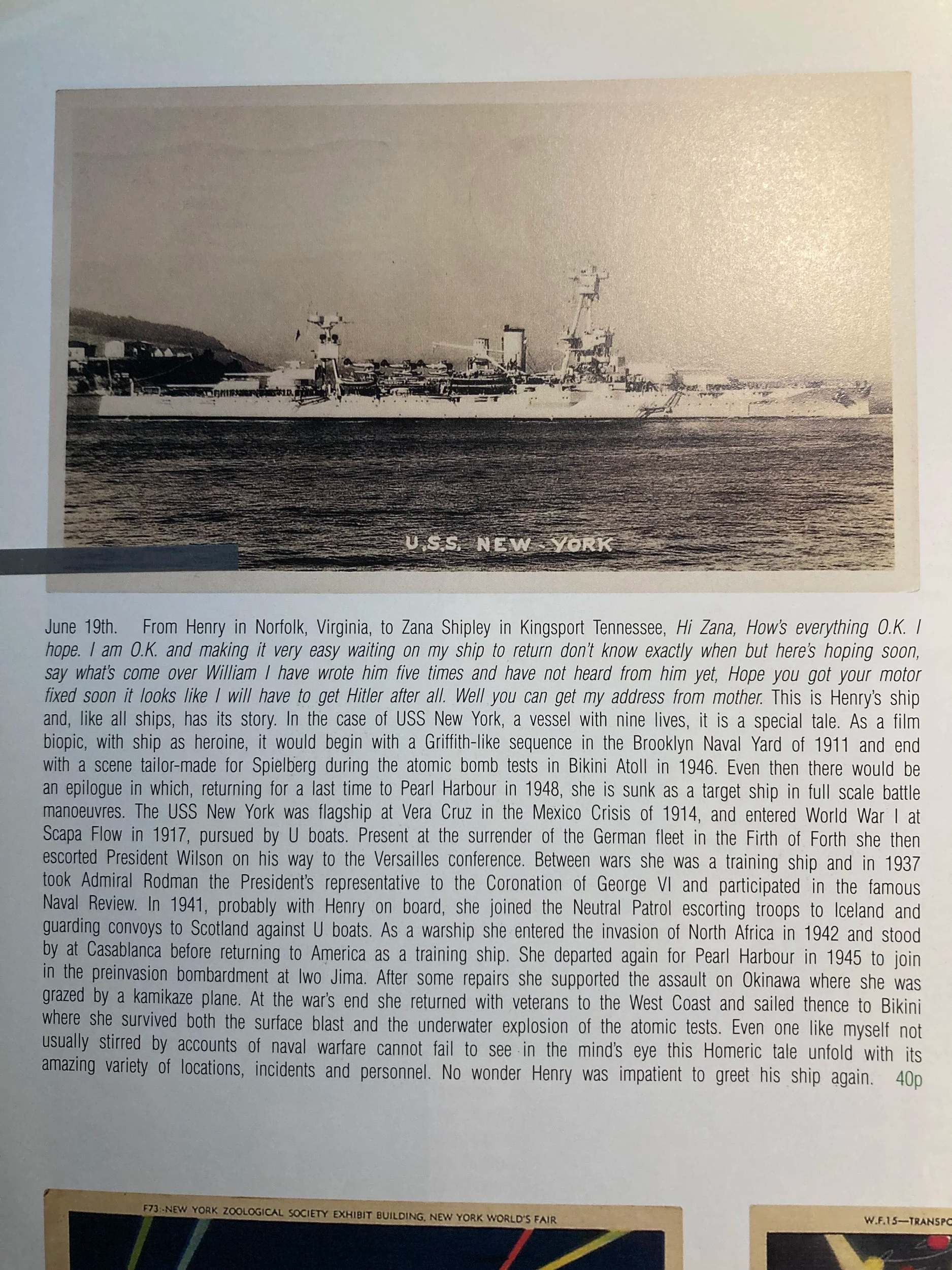
And there are seemingly boring pictures that have an entire backstory that Philipps manages to unlock, as in the case of this USS New York. (p 196)
In 1966, Philipps notes a shift in the tone of comic postcards that I find intriguing… “A cynical hardness enters the comic card as a new generation takes over, coupled with a meaner kind of image.” (p 300) And neighbouring that passing reflection, a postcard featuring a beautiful ocean liner, offers a little reality check: “For all the romance of last voyages, ends of epochs, shipboard affairs and images of fine living on the high seas one mus remember that, for anyone but the rich, long ocean voyages represented weeks of cramped boredom.” (p 300)

One of my favourite is food-related…
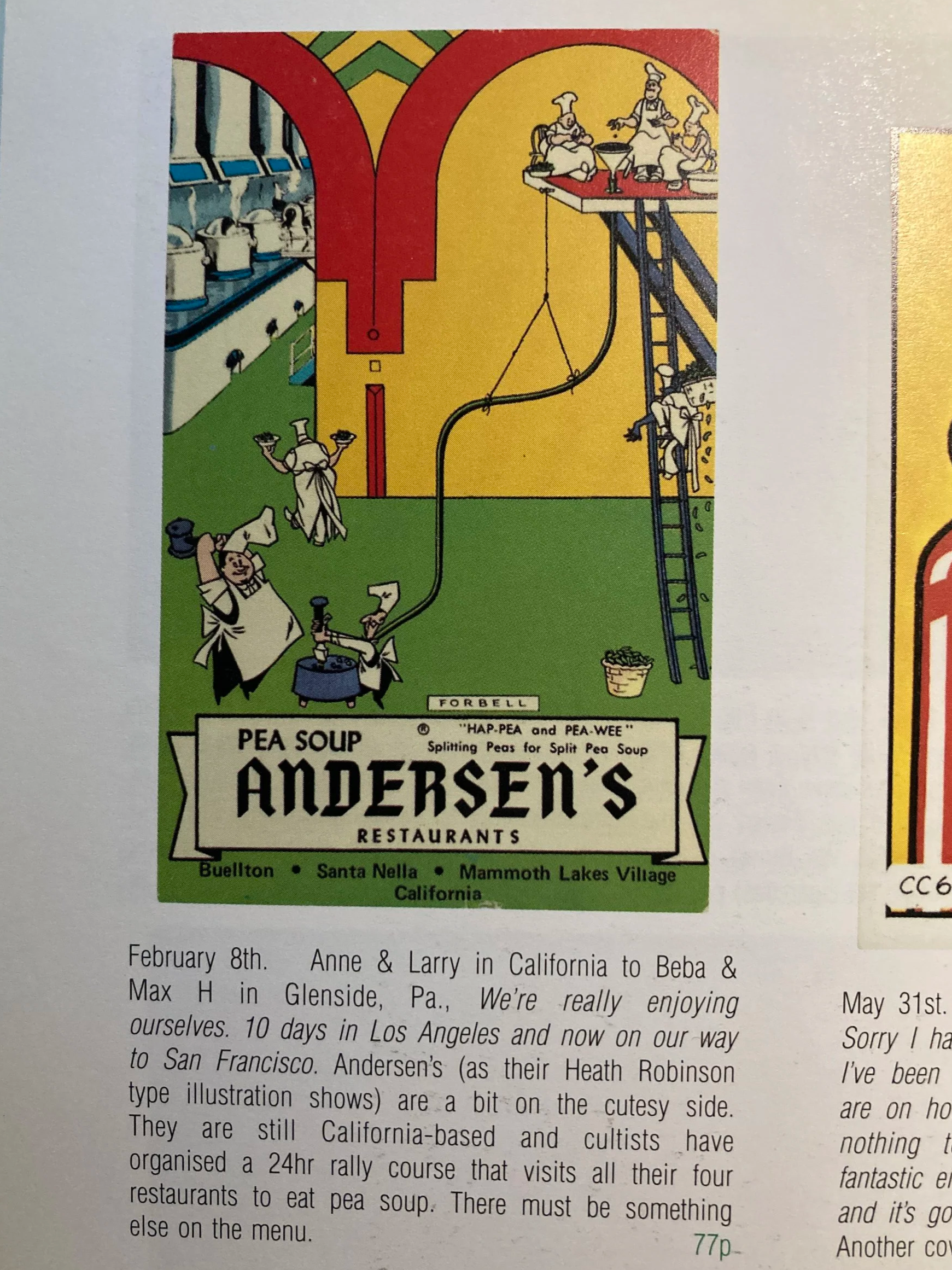
At one point, Phillips’ comments, about one postcard’s provenance, “In the absence of institutional interest from the academic world primary research into postcards is done by collectors themselves, often at the most scholarly level.” (p 144) But perhaps this is turning out not to be the case? I recently came across Omar Khan’s website Paper Jewels, which links to his academic research on the subject of postcards from India.  All in all, it’s been fun to learn how postcards are a medium for viewing history from a different vantage point.

Tangentially

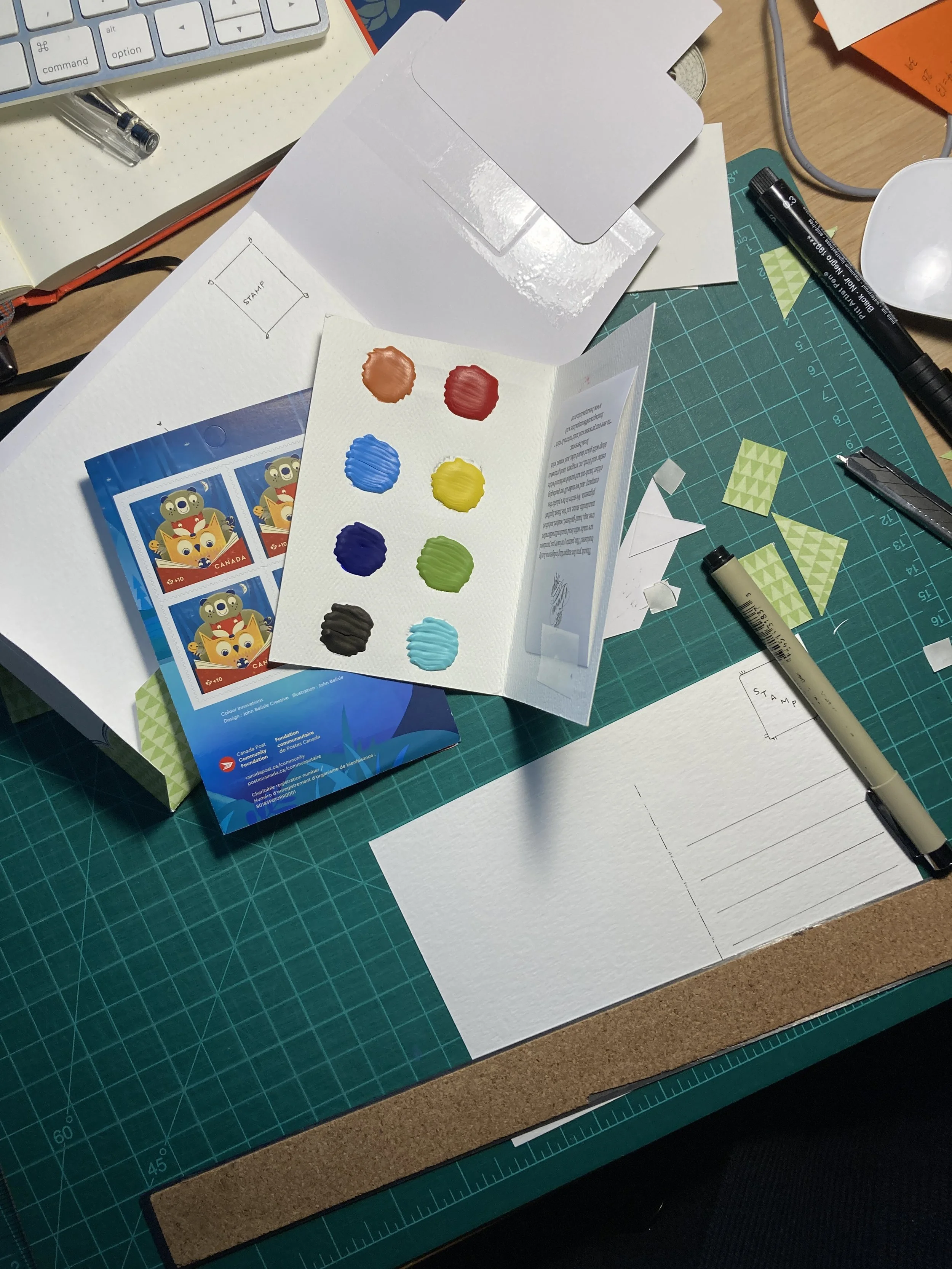
Postcards are now rare and perhaps correspondence is a dying art. But I’m always feel inspired by ideas such as Rose Pearlman’s “How to Make A Correspondence Kit”. I agreed to make one for a niece and I’m curious to see whether the tangible feature of letter-mail still holds charm.  
Local love

For his participation in the school’s band, my son needed black pants and a white shirt. These were handily found at Value Village, although there was a problem with the shirt sleeves being too long. The solution for long shirt sleeves is called “sleeve garters” and ushering in their fashion renaissance is my own 7th-grader. While he lives oblivious to shows like Peaky Blinders (and long may it be so), my sister and I have not. So if this partially-Irish, growing weed of a boy is fine with his mother’s fondness for Irish lore and Irish accents, I will blame not only the culture which inspires a collection of wool scarves, but also the local Winnipeg businesses that purvey such accessories. There is Amazon of course, but a sense of duty had me call a suit store and the gentleman there suggested another local business, and the gentleman there suggested a third. Were it not for this chain of phonecalls and kind voices, I would not have pulled into the sunny parking lot of a store called Vintage Glory. And had we not strolled confidently in to try sleeve garters on the aforementioned long-sleeved white shirt, we would not have met the kind man who encouraged us to explore all three rooms of his store. And when we thought we’d done a good bit of exploring, he asked if we’d opened any of the drawers… We hadn’t. So then we did, suddenly noticing all the wood cabinets with narrow drawers everywhere… and my goodness! It was like being in a hands-on museum, encouraged like children to look at all the treasure…
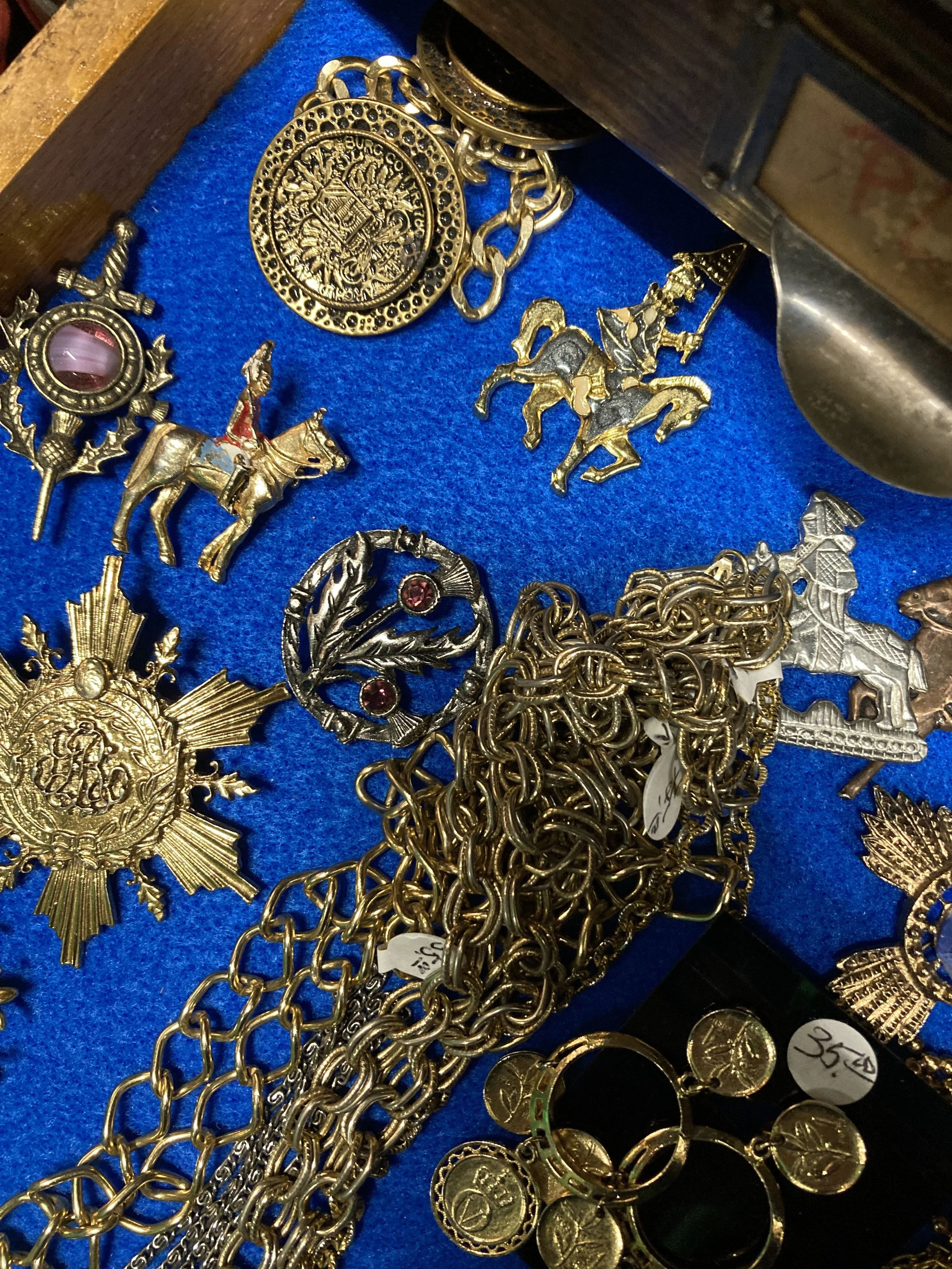
(This is a single drawer where brooches on a theme of chivalry were gathered, making me think of Don Quixote that I’m currently reading.)

Could I have just bought a dumb shirt that fit my son at H&M? Yes, of course. But let’s just say that for a few dollars more, his ensemble has a pretty rich backstory.

First

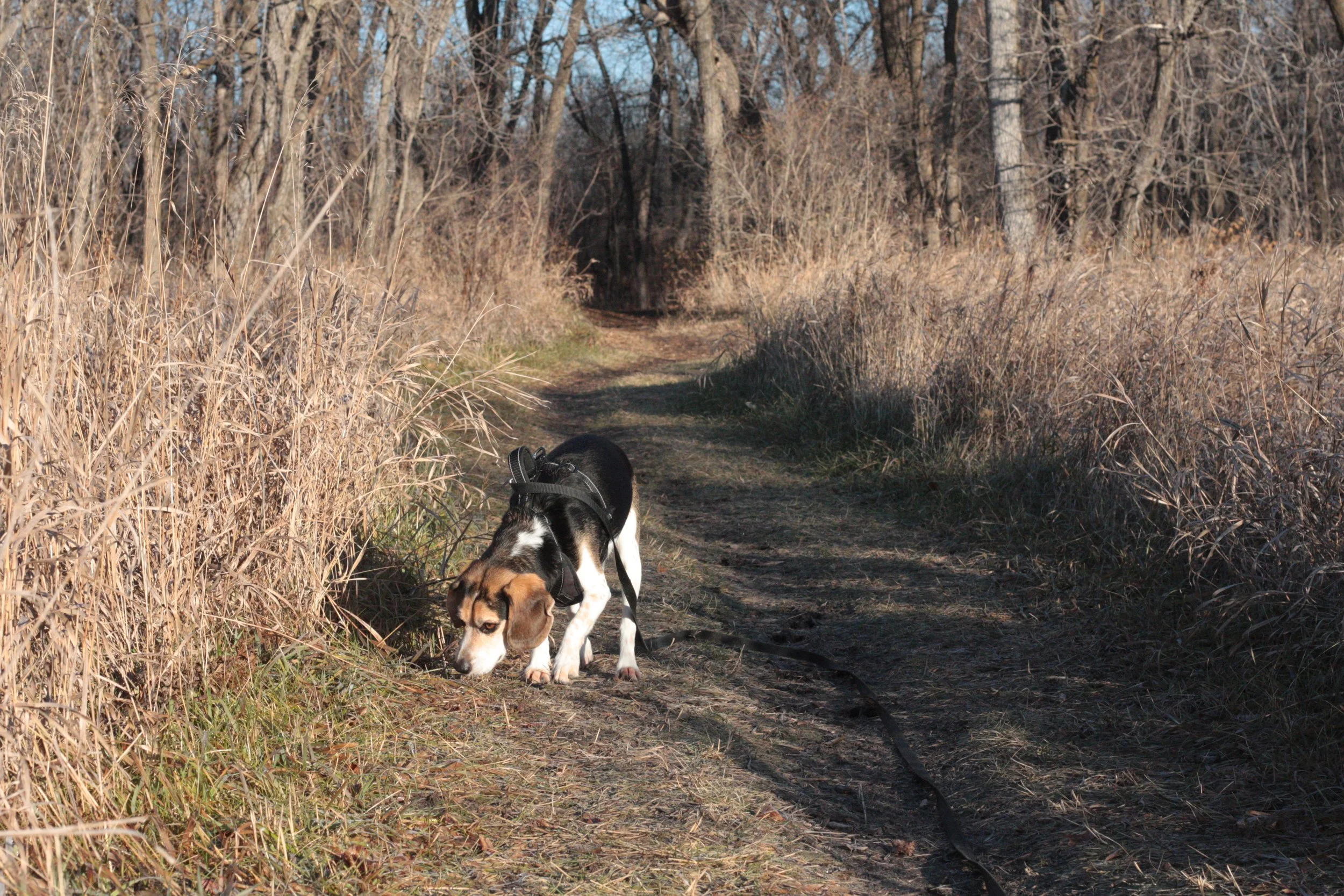
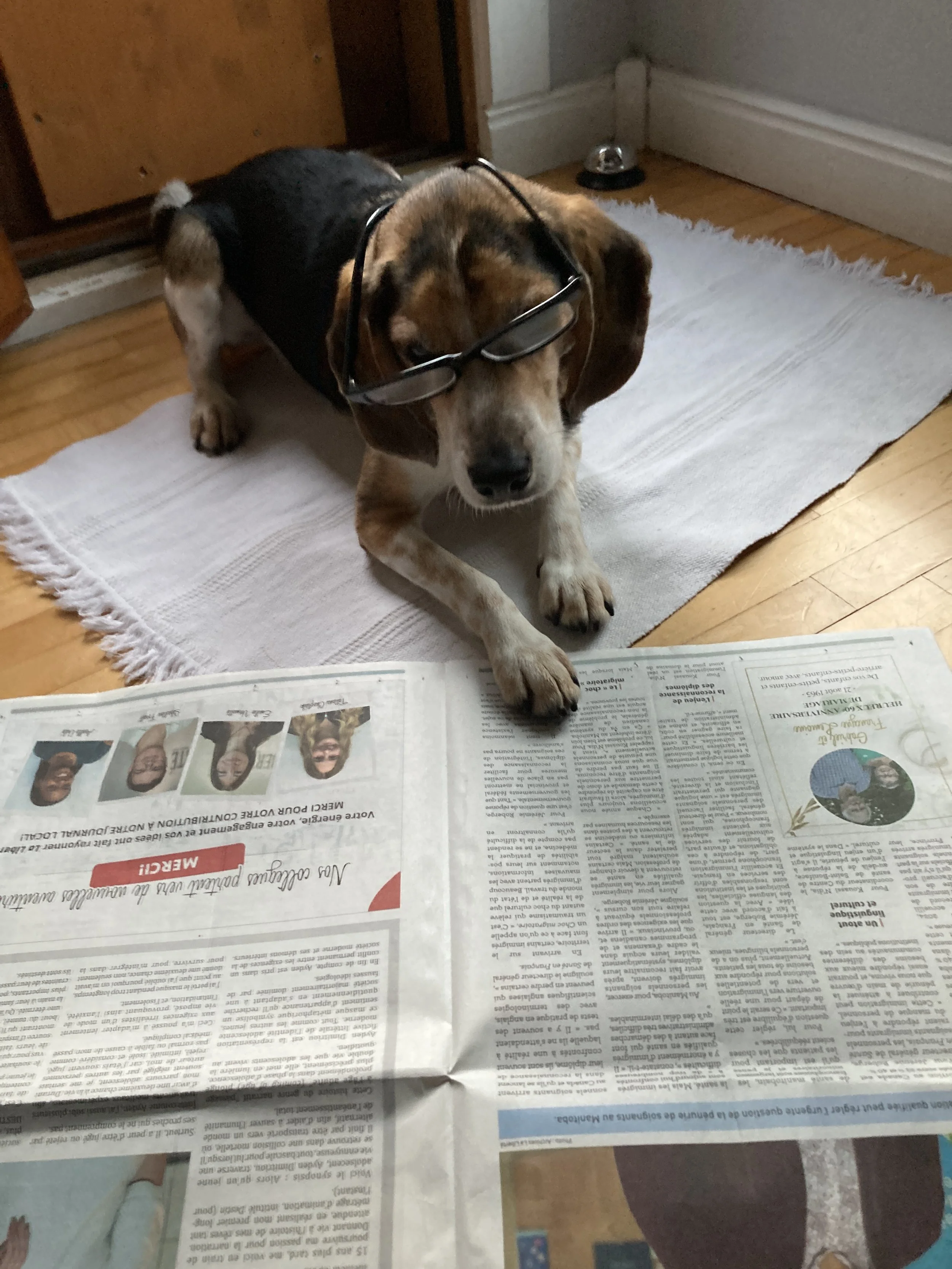
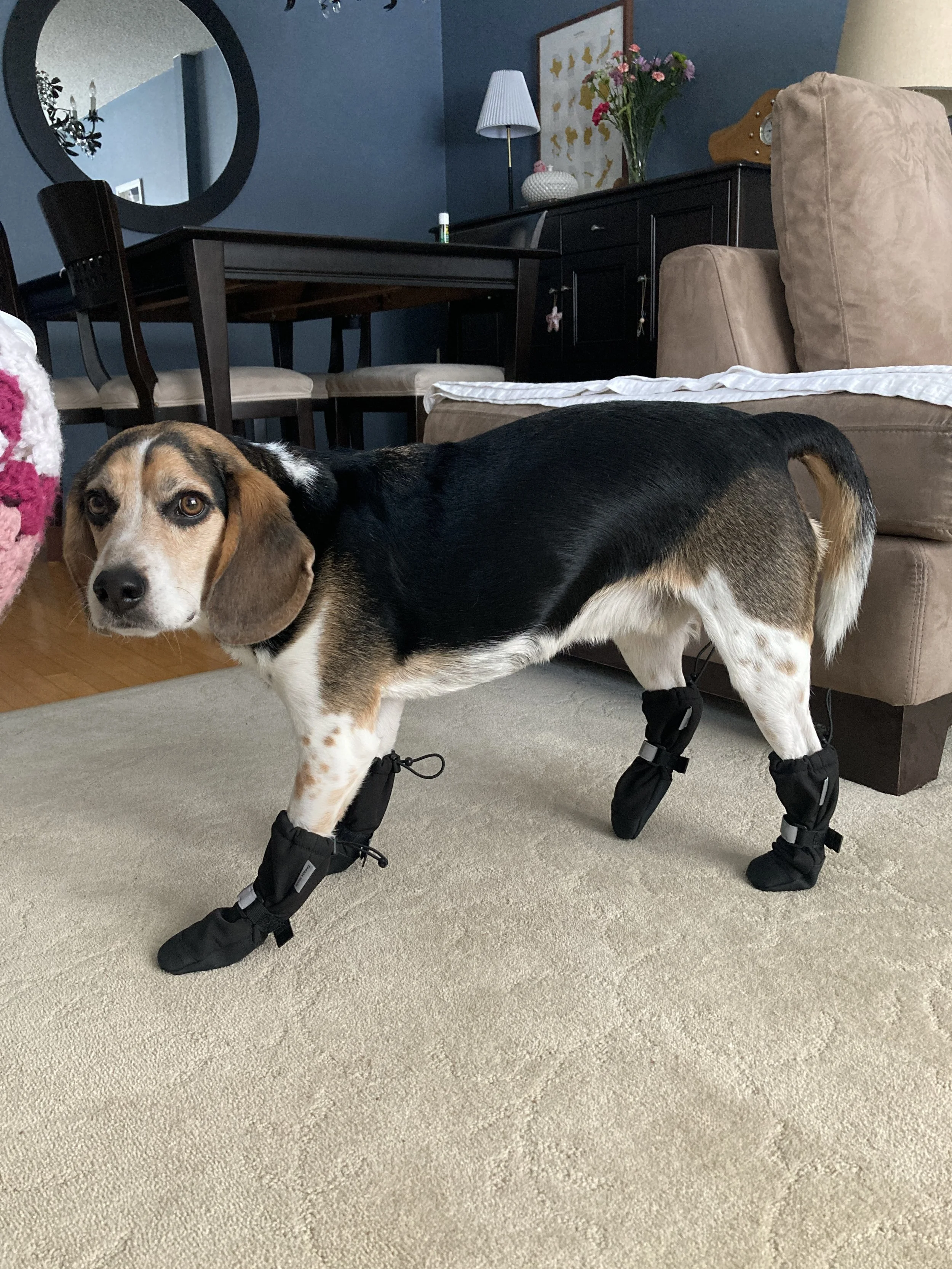
For the first time in his little beagle life, Enzo was fitted with boots. He finds this very weird, but will walk for treats. But only around the house. Outside, in daylight, he refuses to walk. He says it is undignified. Since the weather is not that cold, we don’t insist. 
Eating

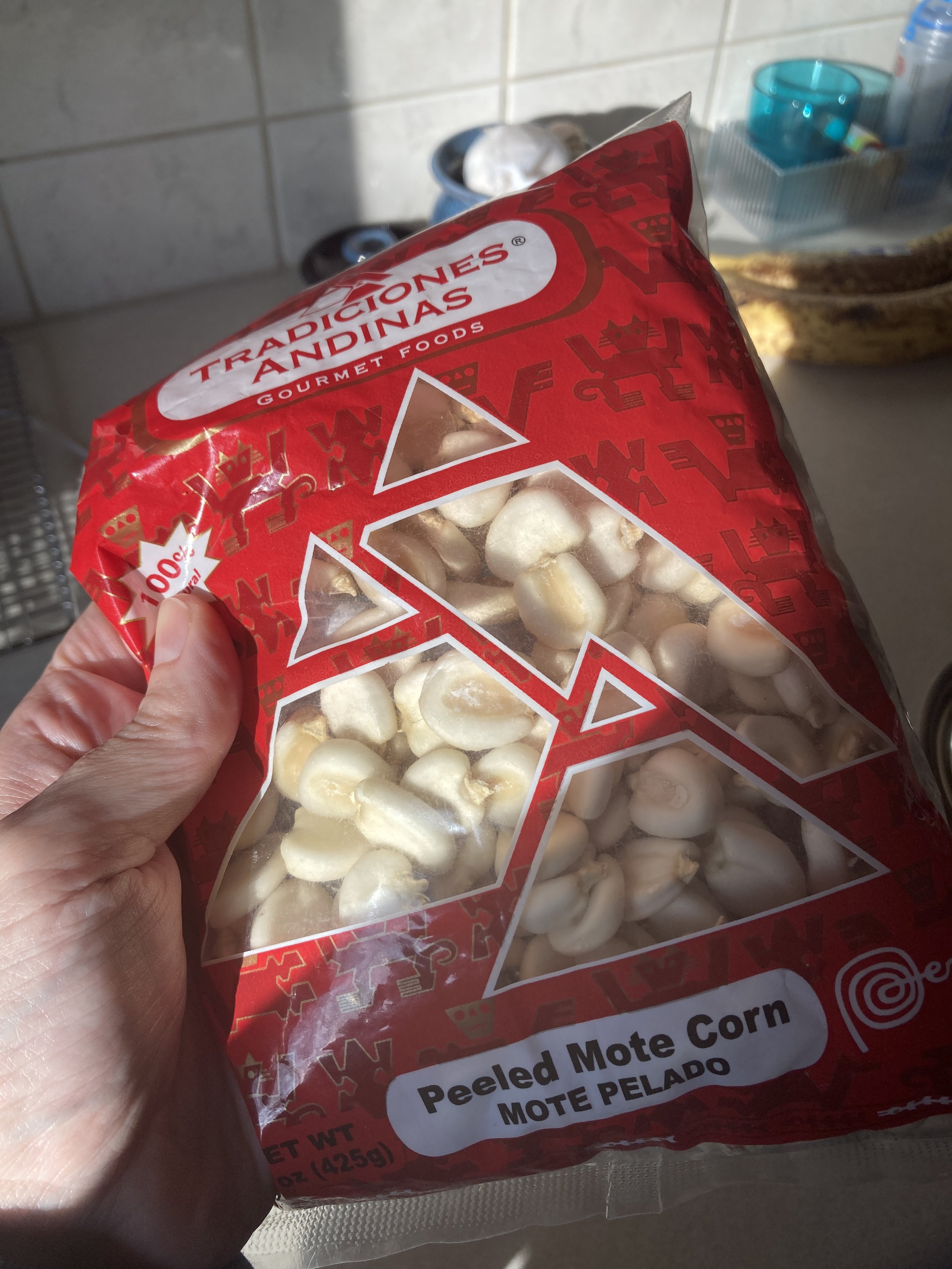
For guests on Sunday we made Carla Lalli Music’s “Pork and Pozole Stew” (which can be seen here on Youtube). Pork stew is generally easy and delicious, but I appreciated this version for the short ingredient list, and a chance to try pozole for the first time. I found it at Latinos Market here in Winnipeg.  
Enjoying

I liked learning a bit about potatoes and the Irish famine on CBC’s podcast Ideas. A focus on one architectural detail, explained in depth but also light-heartedly, is a talent I admire. Enter a recent discovery on TikTok. Abby Happel is a junior architect in Chicago who talks about corners and libraries, and I feel like I could take notes. Also, another podcast episode I liked is Chuck Klosterman being interviewed on The Book Review (Youtube link). I felt like I knew a little something about football from having watched all seasons of Friday Night Lights!

Postcard

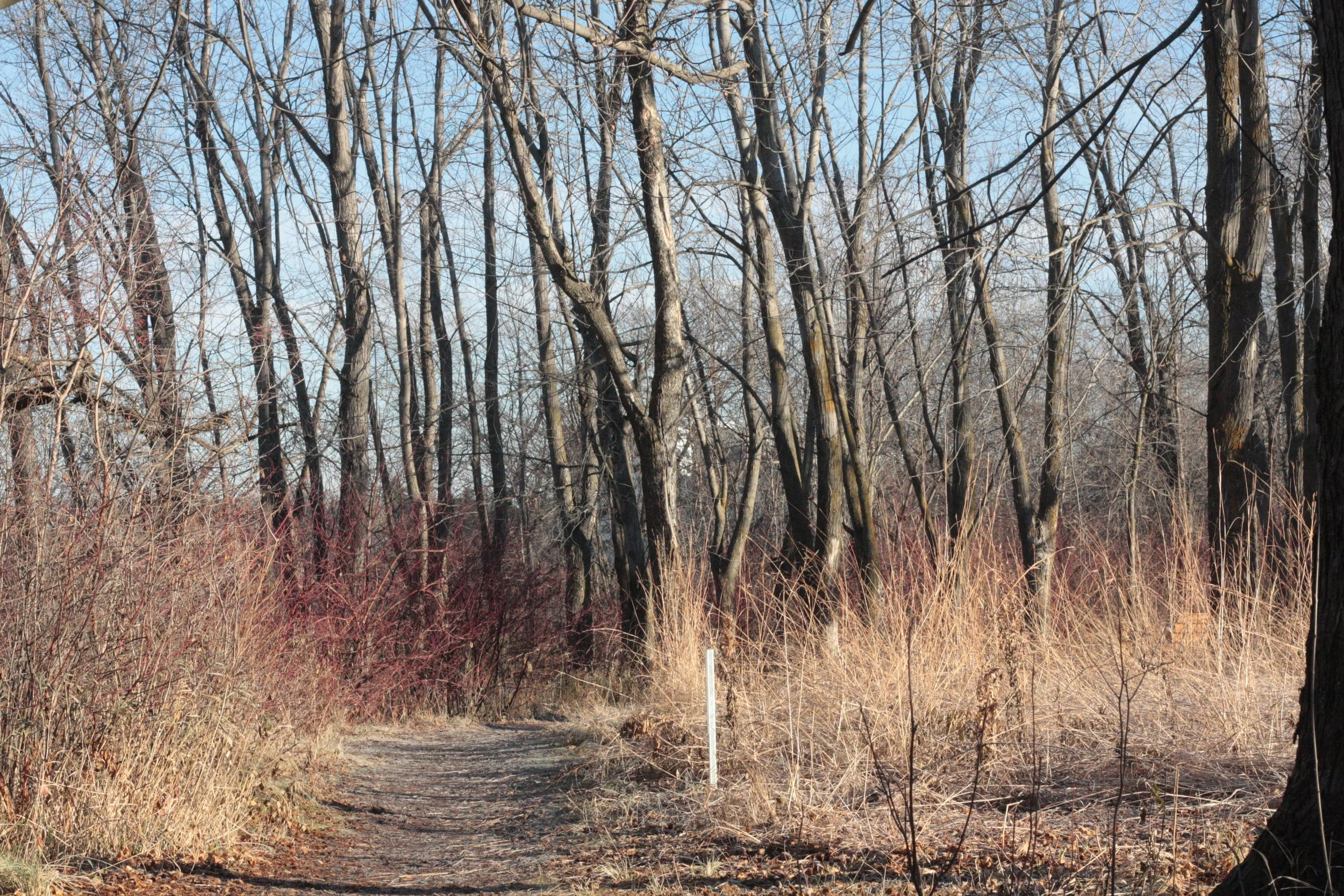
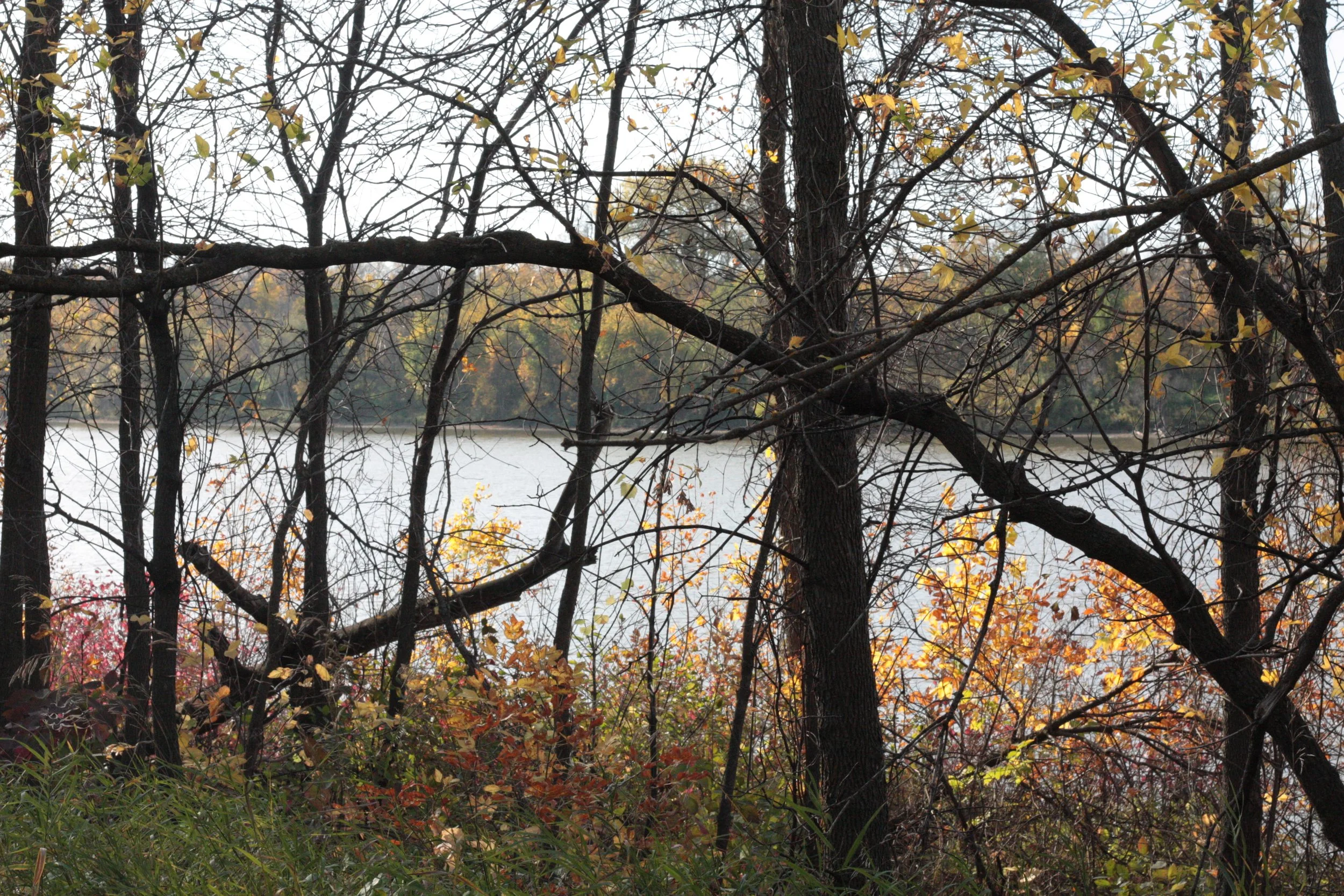
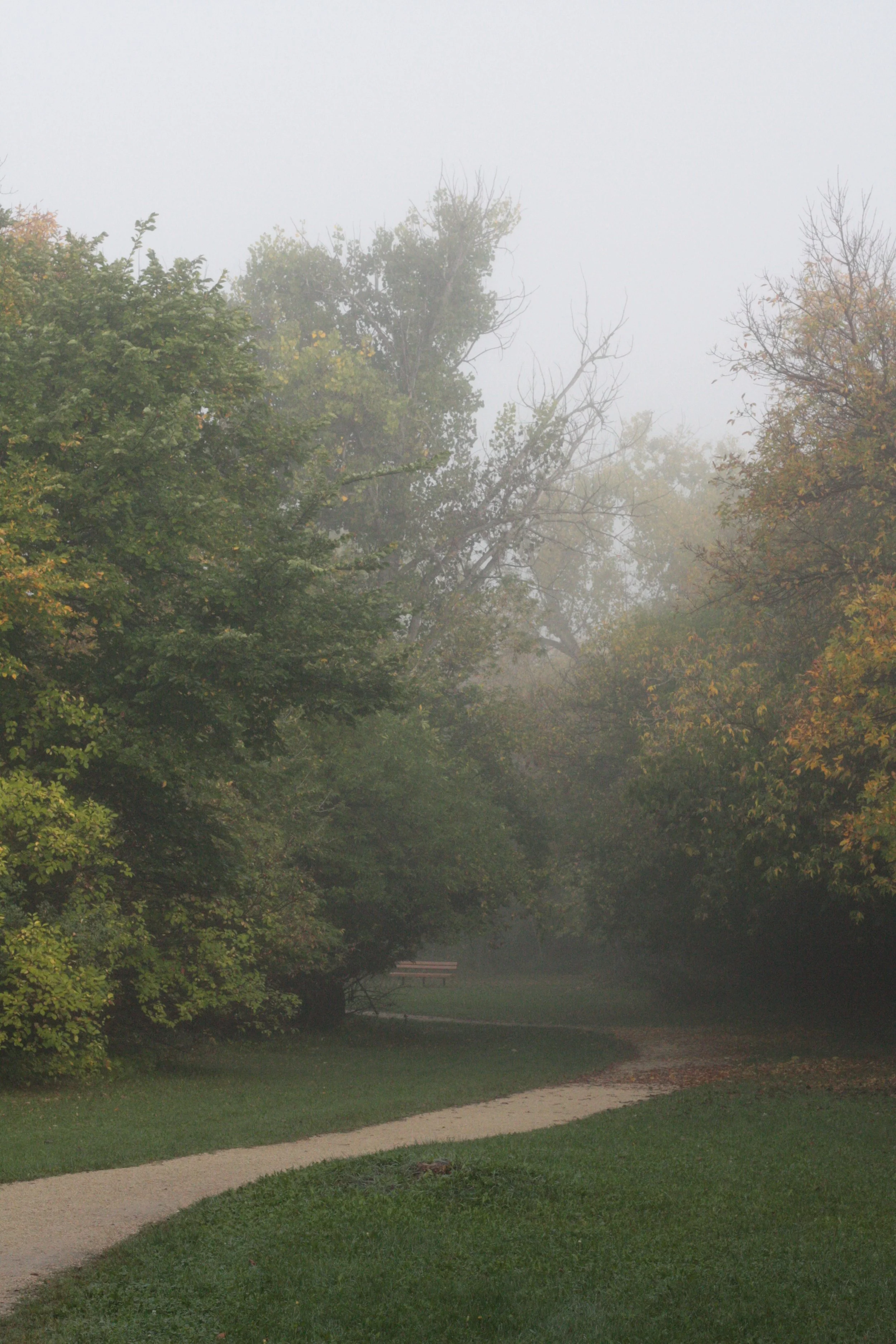
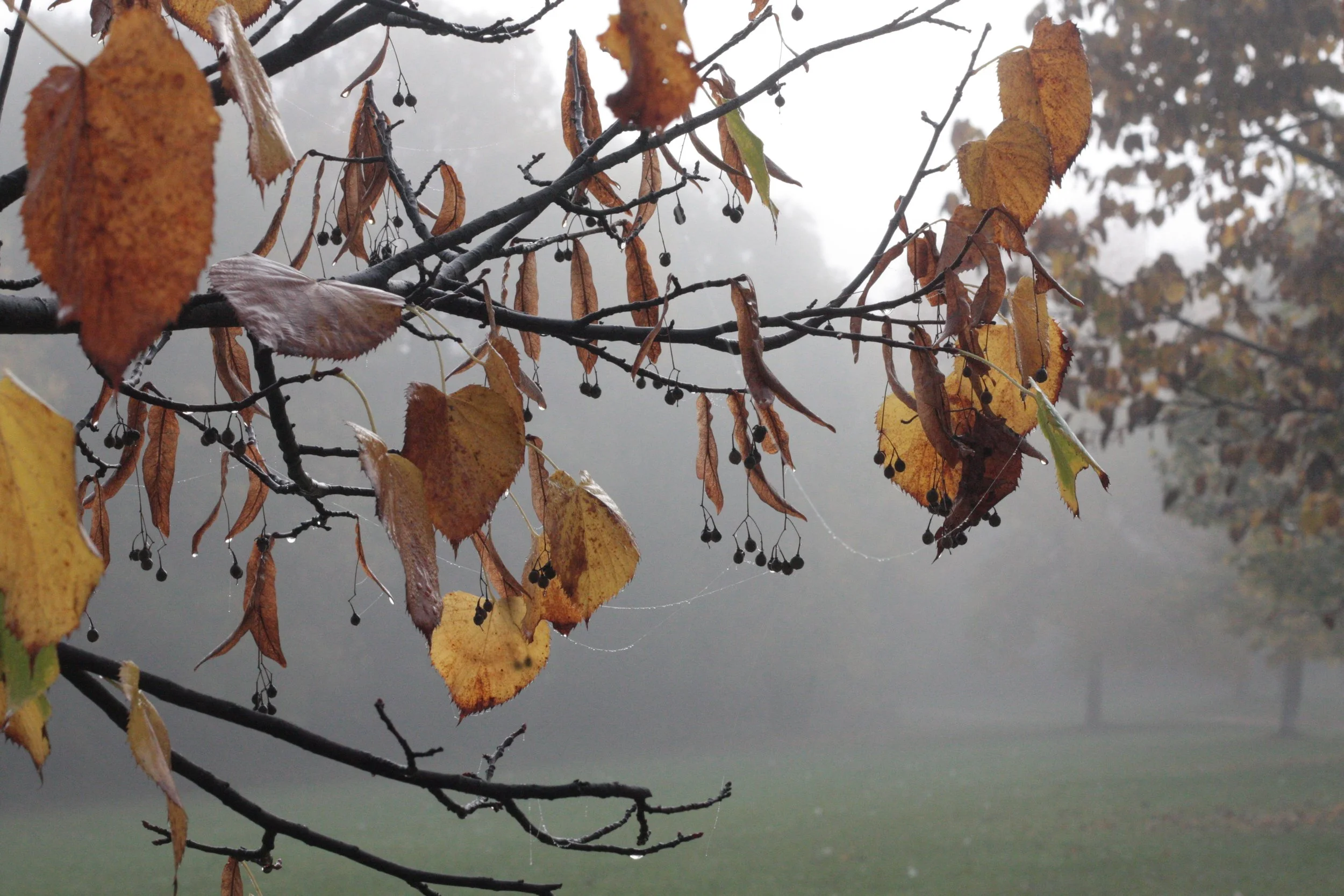
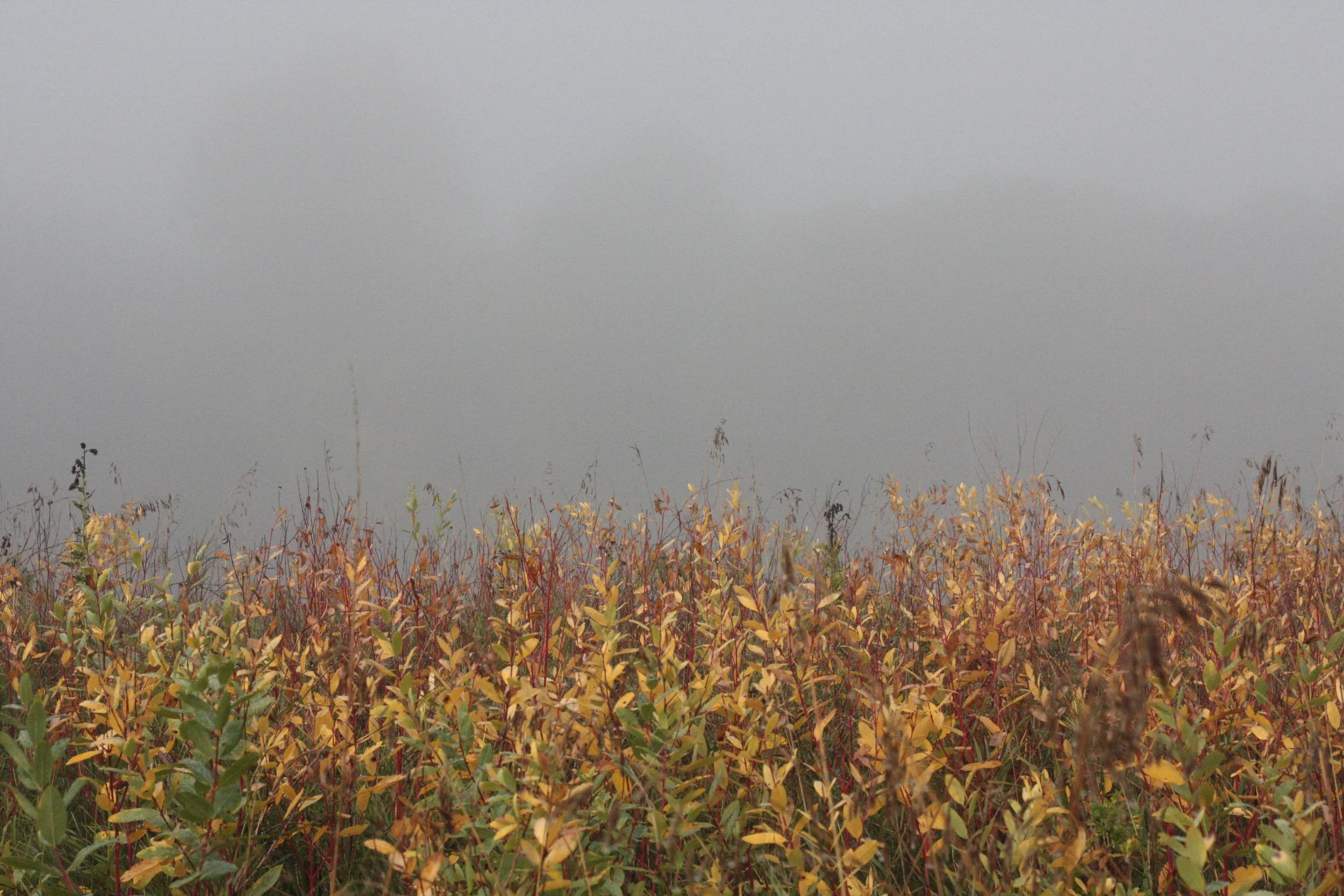
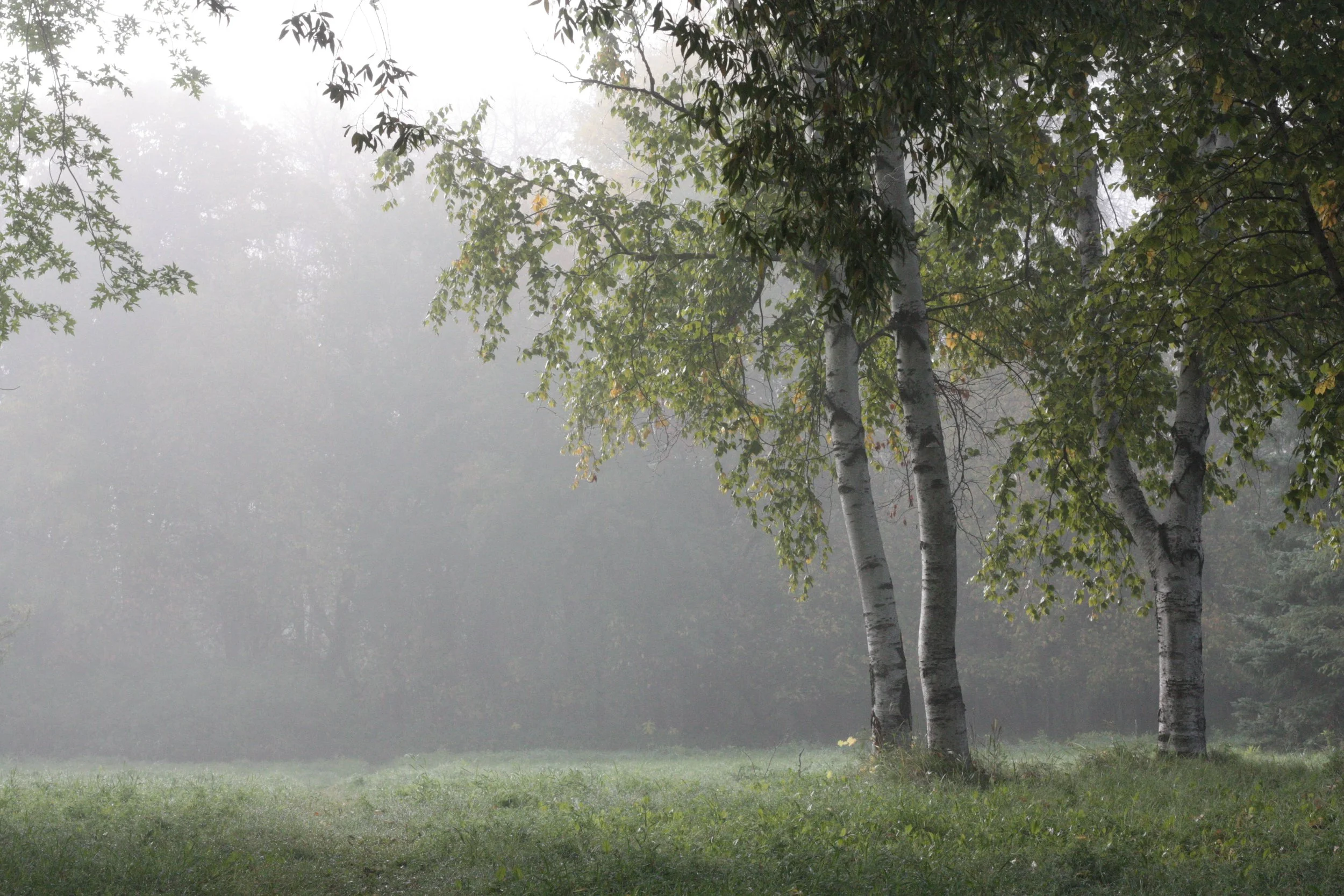
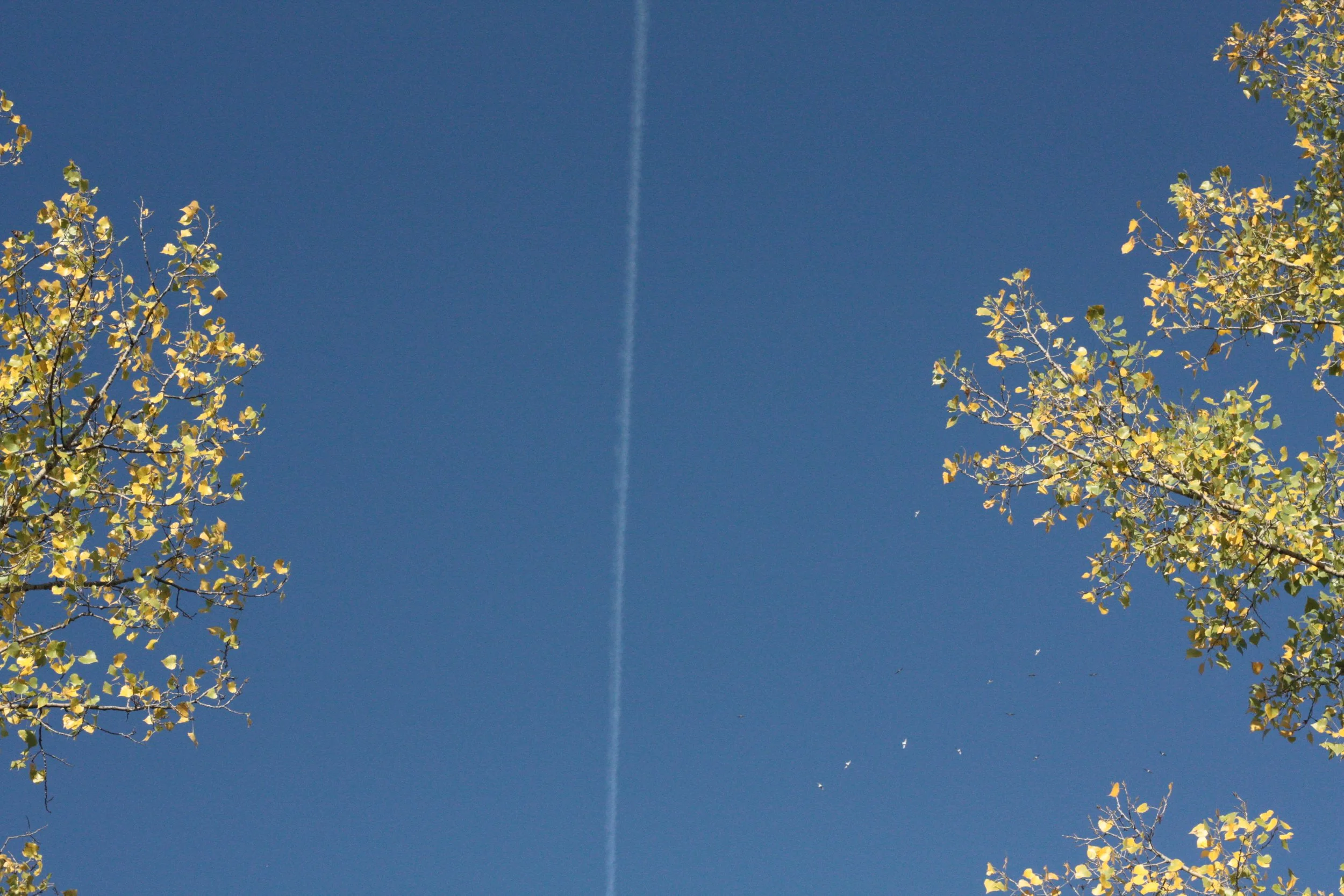
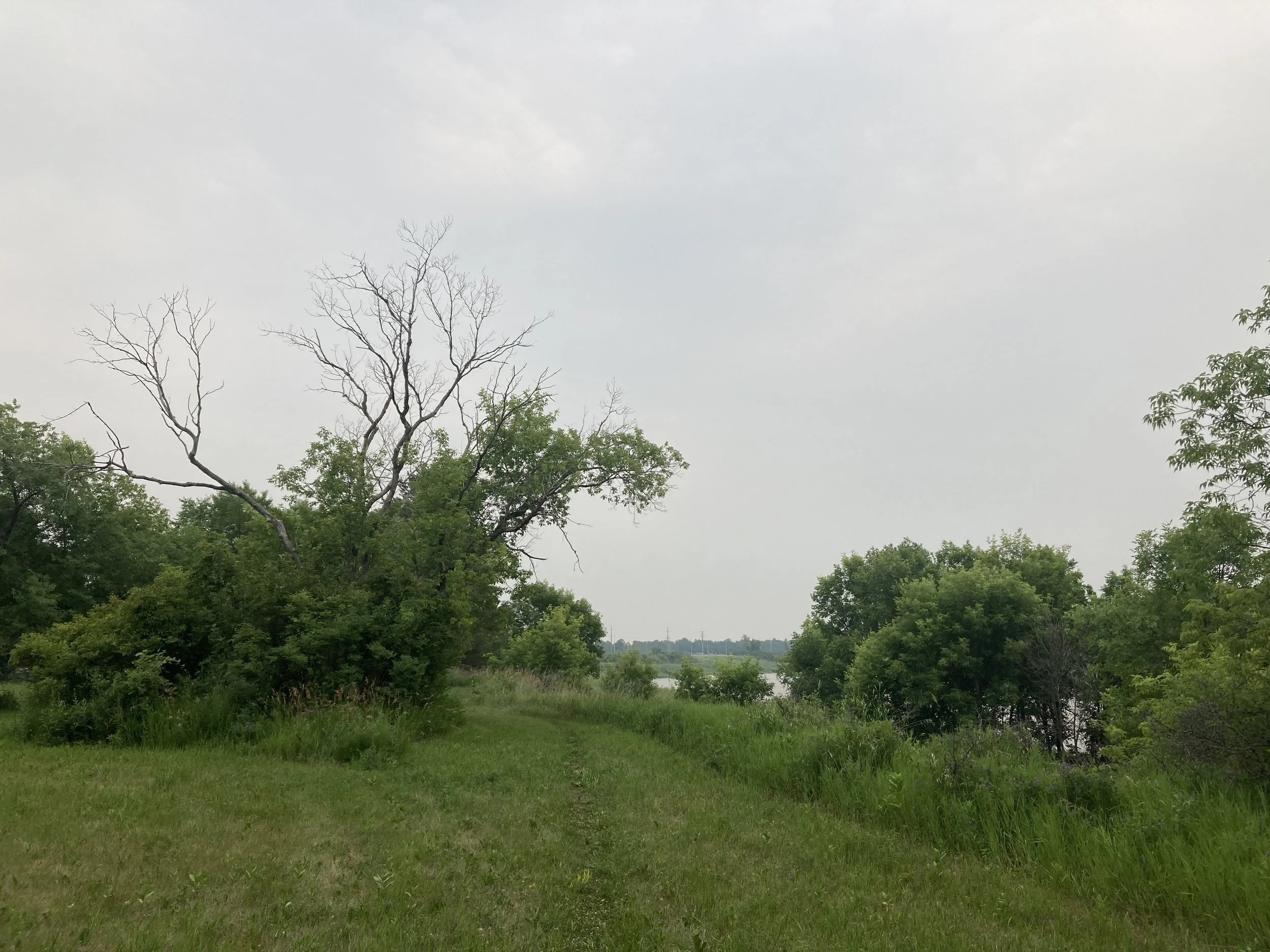
I’m feeling a little self-conscious titling this section of the post in this way, given the picture isn’t a real postcard… but when I thought of changing it, I felt a justification naturally spring to mind… The picture of the view I take on one of the week’s morning walks with the dog is a virtual postcard. Inherent in it is the typical message of old… “The greeting, the weather, health of writer, enquiry as to health of correspondent, signing off; such was the standard pattern, either enough itself or forming a safe basis for permutation and variation.” (Postcard Century p 13) So… weather cold, I’m fine, you too?

Happy Sunday!
A week on Sunday 4/52

Intro

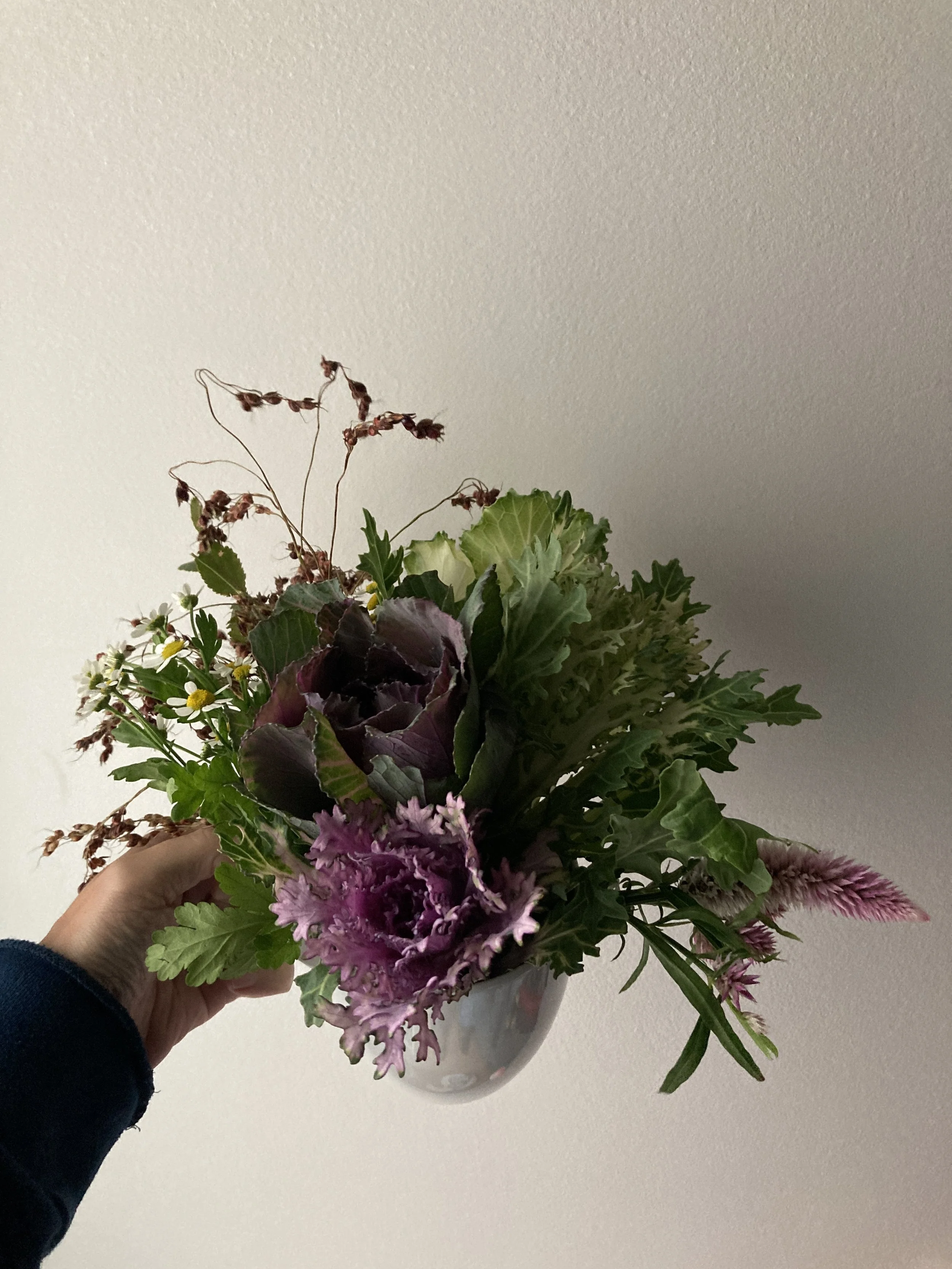
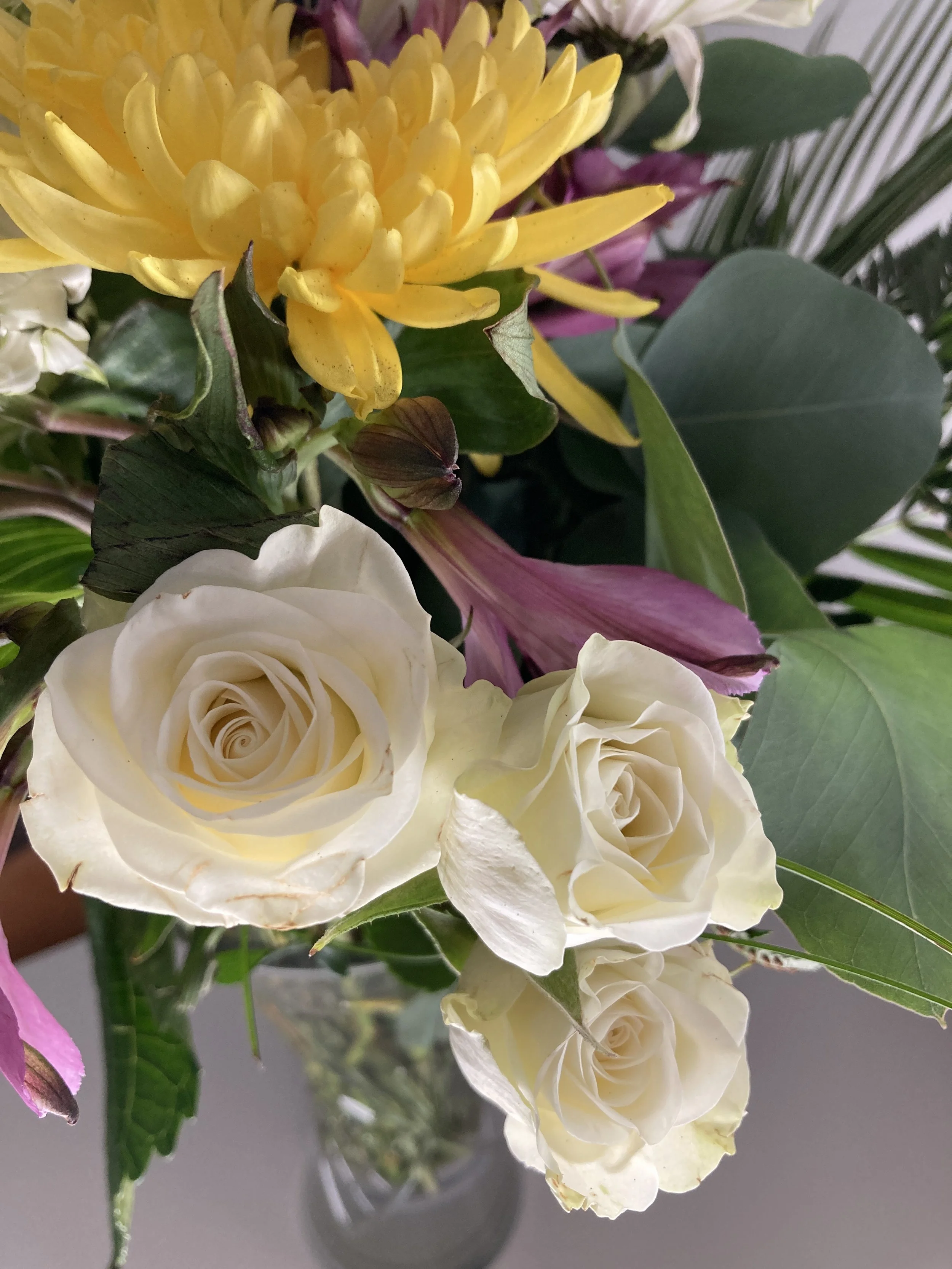
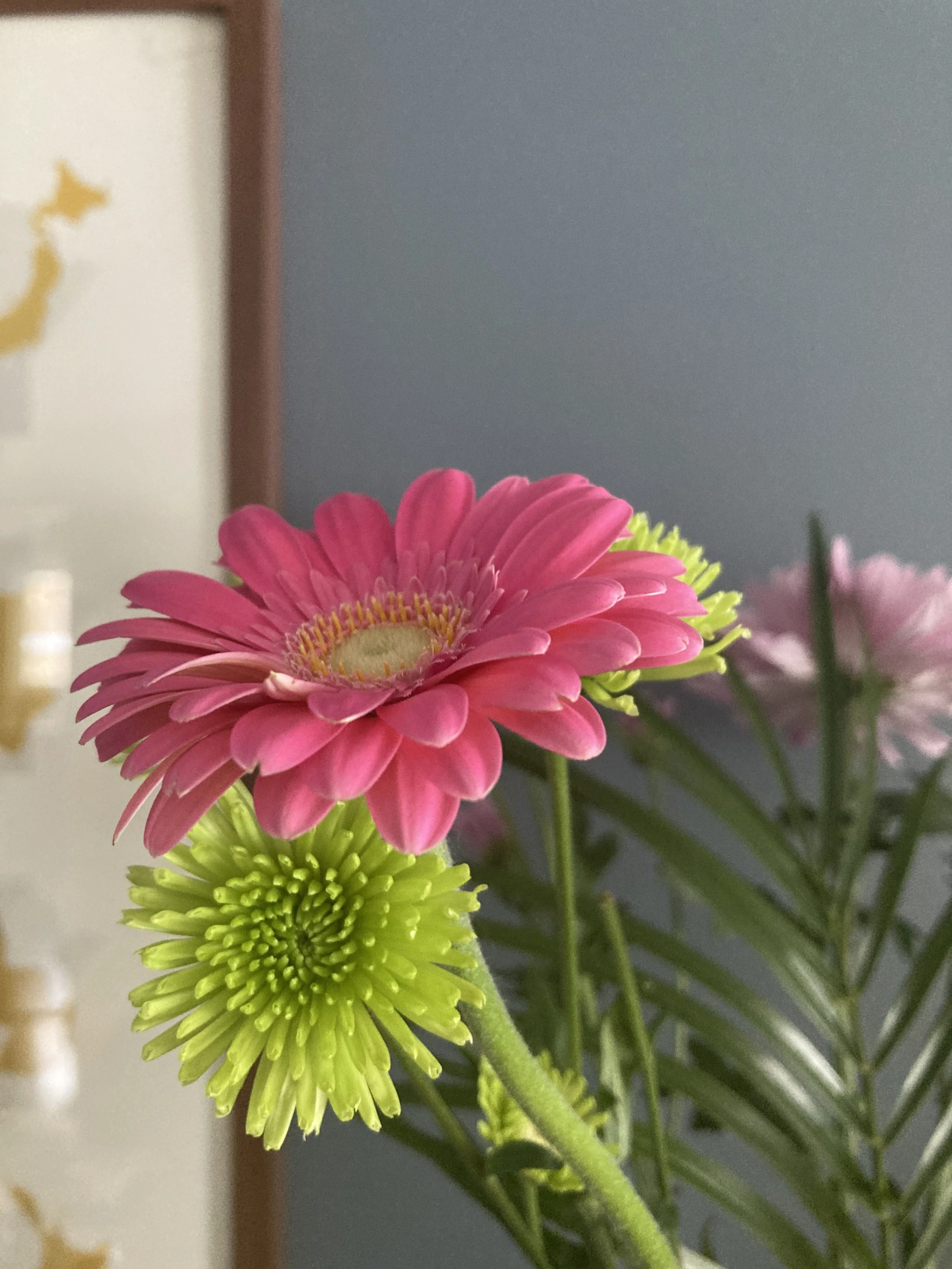
It’s cold here right now… colour is found in gifted bouquets…

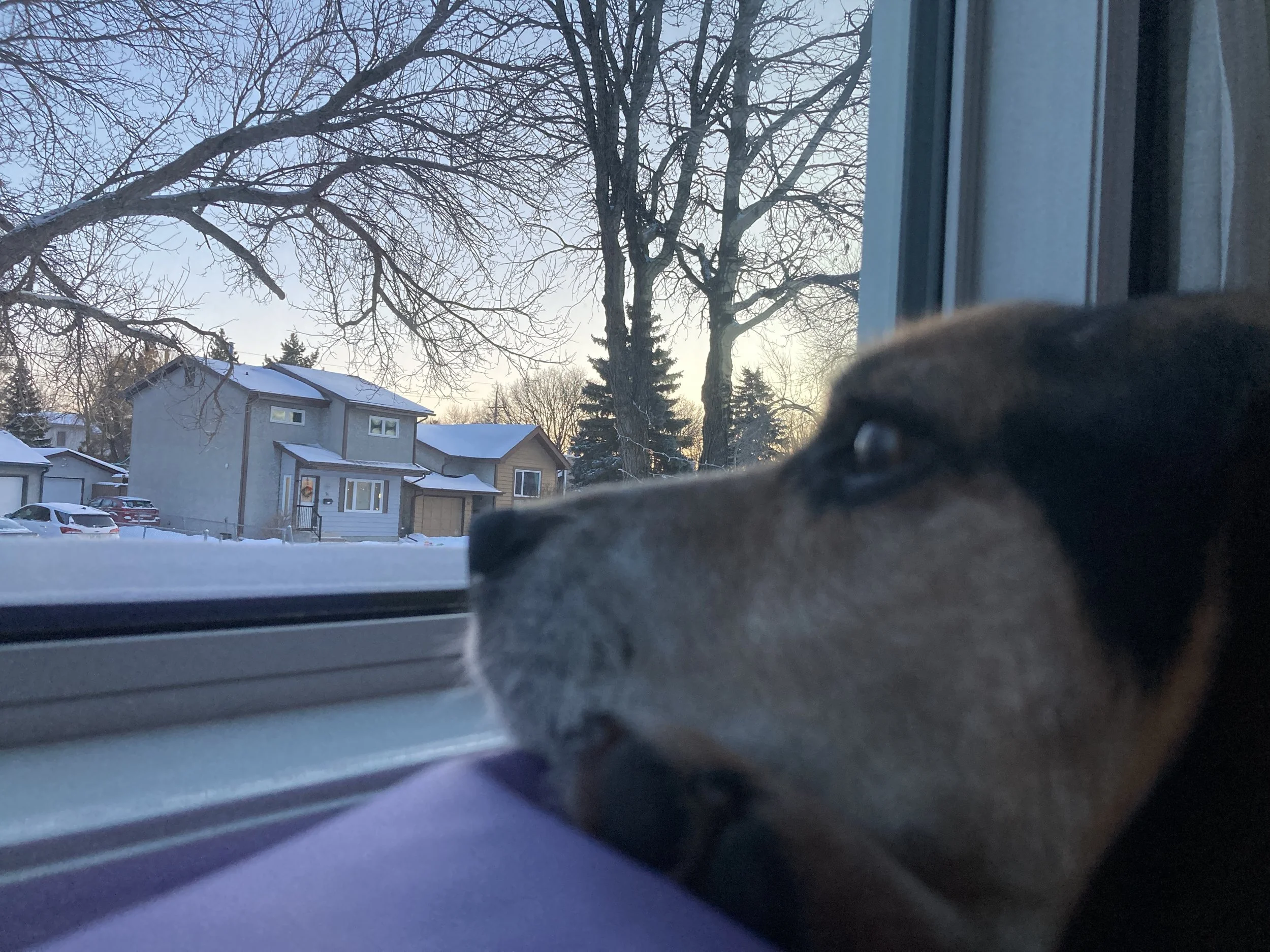
and sunsets observed from indoors…

This week, an overview of a hobby-project, quotes I liked from podcasts I heard lately, and what I’ve baked and cooked in the kitchen.

Genealogy as a puzzle

I’m not that interested in my own genealogy, so much as I am in other peoples. Delving into ancestry reveals first, that it exists… that a person is descended from a long line of individuals within families; and second, little else. The satisfaction comes from filling in a table, which, in the scientific language of academic research, is called “family reconstitution”. It’s a method of filling-in information about a family in an organized way. It has at the top the couple’s name, their parents’ names, their marriage date, and births and deaths; and then it lists their children with all the dates of their birth and death and marriage and who they married.

This past little while, I’ve been gathering information from registries online, to fill in a table for my mother-in-law’s great-grandparents. It is possible to do so because her great-grandparents lived in Quebec, where Catholic parishes kept excellent records. It is also possible because the “Bibliothèque et Archives nationales du Québec” has made these registries available online. (See St. Zéphirin-de-Courval, for example. A map of parishes in the province of Quebec can be found here.)  

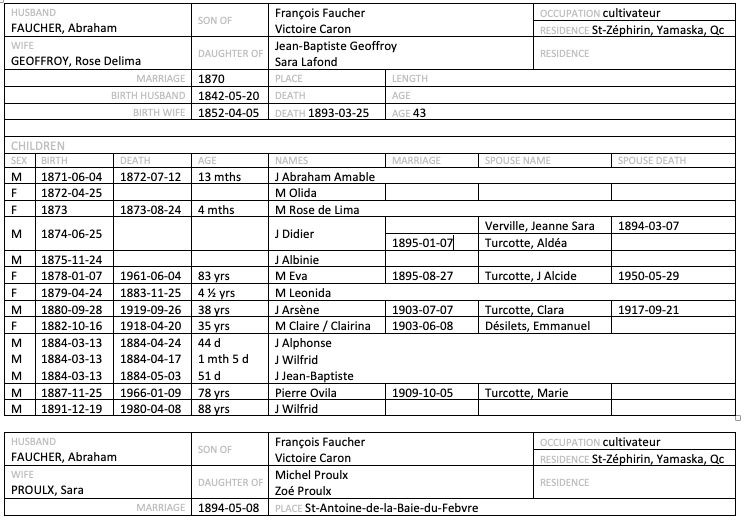
Filling in the table for her great-grandfather’s family looks like this:

A table allows me to summarize facts like this: Abraham Faucher and Rose Delima Geoffroy married in 1870 and in their 23 years of marriage, they had 14 children, among whom were a set of short-lived triplet boys. Three of their four surviving sons came to Manitoba: Didier, Arsène and Wilfrid. Didier brought his family. Arsène, recently-widowed, brought his children. Wilfrid was a bachelor. The recently-widowed Arsène met with ill-fate. His arrival in St. Boniface coincided with the outbreak of the Spanish Flu, and he, along with 60,000 other Canadians, became one of its victims. His son, Arthur - Rose-Marie’s father - was 4 years old when his mother (Arthur’s wife) died. He was 6 when, two years later, almost to the day, he lost his dad. 

Listening

I find narcissism interesting and appreciated this observation in passing by Diarmaid Macculloch on Conversations with Tyler:

[Thomas] Cranmer survived, remember. He survived by loyalty to King Henry VIII, and I think he genuinely loved Henry VIII, and so served him with a good conscience.

Trouble about that is that a man like Henry VIII is a narcissist. […] The thing about narcissists is that they make good people do bad things. Henry VIII was talented at making good people, such as Cranmer and, I would say, Thomas Cromwell, do bad things. 

I have a theory that persons with a narcissistic disorder build up an image of themselves that they constantly maintain and demand to be maintained. So, indirectly, I feel like Kevin Townley’s comment (here) on the subject of personal brand is indirectly related to narcissism. He says “[…] the attempt to codify and maintain a branded identity is an act of violence. It requires a kind of aggressiveness that is detrimental to you, and I would venture to say others as well.” 

But I also liked his descriptions of art and creativity: “Art is a liberation from being a self. You can do anything.” And:

The writer Robert Olin Butler talks about how creativity is hard. It’s really hard to do. And quite often, we avoid doing it because to delve down into the unconscious realm where the creative impulse seems to simmer is literally hell for a lot of people. For most people, it’s hellish. Even if you’re trying to write a joke, it’s torture.

So the idea is like, if you’re looking at a masterpiece, then you are engaging with a work made by somebody who is doing this all the time. […] you are looking at something that went through this kind of rigorous practice, it’s a practice of not knowing, of transforming negativity into something colourful, something with shape, something with tone, somebody who is able to handle the heat, the white hot heat of the creative process, and bend it […] into some other medium.

Approving

Any new article that makes the case for blogging is one I’ll read! This one from Joan Westenberg.  

Eating

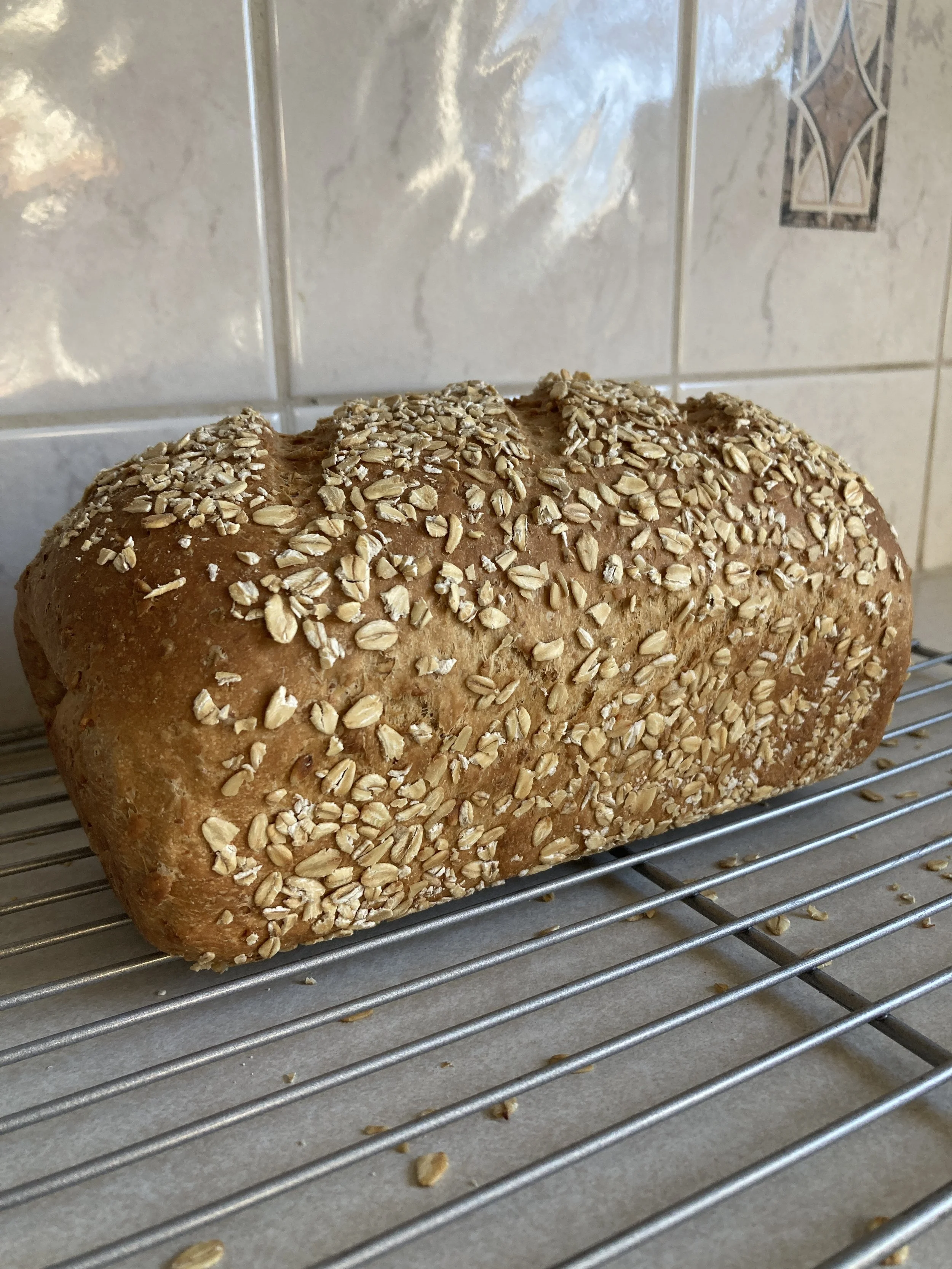
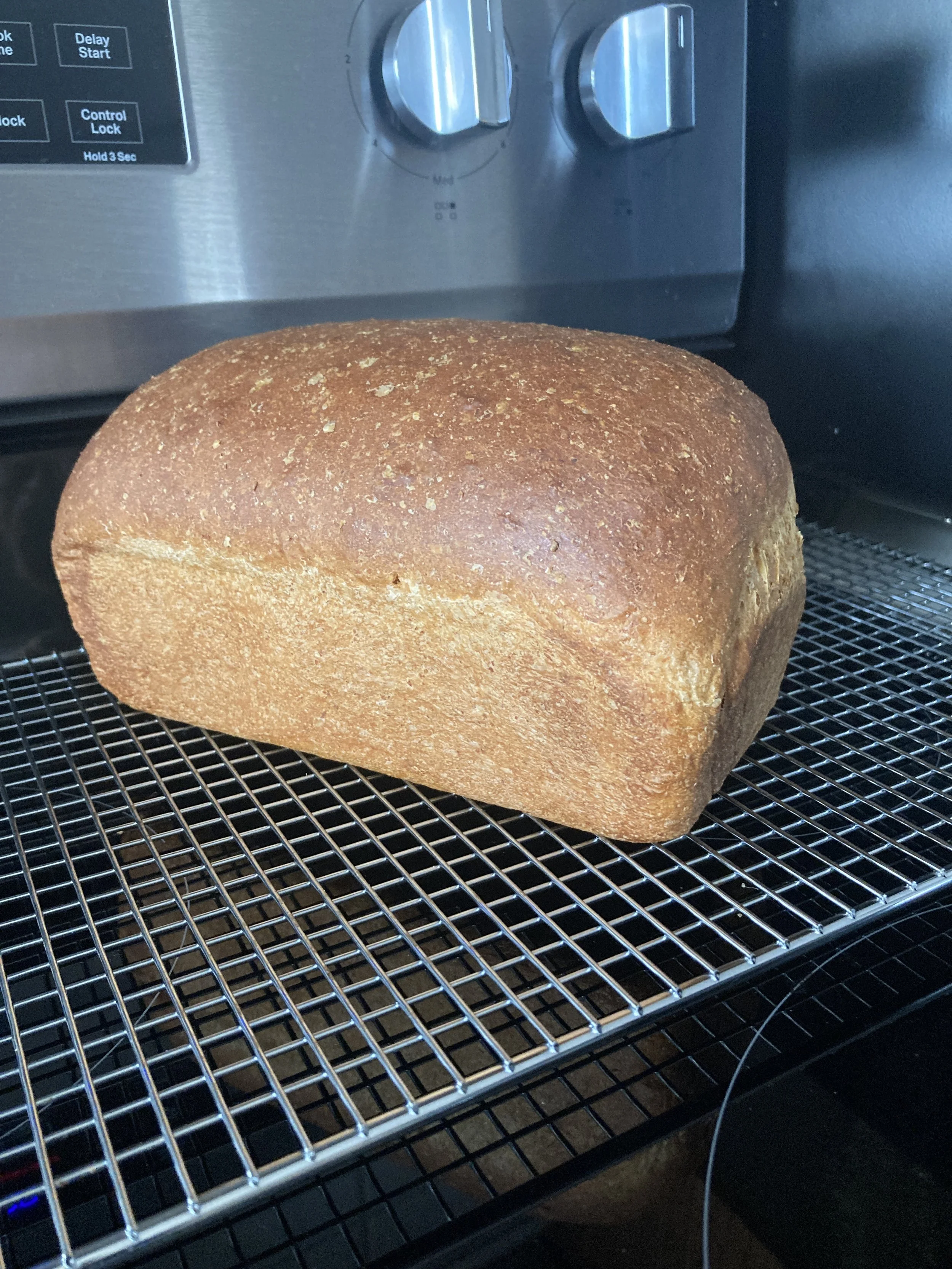
The foray into bread-making continues! This week, a lovely brown “Oat and Molasses” loaf.

Winter is a wonderful time for ragu-type recipes… A slow-simmering meat sauce served over pasta felt like the perfect way to welcome Christian home after his class’s 3-day camping trip. Molly Baz’s recipe in Cook This Book, titled “Paccheri with Pork and Lentil Ragù” (see an iteration on Instagram) uses anchovies for depth of flavour and red lentils for creaminess.  I think I preferred it over other group-pork-based ragù recipes that simmer with milk and vegetables. It’s proof, I would argue, that recipe collecting is a good thing, because you get to discover variations on a theme!

Postcard

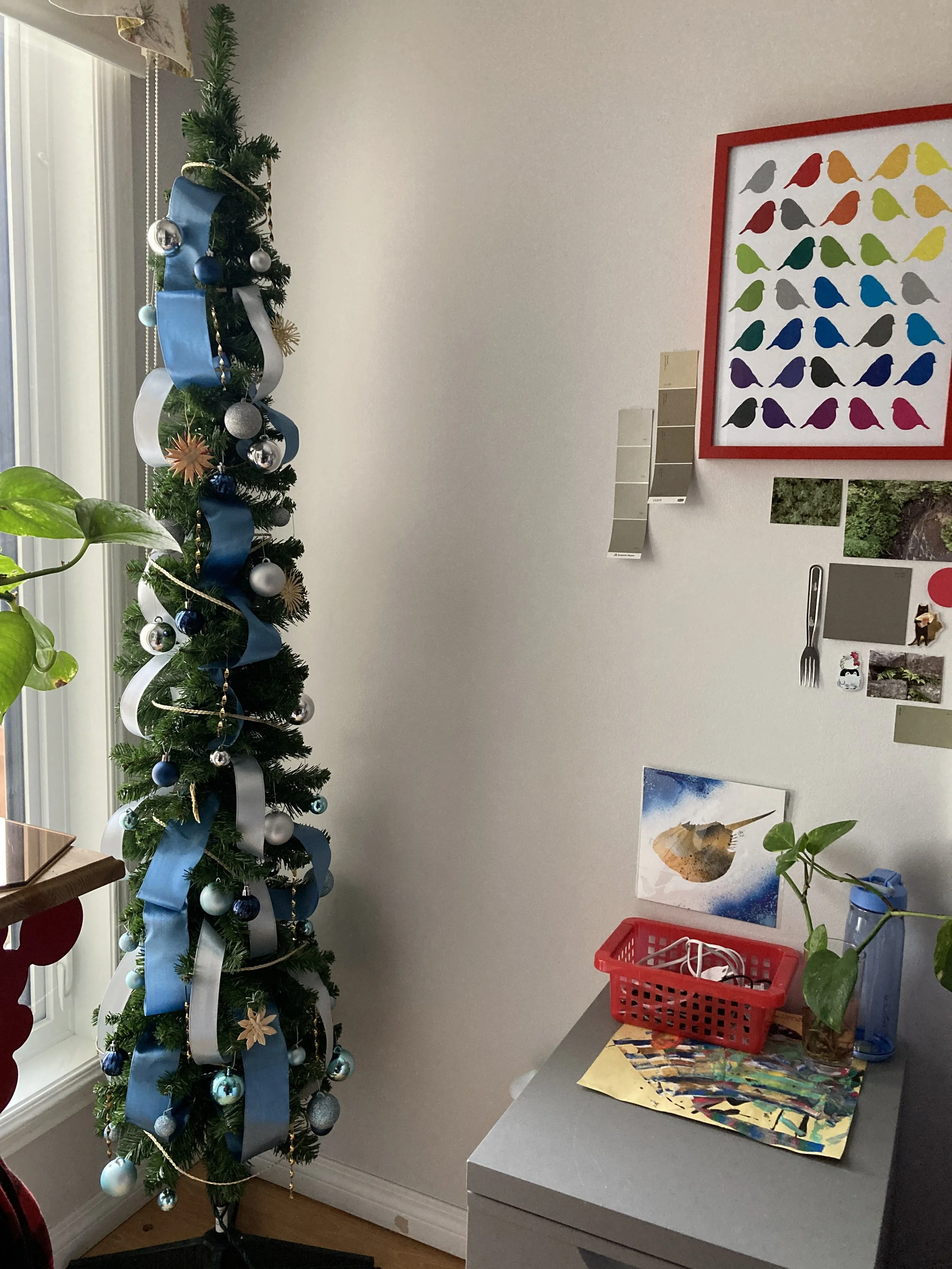
On cold days, when temperatures don’t invite much more than a glance at the landscape as you trudge through the snow, it’s the golden colour of the grass that draws my eye.

Happy Sunday!
A week on Sundy 3/52

Intro

This week, quotes and links related to creativity… It’s where my mind is leaning at present, and I’ll tell you why in a minute. But first, a documentary.

David Hockney: A Bigger Picture

About 12 minutes in to the above titled film available on Kanopy, Hockney says this:

I got a little sketchbook, a Japanese one, like a concertina and I would draw a certain kind of grass. I filled the book in about two hours with all these different kinds of grass. To most people, it looks like a jumble - because it is - but because you’ve done that, looked into the hedgerows, seen all the variety, then you draw it. When you’ve drawn it, when you then look again at the hedgerow, your seeing becomes clearer and you know you understand what’s going on more. And you realize there’s a fabulous lot to look at. If you want to replenish a visual thing, you’re gonna have to go back to nature, ‘cause there’s the infinite there, meaning you can’t think it up, I don’t think. 

I like how he shares a tip, a little practice he’s used himself that I can use too, and the subsequent appreciation for nature that comes from it. It makes me feel like drawing should have a place in education. Not a prescriptive kind of place, but a “freedom of exploration” kind of place. (I found this documentary from a book Sandi Hester recommended on her Youtube channel here. The library here doesn’t carry the book, but does have the documentary and I enjoyed it.)

A few more quotes on the subject

I like how Kristen Vardanega begins her first video of the year with a phrase to contradict the other well-known one… She says “I would like to ‘move slow and make things’.” Me too! In that vein, I appreciate the encouragement such as Orla Stevens offers it: 

You don’t need to know why you’re doing something. You don’t need to know where it’s going to take you. You just need to listen to your curiosity and let it take you where you’re meant to be going.

And her reflection that comes from pursuing that curiosity:

One of the main life lessons I think have been as a kind of byproduct of making and working in sketchbooks it’s not even really the art that’s the most important bit. It’s like the way that it lets you see the world more creatively and lets you appreciate the little things.

House upgrades and Mr. Enzo (the dog)

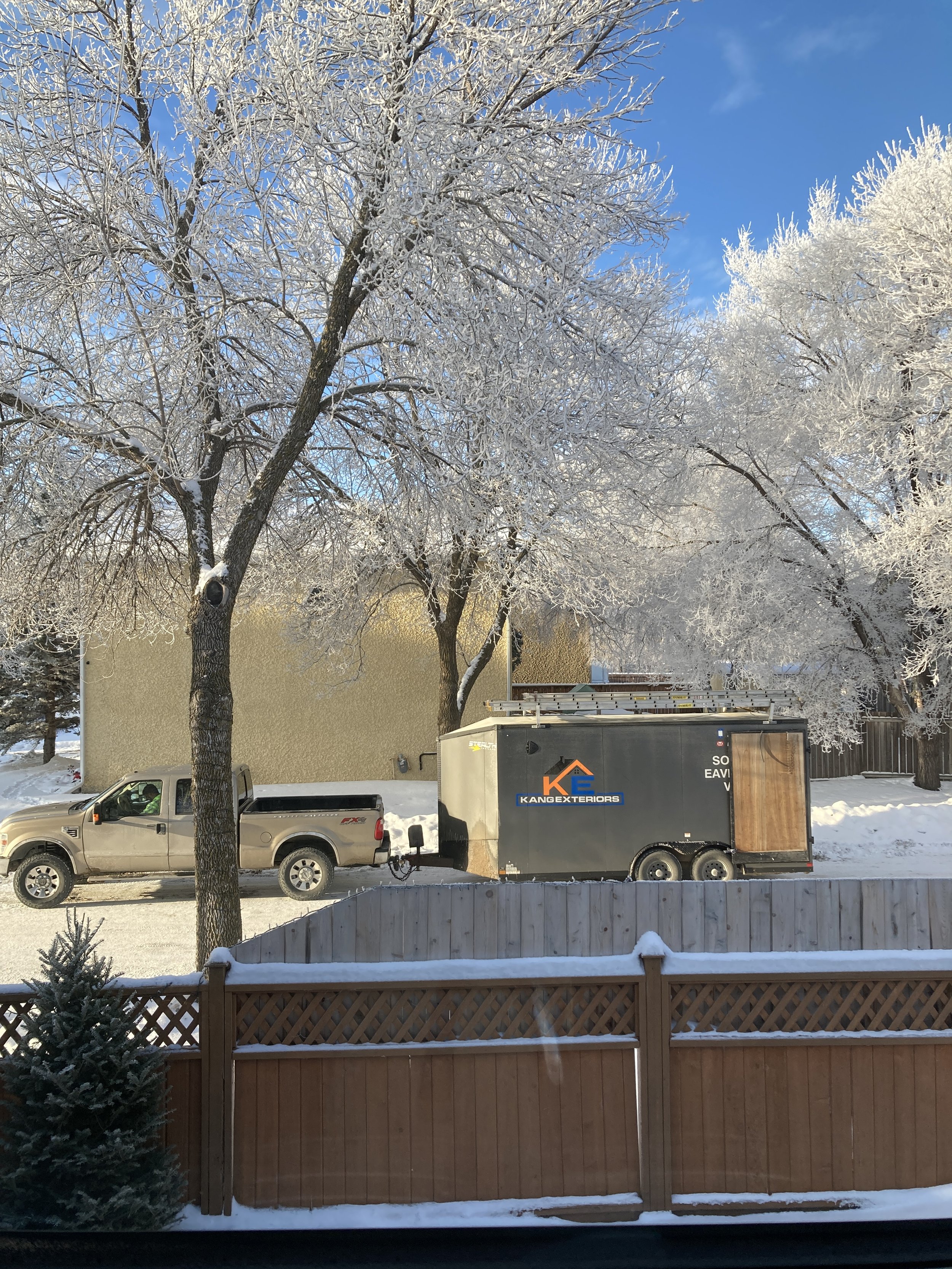
One day last week and two days this week, a little team of workers ascended ladders to replace the original eaves troughs on our house. Until then, we didn’t know it could be a winter project. It seems especially productive to transform a bit of our house when the yard is in hibernation, so that spring runoff will have a brand new highway.

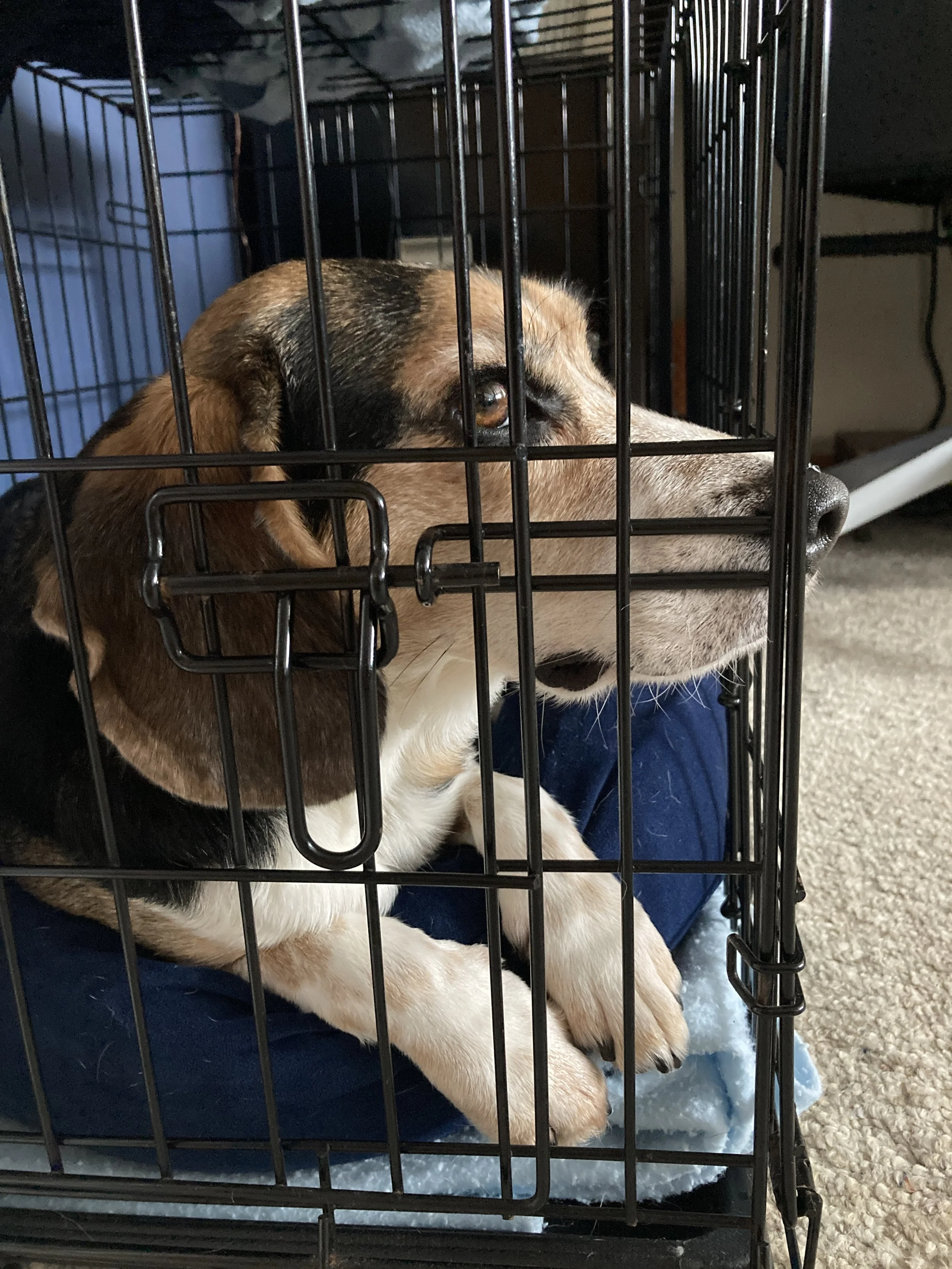
As nice as that is, our dog was acting as if the fortress was under siege and I would have reached the end of our Tupperware of treats before he would agree to settle. Eventually, he seemed most comfortable in his cage, but at risk of teasing the poor boy, let’s just say his anxiety was still manifest:

As soon as the workers left and order was restored to his little universe, all he wanted was a peaceful stay in his new bean bag.

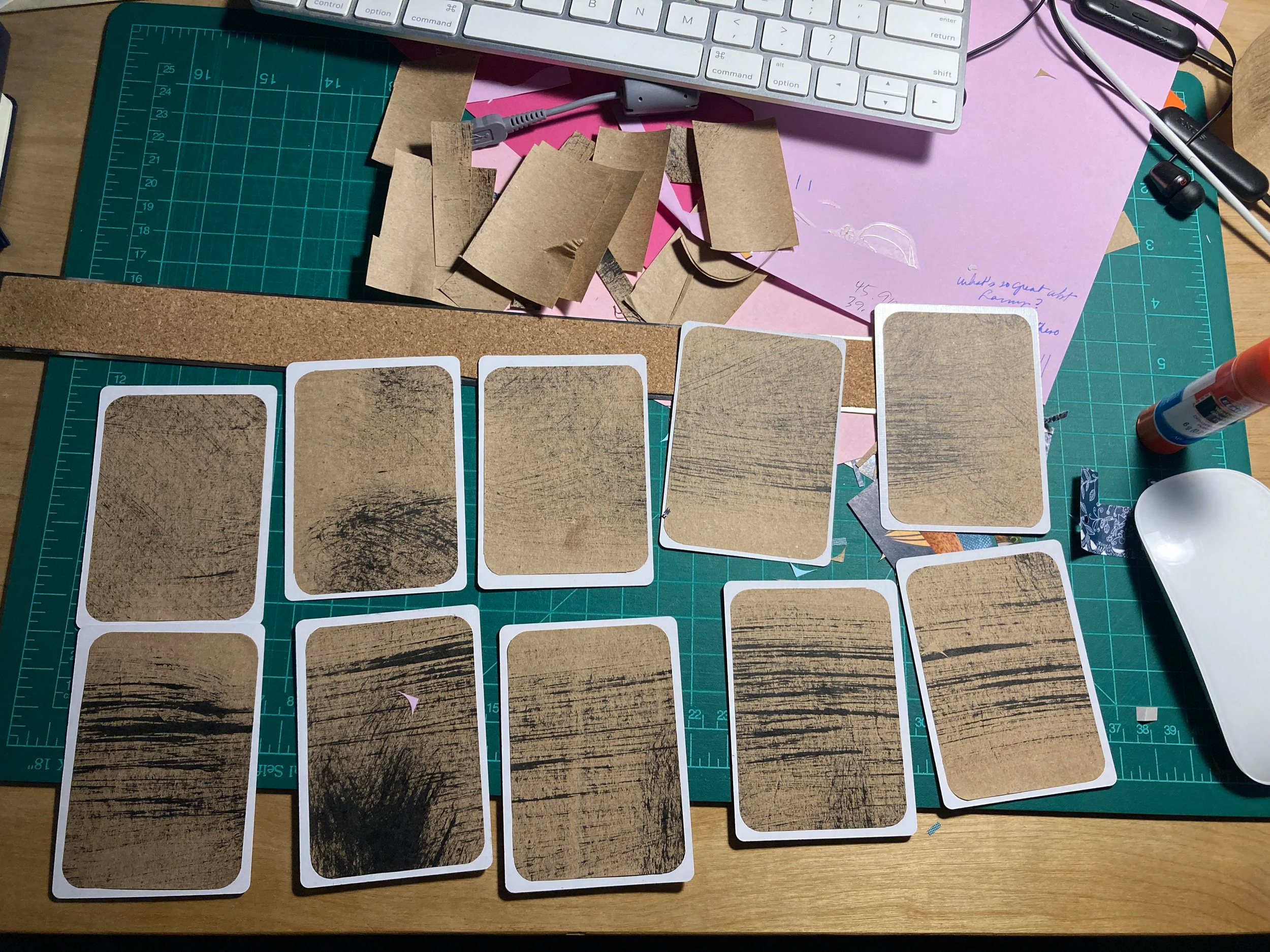
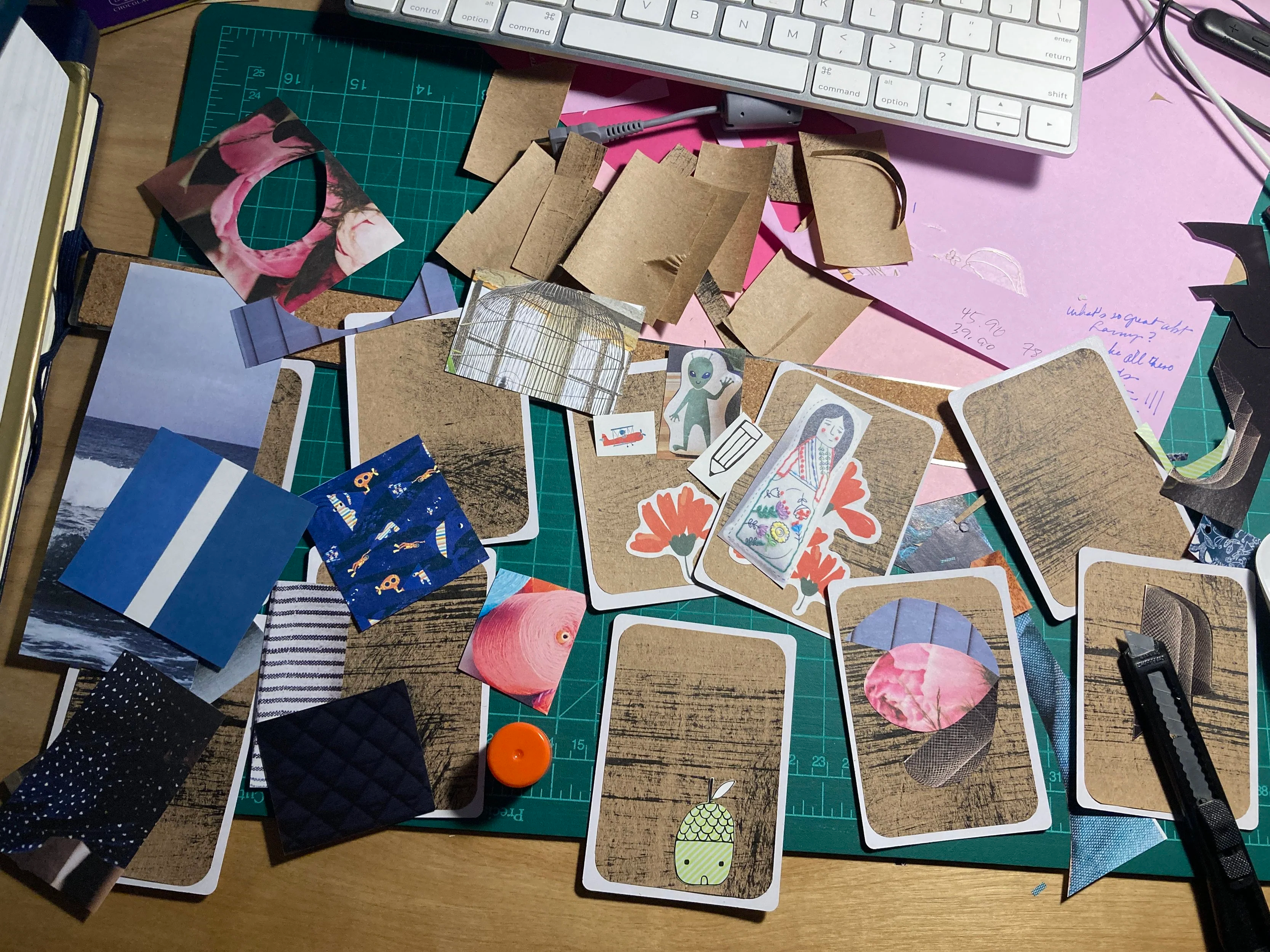
Hardly less rattled than our poor dog, I eventually dedicated a few hours to playing around with collage. Collage feels like almost childish fun to me, and in my imagination it has even fewer rules than drawing does… collage, in the end, doesn’t need to look like anything. You stop when you feel like it. You arrange at will. 

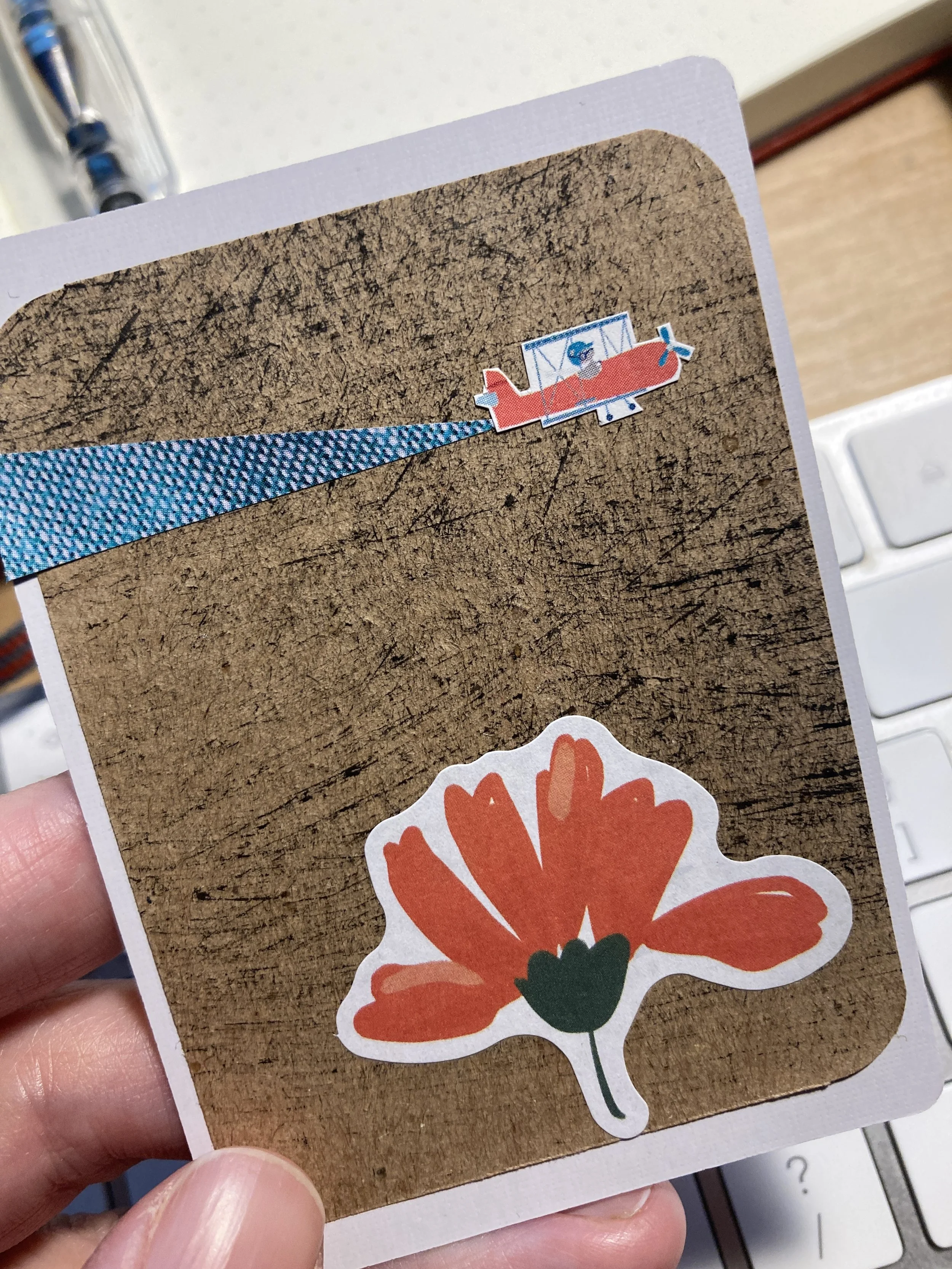
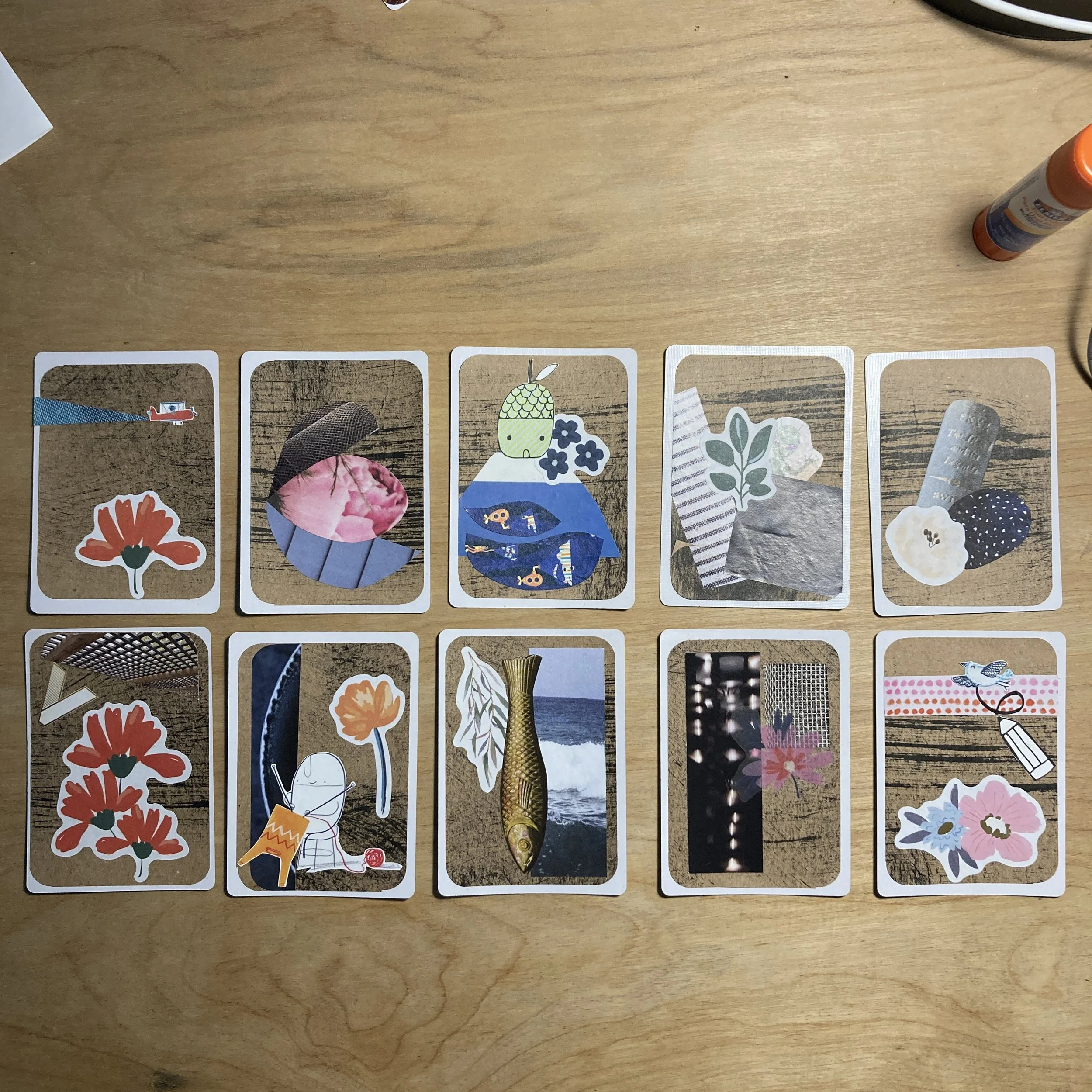
To trick myself into doing collage, I’ve given myself an appropriately small mission… Having been accidentally gifted the game “Cards Against Humanity”, I’ve been covering the inappropriate phrases with visuals I like better. “Cat pee in a water gun”? How about a floral sticker with a tiny animal-piloted plane flying overhead?

And who knew that India ink roughly brushed onto Kraft paper could make for such interesting textures! I call this series of tiny collages, my “cards for humanity”. 

After making ten, cortisol levels were indeed lowered just like Amie McNee says here.  

Reading online

I really liked the point made in this essay by Owen Kellogg who opens with the following

Phones do matter, but their role is often misunderstood. Instead of operating as a primary source of distress, heavy phone use appears to function as a compensatory behavior. When young people lack reliable sources of support or connection, they turn to tools that provide stimulation or regulation. Heavy screen use fills gaps left by unmet material and psychological needs.

This came via The Marginal Revolution who quoted a line from the conclusion: “The most reliable way to improve youth well-being is to meet individual needs through connection instead of control.” 

One of the things about December is that it’s a busy month, always and forever will be, meaning that I didn’t have the chance to sit down and peruse all the great year-end type posts that are so fun to read. It’s mid January, and I’m only now delving in… Thus did I come across… (thus did I? Alas, I am reading Smollett’s translation of Don Quixote and it is full of fancy language, so now I write in fancy language too… I’m about 170 pages in, since January 6th, and, yes, had to remind myself why I should be patient with all Quixote’s useless scrapes, and so read the first link served up to me… this by a Mr. Nick Senger back in 2018. Fine. Back to where I was going…) 

As I was saying… Kottke linked to this list of Best Video Essays, and I enjoyed listening through Josh’s “You are a better writer than AI. (Yes, you.)”. Anything about writing and A.I. is like catnip to me, and Josh’s comments about “beauty in recombinance” (at the 7:38 mark) makes me think of collage. His class syllabus has me nod with recognition, because yes, I find myself ”writing because you feel like you need to” (at 28:12). Literature that feels impenetrable? Another bit reminding me of the purpose of the self-imposed reading list!

Postcard

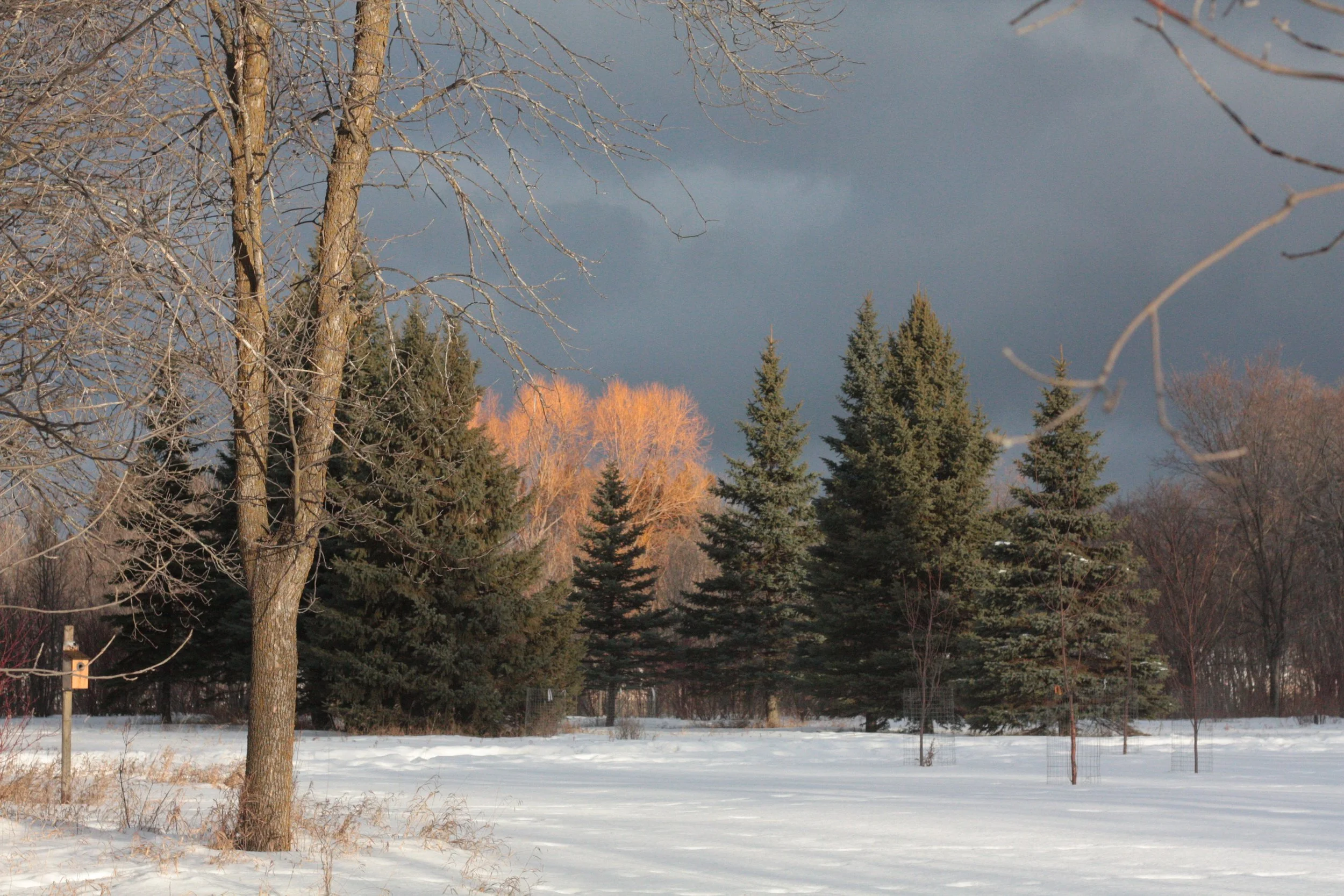
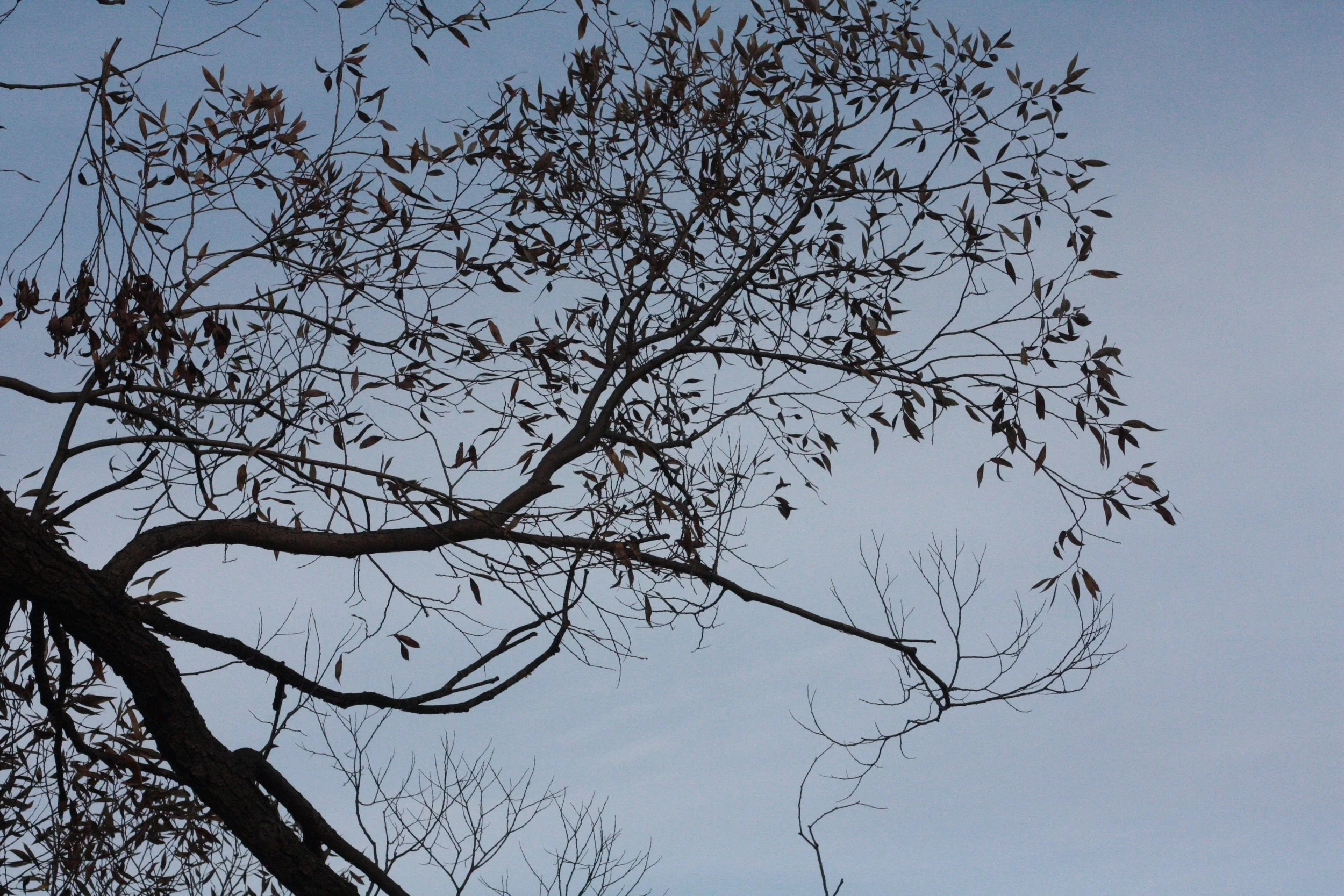
This week the temperature has fluctuated dramatically in Winnipeg, from melt to freeze, and one morning, the changing conditions during my walk lead to capturing some dramatic lighting. This dark slate sky and orange willow branches reminds me of summer evenings after a storm, when the sky is dark blue and the foreground is gold.

Happy Sunday!
A week on Sunday 2/53

Reading

I recently finished Mussolini and the Pope by David I. Kertzer and enjoyed the product of his historical research. I can only imagine how thrilling it must have been to access the Vatican’s archives for this story. This inside look at Pius XI’s pontificate and Mussolini’s political career grounds the tangential things that have floated past in the last little while… The political unrest in My Brilliant Friend, for example. This online peek at an exhibition of fascist posters. Or Tom Philipps’ comment on Hitler’s organization versus Mussolini’s: “This anniversary card of Hitler’s year-old chancellorship was hot off the press and Hitler makes his first appearance on a stamp. The control exercised over all the semiotics of power, masterminded by Goebbels, already marked Hitler out as in a different league of dictatorship from Mussolini who only made one philatelic appearance in Italy […].” (From Postcard Century, p 172).

But back to Kertzer’s book for a quotation… This one encapsulating the crux of the scandal from those years:

Neither Pacelli nor the pope's two emissaries - the official nuncio and the unofficial Jesuit - had ever uttered a word to challenge the government's decision to treat Jews as a danger to healthy Italian society. For anyone eager for a sign of the Vatican view of the new campaign of persecution, including parish priests and bishops seeking guidance on how to respond to it, the message was clear. The state was finally heeding the warnings that had been appearing in the Vatican daily newspaper and that had been regularly repeated in the Vatican-supervised La Civiltà cattolica and in much of the Italian Catholic press, from weekly diocesan bulletins to major daily newspapers. The recent opening of the Vatican Secret Archives has brought to light a report that makes clear that, as far as the Vatican was concerned, the August 16 [1938] agreement Tacchi Venturi negotiated with Mussolini, promising not to criticize the racial laws in exchange for favorable treatment of Catholic Action, remained in effect. (P 345)

Ideas and the elderly

Reading Gordon S. Wood’s The Purpose of the Past, I came across this passage on the subject of ideas:

These early twentieth-century historians [like Theodore Draper and Lewis Namier] knew that ideas existed, but they tended to dismiss them as propaganda, as manipulated rationalizations covering more deep-lying motives, which were usually economic. Ideas, they said, could not realistically be considered as motives for action, as causes of events.

Even if this realist or materialist position is true, however, ideas are still important for explaining human behaviour. Although ideas may not be motives for our actions, they are nevertheless the constant accompaniment of our actions. There is no human behaviour without ideas. Ideas give meaning to our actions, and there is almost nothing that we humans do that we do not attribute meaning to. We give meaning to even our simplest actions, a wink, for example, and these meanings - our ideas - are part and parcel of our actions. These meanings or ideas are the means by which we perceive, understand, judge, or manipulate our experiences and our lives. They make our behaviour not just comprehensible but possible. We have a human need to make our actions meaningful. 

Although we have to give meaning to nearly everything we do, we are not free at any moment to give whatever meaning we wish to our behaviour. The meanings we give to our behaviour are necessarily public ones, and they are defined and delimited by the conventions and language of the culture at that time. It is in this sense that the culture creates behaviour. It does so by forcing us to describe our behaviour in its terms. The definitions and meanings that we seek to give to our behaviour cannot be random or unconstrained, which is why the concept of “propaganda” as freely manipulated meanings is flawed. Our actions thus tend to be circumscribed by the ways we can make them meaningful, and they are meaningful only publicly, only with respect to an inherited system of conventions and values. [Emphasis mine.]

This feels especially pertinent when I think of my 88-year-old mother-in-law. As I am reading through the newspaper archives of her young adulthood in the late 1950’s, I am struck by the social conventions that shaped her and that feel so alien today. If she comments about the number of immigrants she has encountered on an errand, it helps to recall that in 1958, the appearance of a Black student teacher in the French school’s grade 7 class was a newsworthy headline. (See page 4 here.) 

Eating

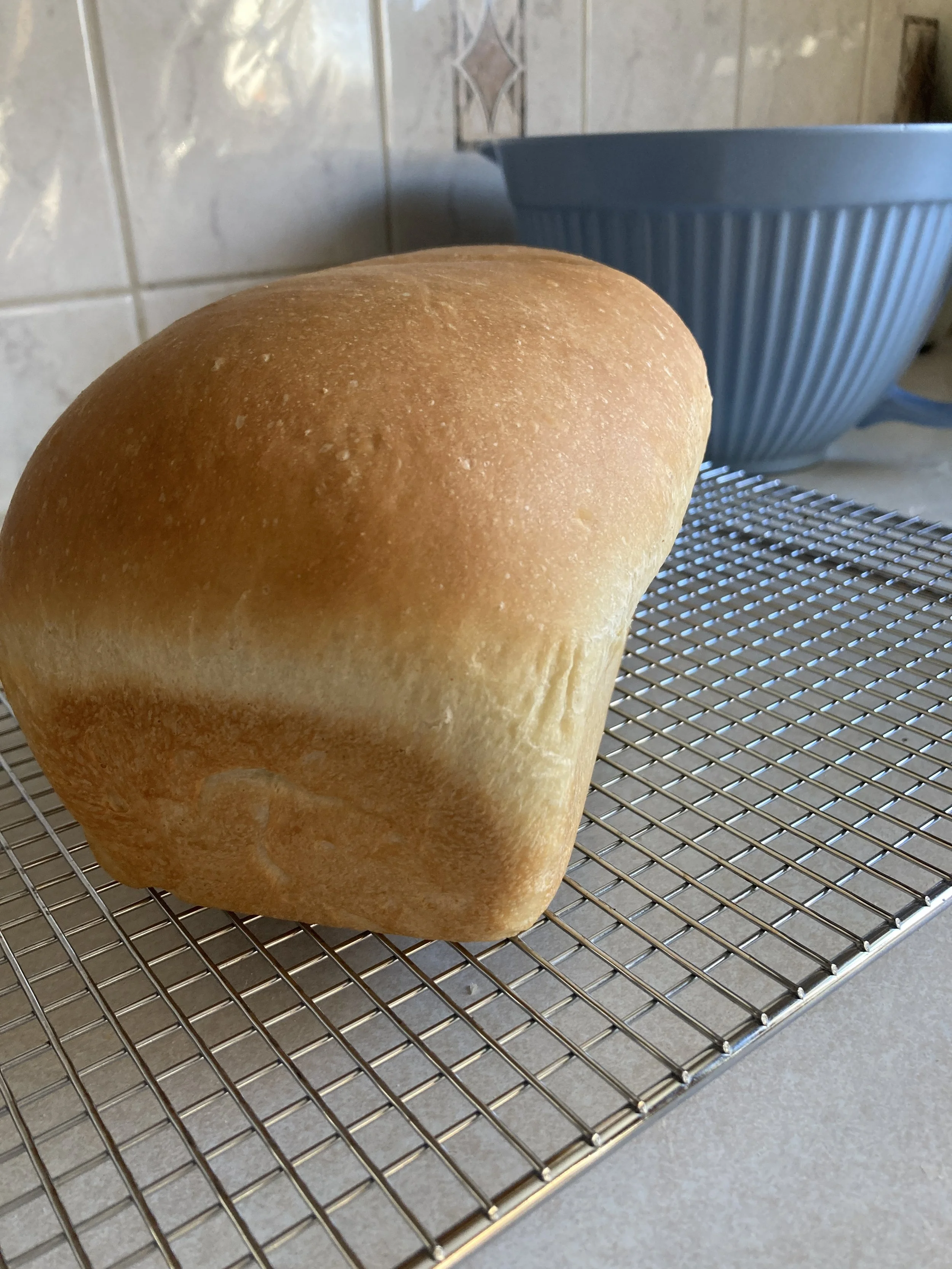
The Big Book of Bread has encouraged me to try making simple loaves… Basic White, and a whole-wheat Everyday Bread. I’m learning about controlling the temperature of the ingredients so that the dough doesn’t overproof. I like the feeling of bread-making as an art.

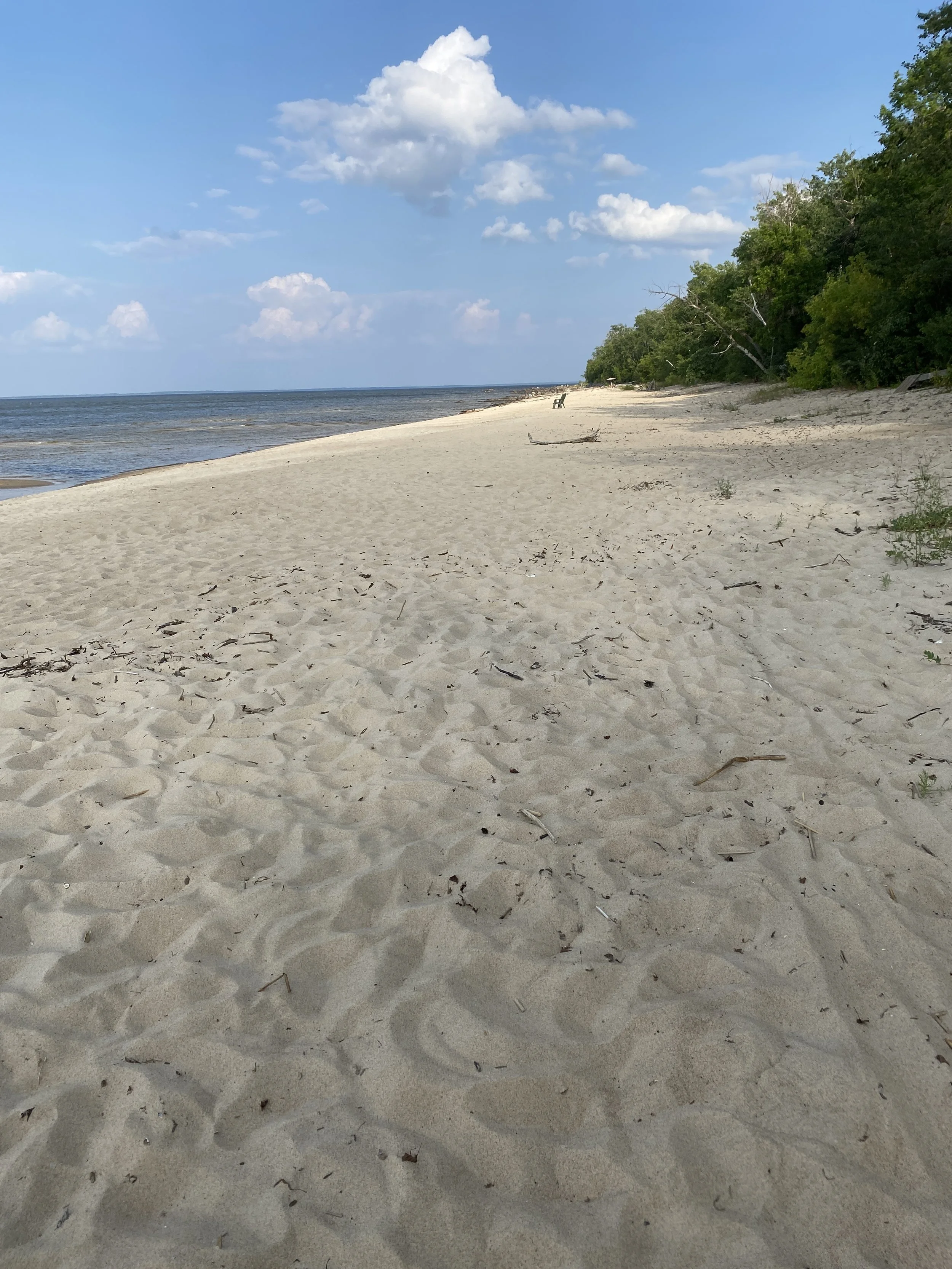
Postcard

We had three days of frost on the trees, the third being the most impressive…

Happy Sunday! 
A week on Sunday 1/53

Reading

If you’d like to be convinced of Henry Oliver’s “Ten reasons to read great literature in 2026” I’d suggest Sleepwalker in a Fog by Tatyana Tolstaya for the first two… “particular pleasure” and “the force of language”. I mean, sure, read any great literature you would like, but having just surfaced from this one, this slim volume of short stories, I feel a little like laughing along with the jollity of her descriptions, I feel like I’ve been awash in the brilliance and control of her use of words. Here are two quotations:

People assert themselves, sink their hooks in, refuse to go - it's only natural! Take the recording of a concert, for example. A hush falls over the hall, the piano thunders, the keys flash like lozenges gone berserk, lickety-split, hand over fist, wilder and wilder; the sweet tornado swirls, the heart can't stand it, it'll pop right out, it quivers on the last strand, and suddenly: ahem. Ahe he kherr hem. Khu khu khu. Someone coughed. A real solid, throaty cough. And that's that. The concert is branded from birth with a juicy, influenza stamp, multiplied on millions of black suns, dispersed in all possible directions. The heavenly bodies will burn out, the earth will become crusted in ice, and the planet will move along inscrutable stellar paths like a frozen lump for all time, but that smart aleck's cough won't be erased, it won't disappear, it will be forever inscribed on the diamond tablets of immortal music - after all, music is immortal, isn't it? - like a rusty nail hammered into eternity; the resourceful fellow asserted himself, scribbled his name in oil paint on the cupola, splashed sulfuric acid on the divine features. [From the title story, “Sleepwalker in a Fog”]

Having company in the country - it's not like having company in the city. There's a pleasant lack of obligation. In the city a guest  won't just drop in, he'll phone first to say, I'd like to come by and visit you. The hostess will glance quickly at the floor: is there a lot of dust? - she'll do a mental check: is the bed still unmade? - she'll give a nervous thought to the refrigerator shelves - all in all, it makes for tension. Stress. But in the country none of that matters: what to sit on, what to drink, or from what cups. And it's no disaster if you leave a guest alone for five minutes - in the city that's a cardinal sin, but not in the country. It's a different type of hospitality. The guest lounges in a wicker armchair, has a smoke or just sits quietly, gazing out the window at the view, at the sky, and there's a sunset playing through all its colors - it'll give off a red or lilac stripe, then a golden crust will flare on a cloud, or everything will be tinged with a frosty green or lemon - a star will sparkle... Better than television. [From a story titled “Heavenly Flame”]

Eating

Last Sunday, I made this Sheet Pan Chicken with Tomatoes and Chickpeas by Carla Lalli Music and it was well liked!

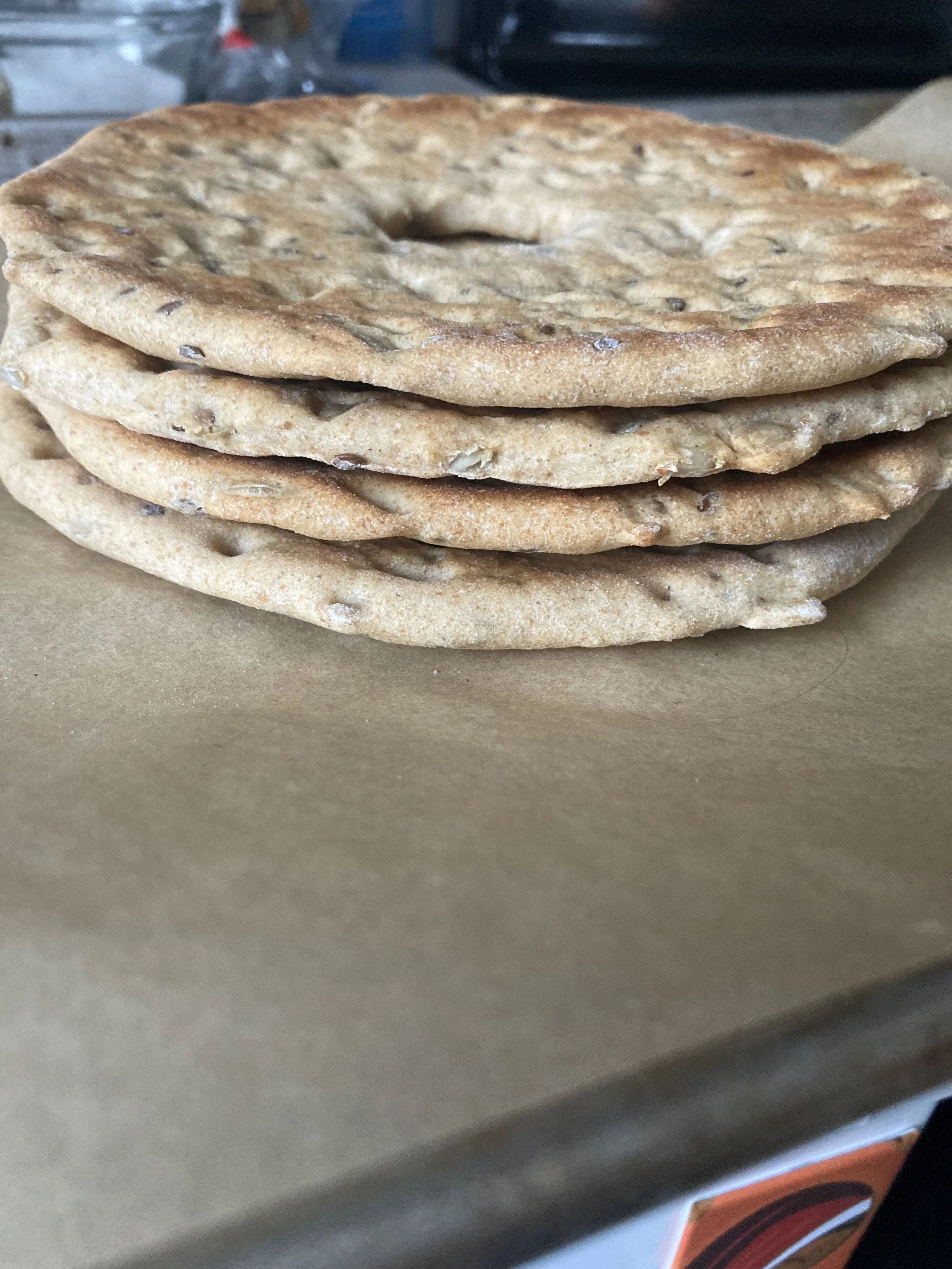
I was very happy to receive The Big Book of Bread (see here) as a gift on my birthday and chose, as a first recipe, Knackebrot to feature in a platter. It’s an intriguing bread, flat and seedy, but, as the recipe’s introduction says, it is flavourful and lightly sweet. 

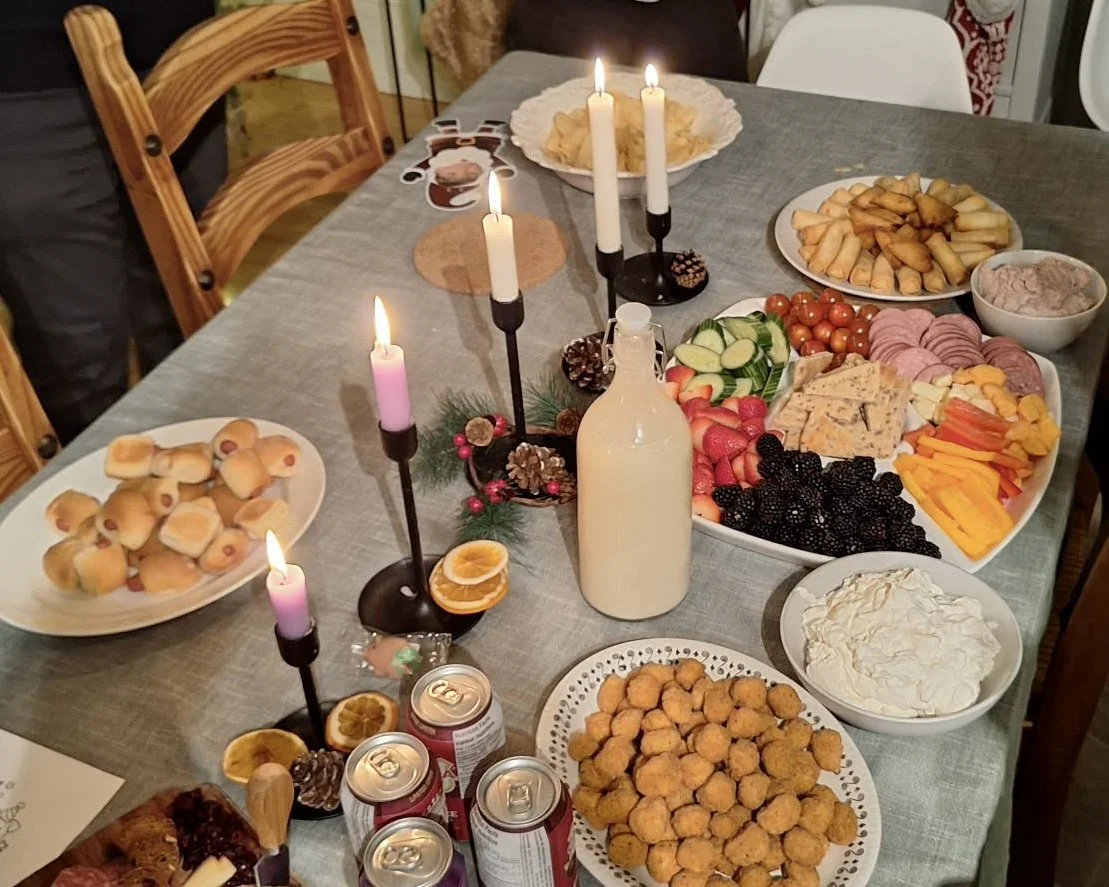
The New Year’s Eve spread at a friend’s house looked like this:

Photo credit: Sébastien Forest

It reminds me that I should mention a fruit dip we really like… Contrary to most fruit dip recipes found online, this one doesn’t feature cream cheese. I suspect it’s consequently a bit lighter. I hadn’t kept the little cookbook it came in, called Rookie Cook, from the Company’s Coming series, and I regretted that decision just for this recipe. Fortunately, the Internet Archive has a copy you can borrow and because of that, I had the pleasure of being able to serve it to the kids and share in their enjoyment of it!

Cool Fruit Dip
From Jean Paré’s cookbook Rookie Cook (p. 23)

¾ cup marshmallow crème
½ cup sour cream
1 tablespoon brown sugar, packed
½ teaspoon vanilla
2 cups frozen whipped topping, thawed

Beat marshmallow crème, sour cream, brown sugar and vanilla together in medium bowl until blended and brown sugar is dissolved.

Fold in whipped topping. Makes 2½ cups.

Happy Sunday!
A week on Sunday (no. 42)

Christmas

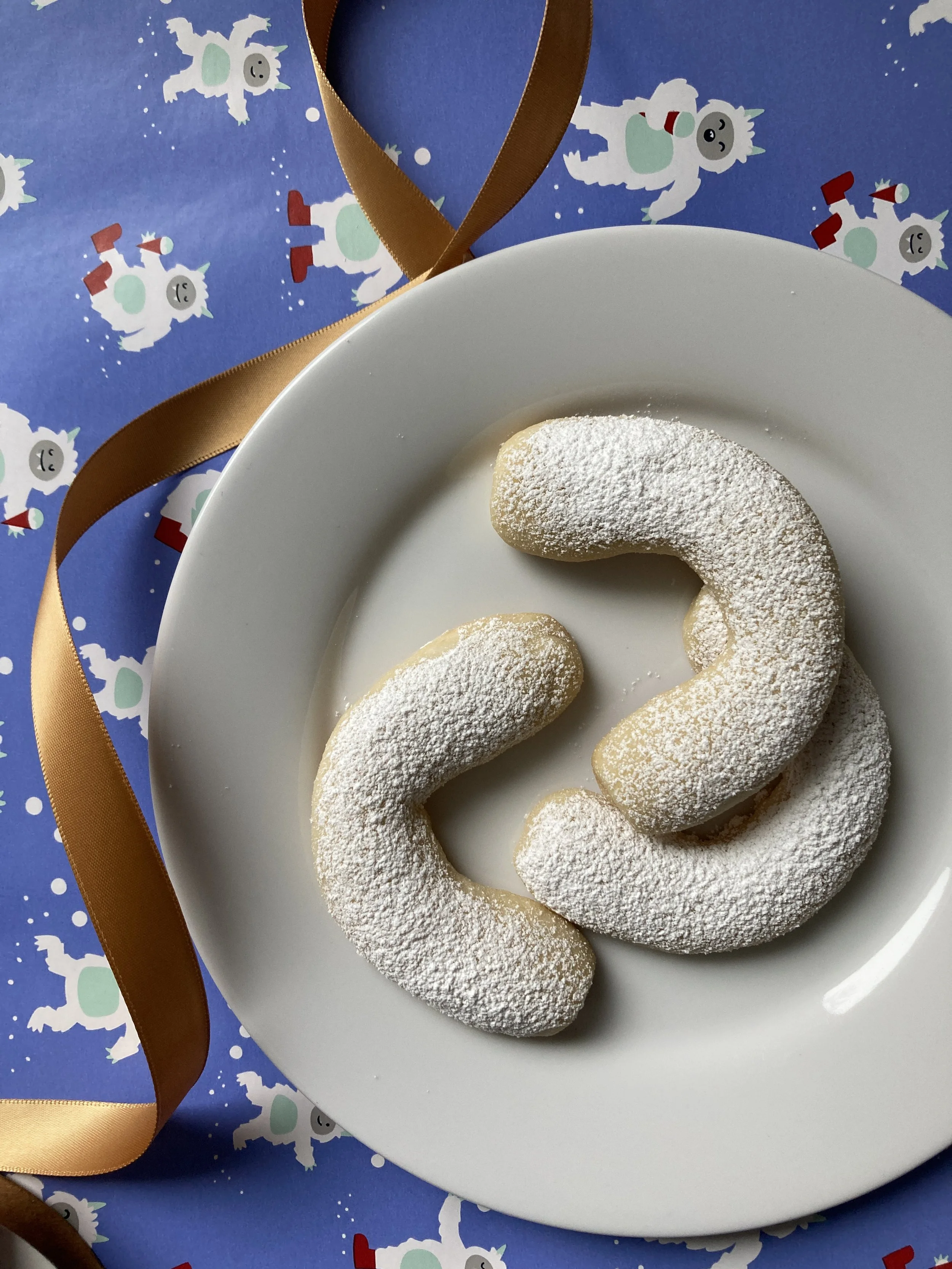
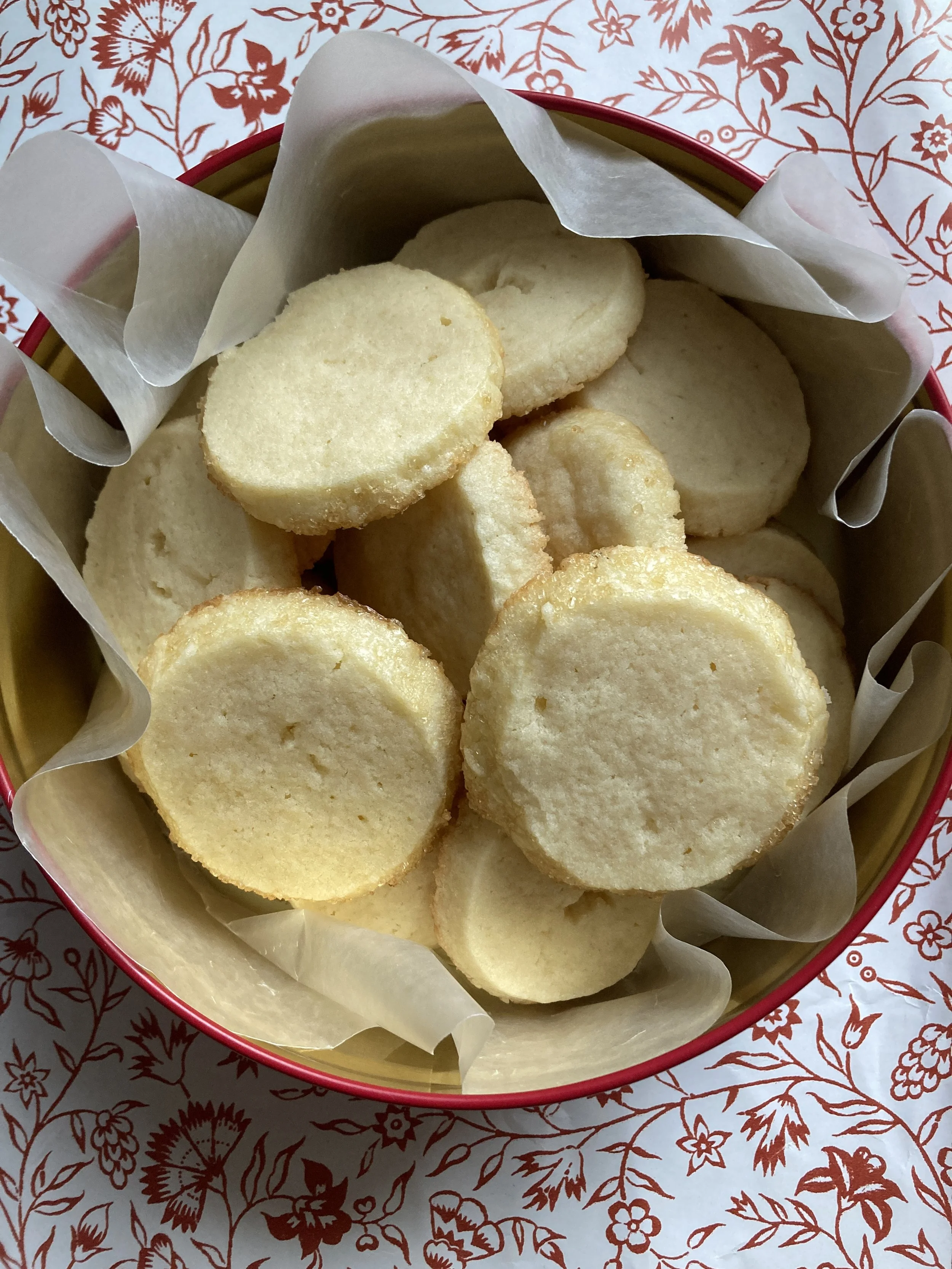
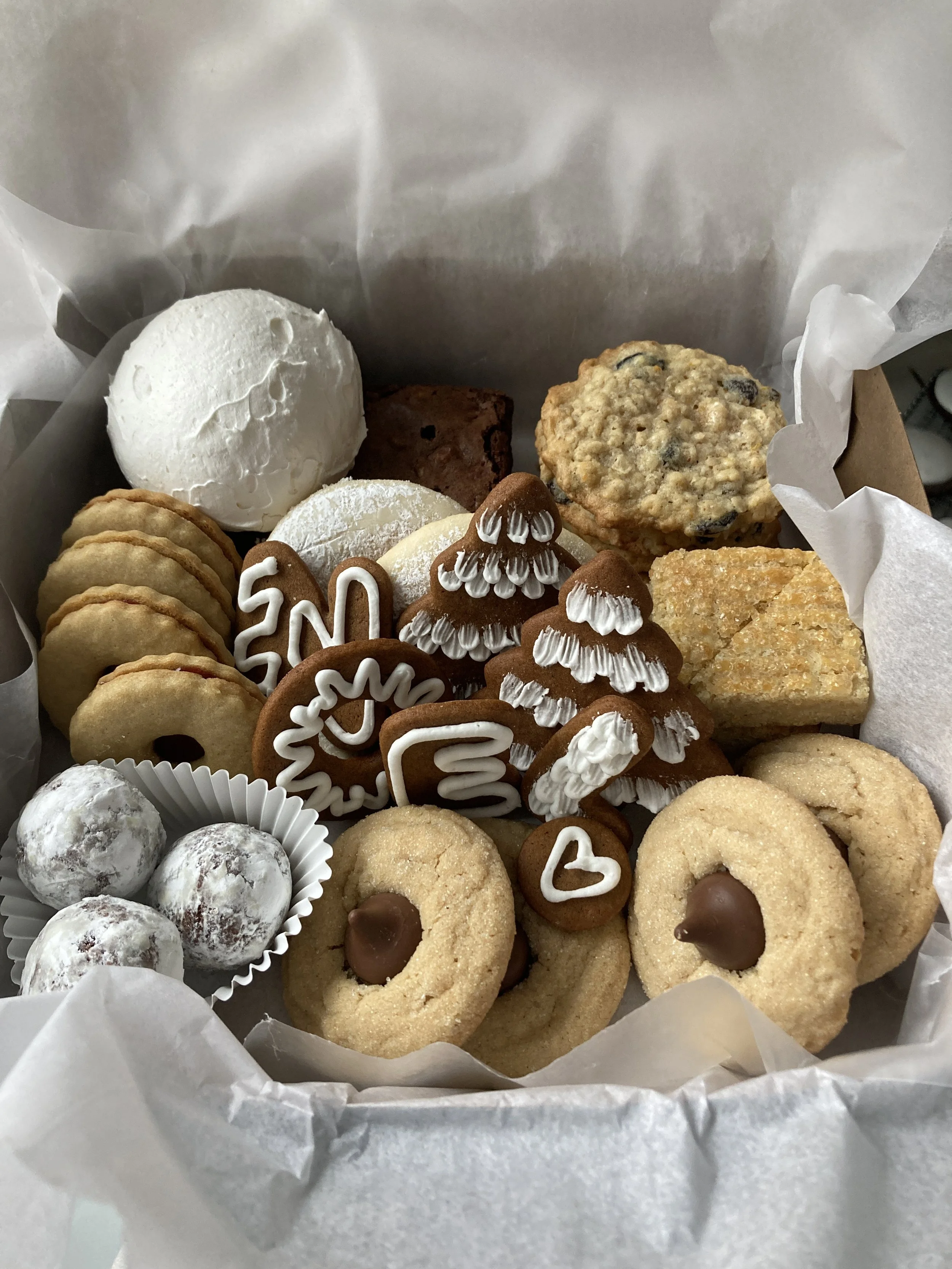
It’s a nice feeling to be on the other side of a holiday having enjoyed the anticipation, and participated in creating the mood. We hosted a small cookies and cocktail party, baking enough cookies and bars to share.

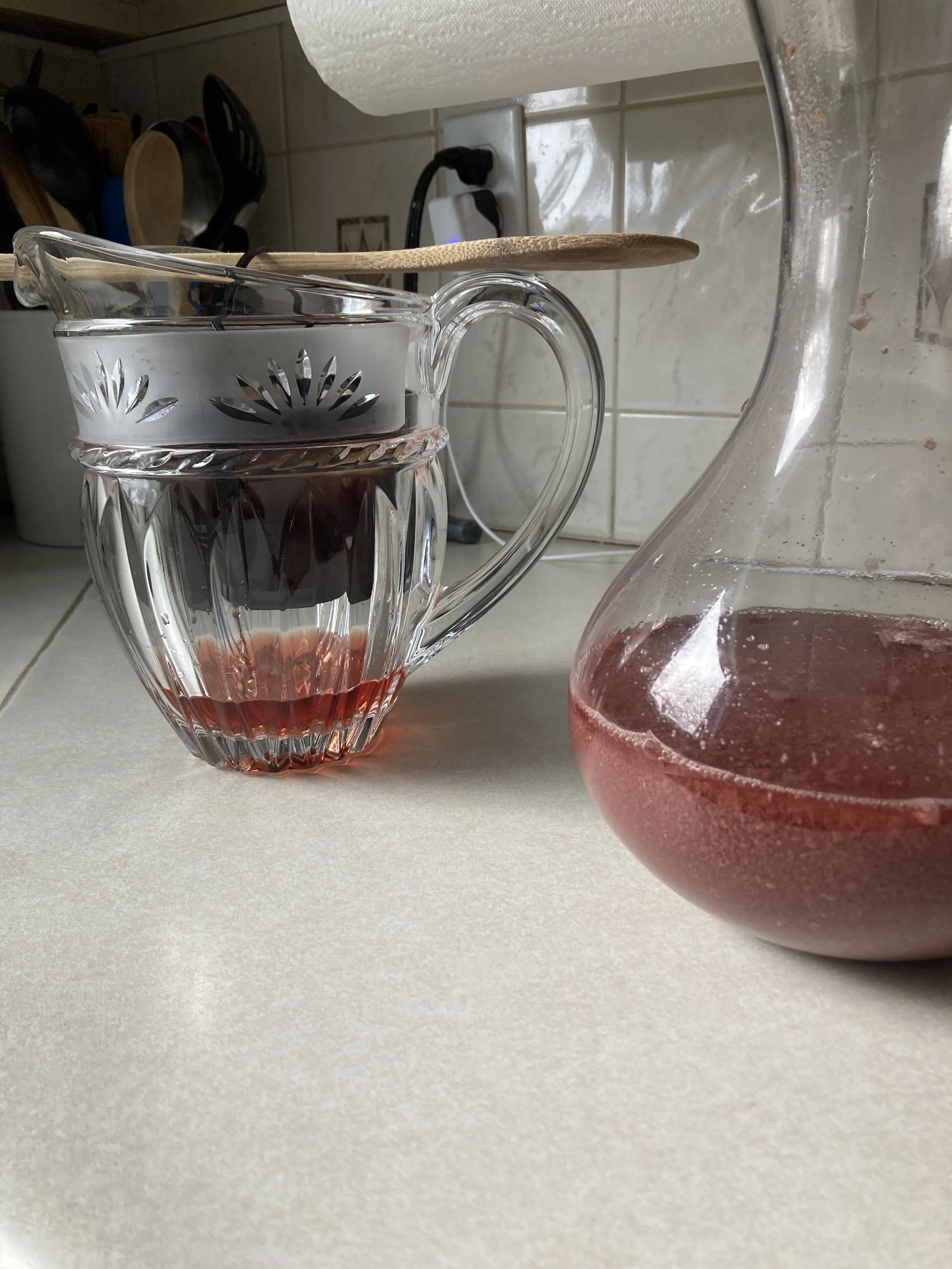
This year’s cocktail was Alton Brown’s Clarified Milk Punch, a recipe seen on TikTok that made me feel like I was pulling off a chemistry experiment in my kitchen. Even the kids were intrigued.

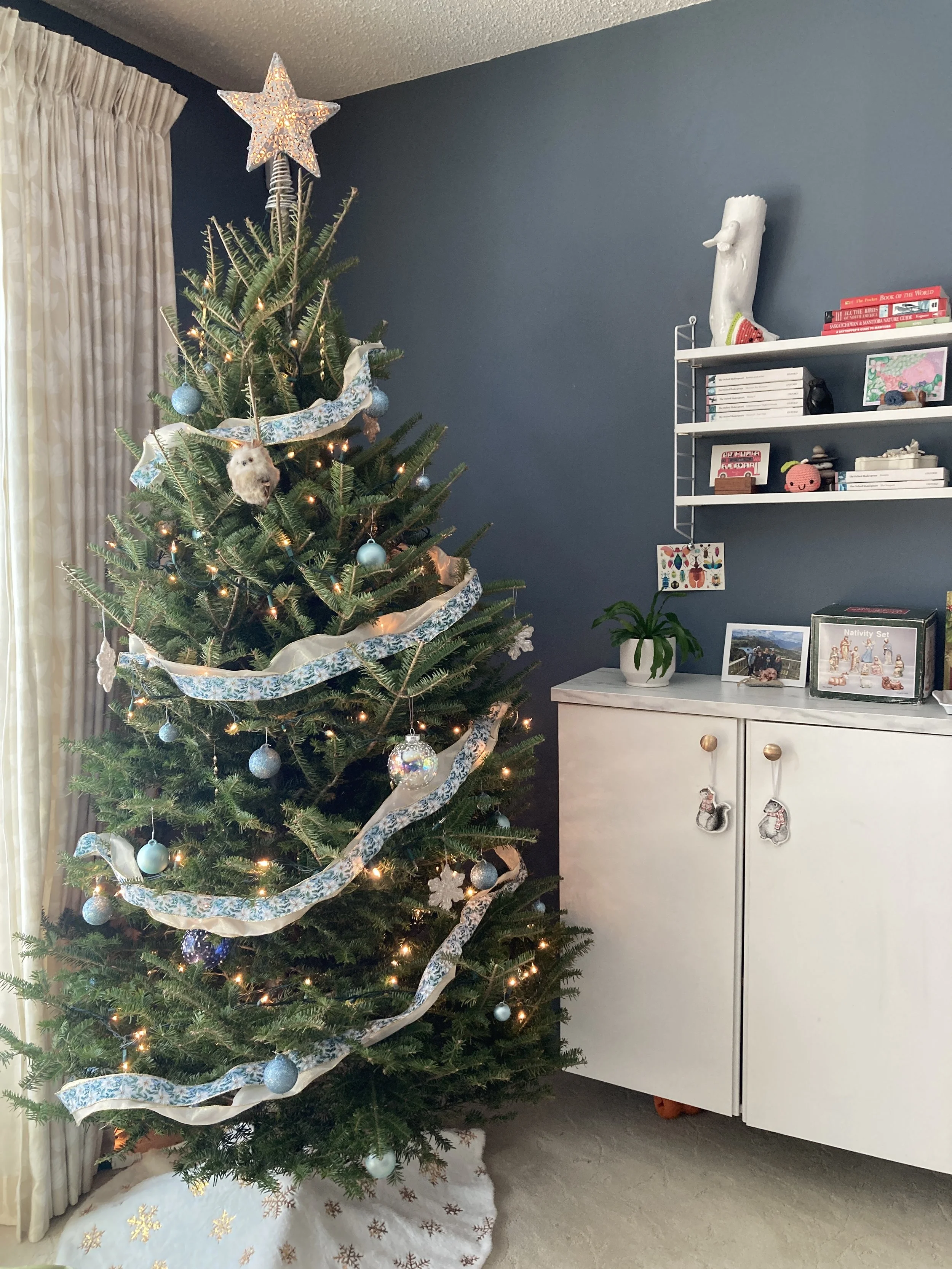
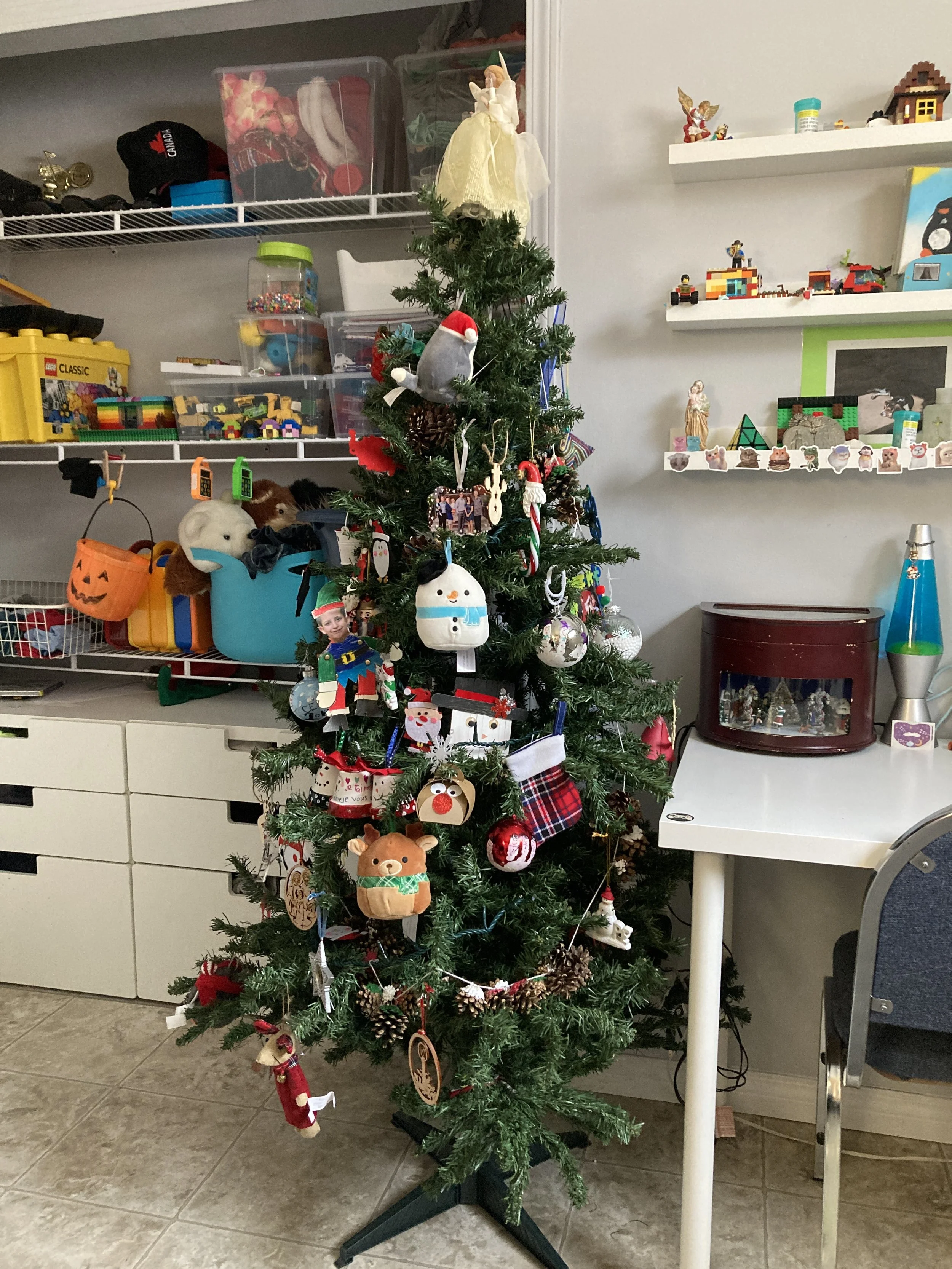
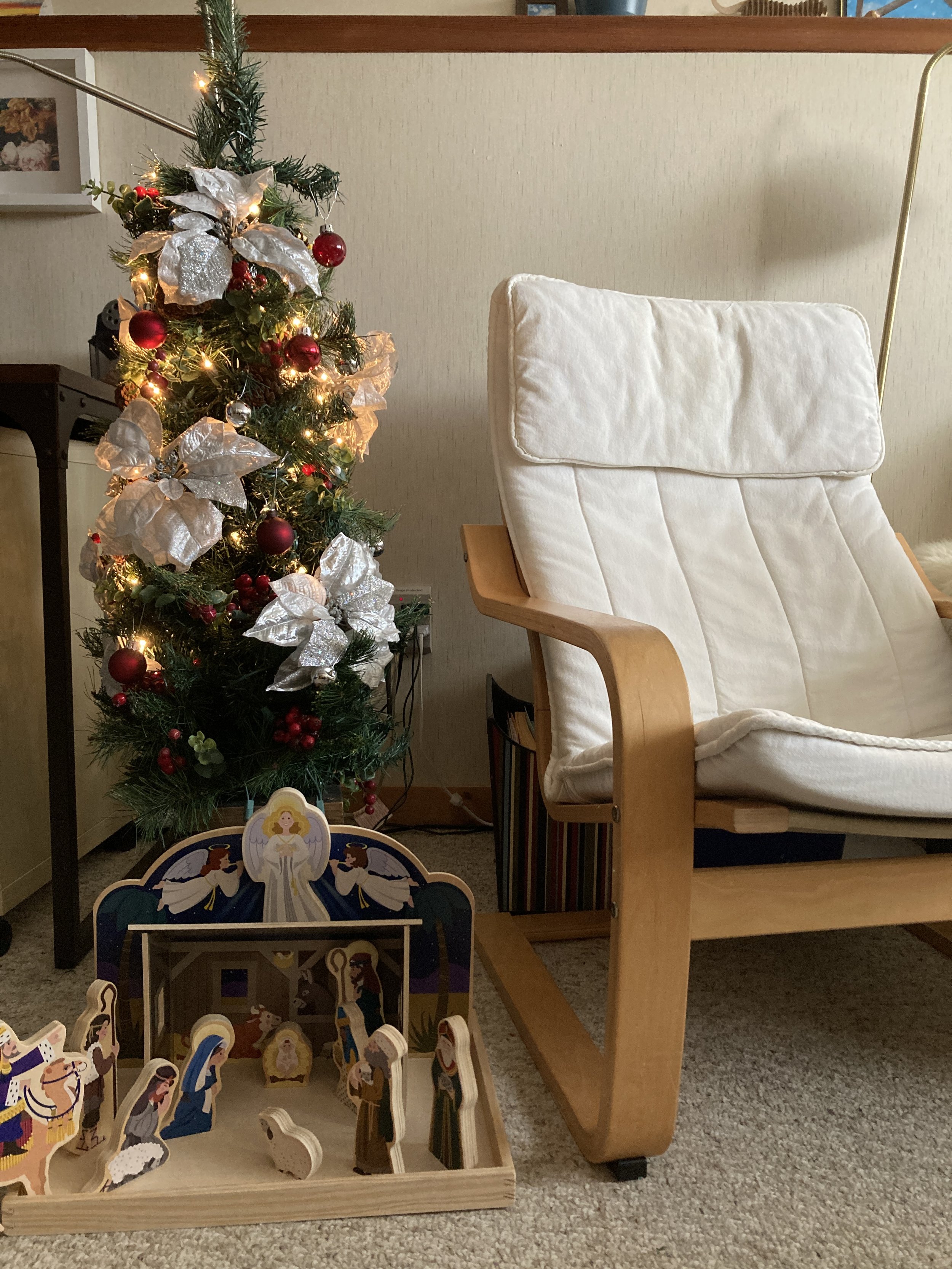
This year, our living room tree was a live one, bought all wrapped-up from Home Depot. I decorated it very simply in blues and golds. But our house features three additional trees… Marie-Hélène’s pencil tree, the boys’ room tree, and the downstairs mini tree.

Reading review

Looking over the 20-some titles of books read in 2025 reminds me of the books I enjoyed… The year began with Matar Hisham’s memoir The Return (mentioned here) and continued with William Finnegan’s Barbarian Days (no. 10). And so impactful for the conclusion it drew, was Katherine Boo’s Behind the Beautiful Forevers (no. 21).

But I didn’t just appreciate Pulitzer-Prize winning books… I also liked the books that taught me something, just by being stories set in a different time, in a different place. With my daughter, I read Betty Smith’s A Tree Grows in Brooklyn and was delighted when an edition of Rob Stephenson’s “The Neighbourhoods” included a picture of the author’s house (here). In the same vein was Kamel Daoud’s novel Houris, containing accounts of the civil war in Algeria. This year I started listening to audiobook versions of French novels just to keep my ear trained to good language. The effects overflowed one day when my daughter said “Why are you speaking [so much] in French? It’s weird!”

Media

Like any typical pop culture consumers, the year’s streaming included Severence and White Lotus, The Night Agent, Adolescence, Friends and Neighbors, The Eternaut, The Wrong Paris and My Brilliant Friend (and the associated documentary). Also Kneecap, Slow Horses and Pluribus. We went to the theatre for Anora and One Battle After Another. But in the last month or so, we discovered that it’s especially relaxing on a Sunday night to just sit and read and stream a live fireplace instead. It took an extra effort, a little push in that direction to commit to doing it, but during the holidays, having finished the first season of Pluribus, we found ourselves reading several nights in a row.

Eating out

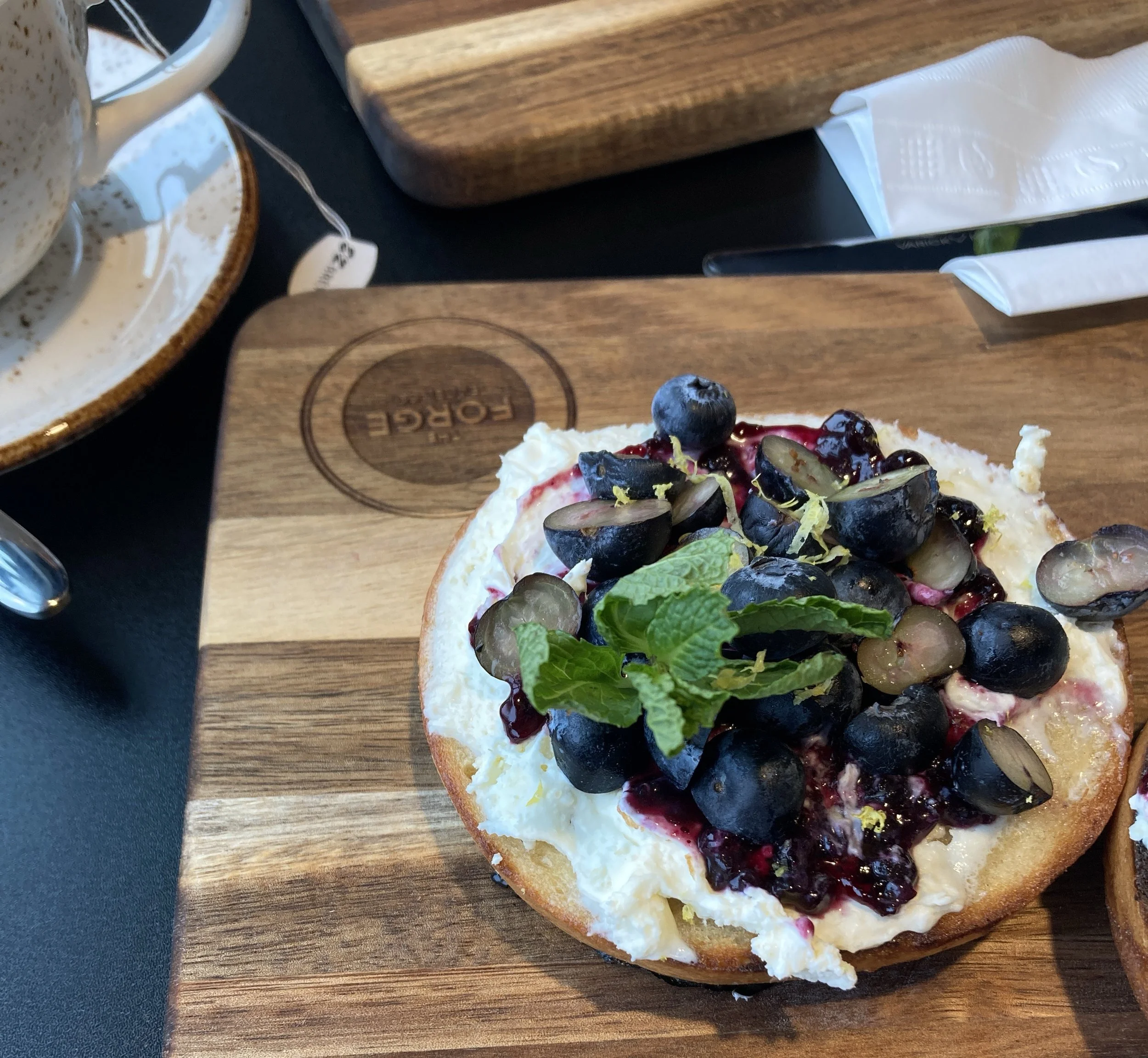
New lunch spots tried with friends this year included: Nicolino’s on Pembina, Bonnie Day on Westminster (so cute and cozy!), Dave & LaVerne’s on Lakewood (really nice customer service!), Next Door (I liked their mango jam!), Le Croissant (a deservedly busy spot!), Primo’s Deli (come hungry!), Buvette (Mmm, that Hashbrown Breakfast Sandwich…), Gather (sorry, the word “outstanding” comes to mind… it was unexpectedly my favourite of the year) and The Forge. At The Forge, I had a Polish Double Malt served as a Devonshire Cream Open Face - Blueberry Patch and it looked - pardon my poor photo skills - like this:

It was delicious.

Thanks 2025

To a year that has taught me: in the happiness of finishing a thesis, a deep appreciation for history; in the confusion of A.I., a love for the soul of craft; and in the ordinariness of life, the steadiness and reward of wholesome routines. Here’s to more of that, to still “refusing to lose your own sense of purpose”!

Happy Sunday!
A Week on Sunday (no. 41)

Reading

Contrast can serve to highlight appreciation for something and this was the case when I was reading Bonnie Tsui’s book On Muscle, and also reading a short story collection by Tatyana Tolstaya. In “Serafin” Tolstaya writes from the character’s point of view of disdain for humanity: “Fat is nauseating muck. The whole world of flesh - is fat. Fatty, sticky children, fatty old ladies, fatty redheaded Magda.” (p 48) But Tsui, focusing on muscle, delves into its various intricacies with an infectious appreciation. Here is a collection of quotes from the book that I liked:

Being a writer as well as a lifelong athlete, I can’t help but notice how language is telling. Muscle means so much more than the physical thing itself. We’re told we need different metaphorical muscles for everything: to study, to socialize, to compete, to be compassionate. And we’ve got to exercise those muscles - putting them to use, involving them in a regular practice - for them to work properly and dependably. (p 4)

The way you build muscle is by breaking yourself down. Muscle fibres sustain damage through strain and stress, then repair themselves by activating special stem cells that fuse to the finer to increase size and mass. You get stronger by surviving each series of little breakdowns, allowing for regeneration, rejuvenation, regrowth. (p 5)

In big ways and small, life is a movement-based relationship with everything around us. Muscles make my fingers fly across these keys, knit my brow in concentration, correct my seated posture, shift my gaze to the window, square my shoulders, tap out the rest of this sentence. So much has become virtual, and yet my body still very physically influences my thoughts even as it conveys them to you. Your own muscles allow your eyes to take this in, to blink thoughtfully and tuck your chin in hand and tilt your head in consideration. We haven’t said a word, but our bodies are talking to each other - even through the page (…). (p 12)

Exerting our influence on the world: That’s the modern-day definition of a flex. (p 13)

Maybe that’s what makes some people uneasy: muscle as potential. And sometimes we don’t know our own power, until, finally, we are given the opportunity to discover it. (p 27)

For all its nobility, the pursuit of mightiness remains grounded in the body and all of its appetites. But the strength community’s insatiable curiosity about the human body is something I find surprisingly moving. To know one’s own strength: I’ve come to understand the meaning of these words not as a binary statement, an “I do” or an “I don’t,” but as an ongoing process of discovery. Muscles matter - they allow us, in an observable way, to see what we can do. Though you may not initially know what you’re capable of, you have vast reservoirs of potential, waiting to be tapped. For just the right moment to be revealed. (p 44)

(…) there is a process in place for human donor dissection, and with that process comes a reverence that helps you to understand the privilege of getting to look. Head, hands, and feet are wrapped before dissection. And at the end of every academic year, a special memorial is held (…). (p 52)

Interoception is your body’s ability to sense itself from inside. (p 142)

All these quotes show a respect for the human body that the character in Serafin does not want to see and both writers make their point with the deft use of language. Words can be so strong…

Cards

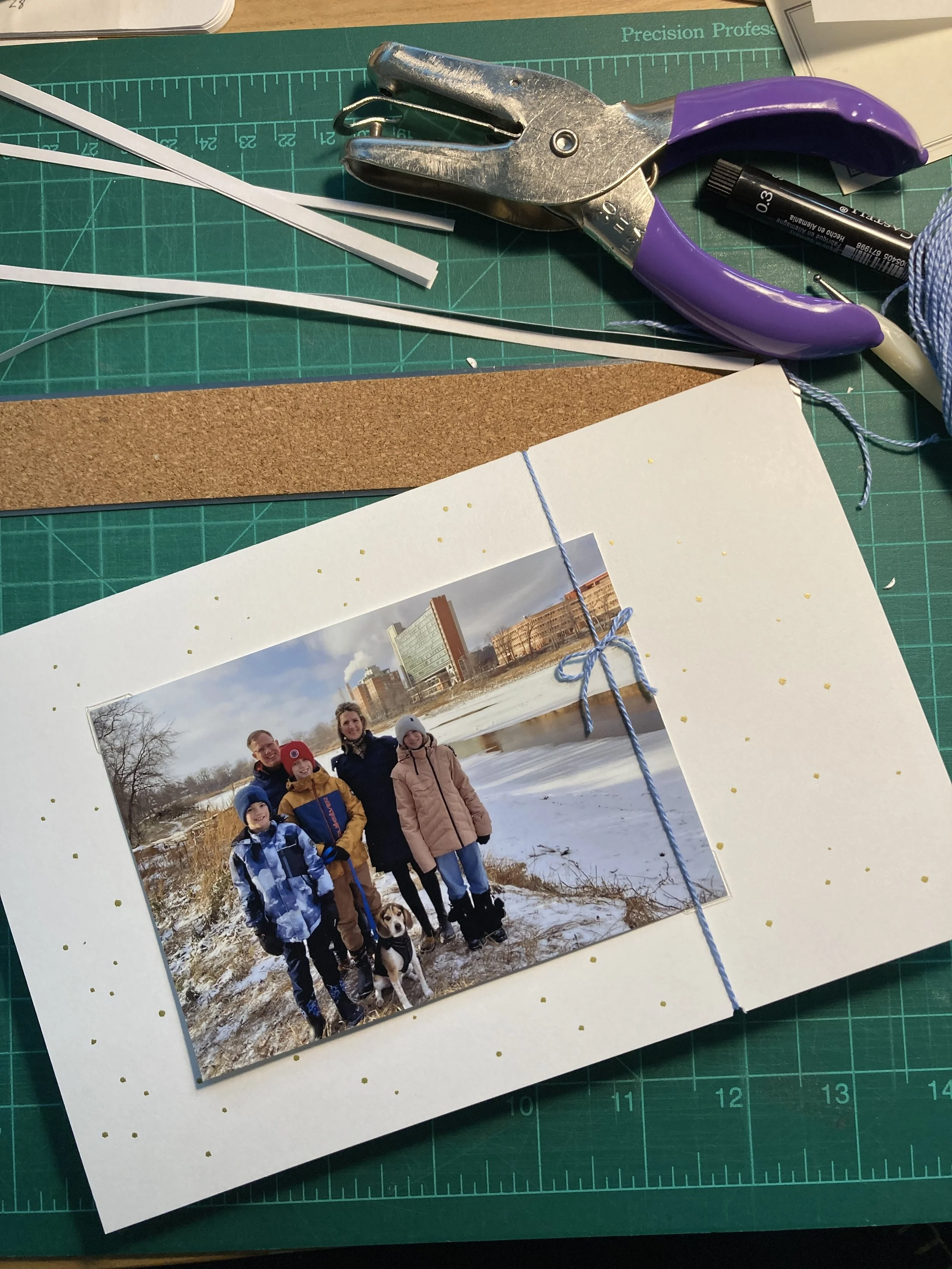
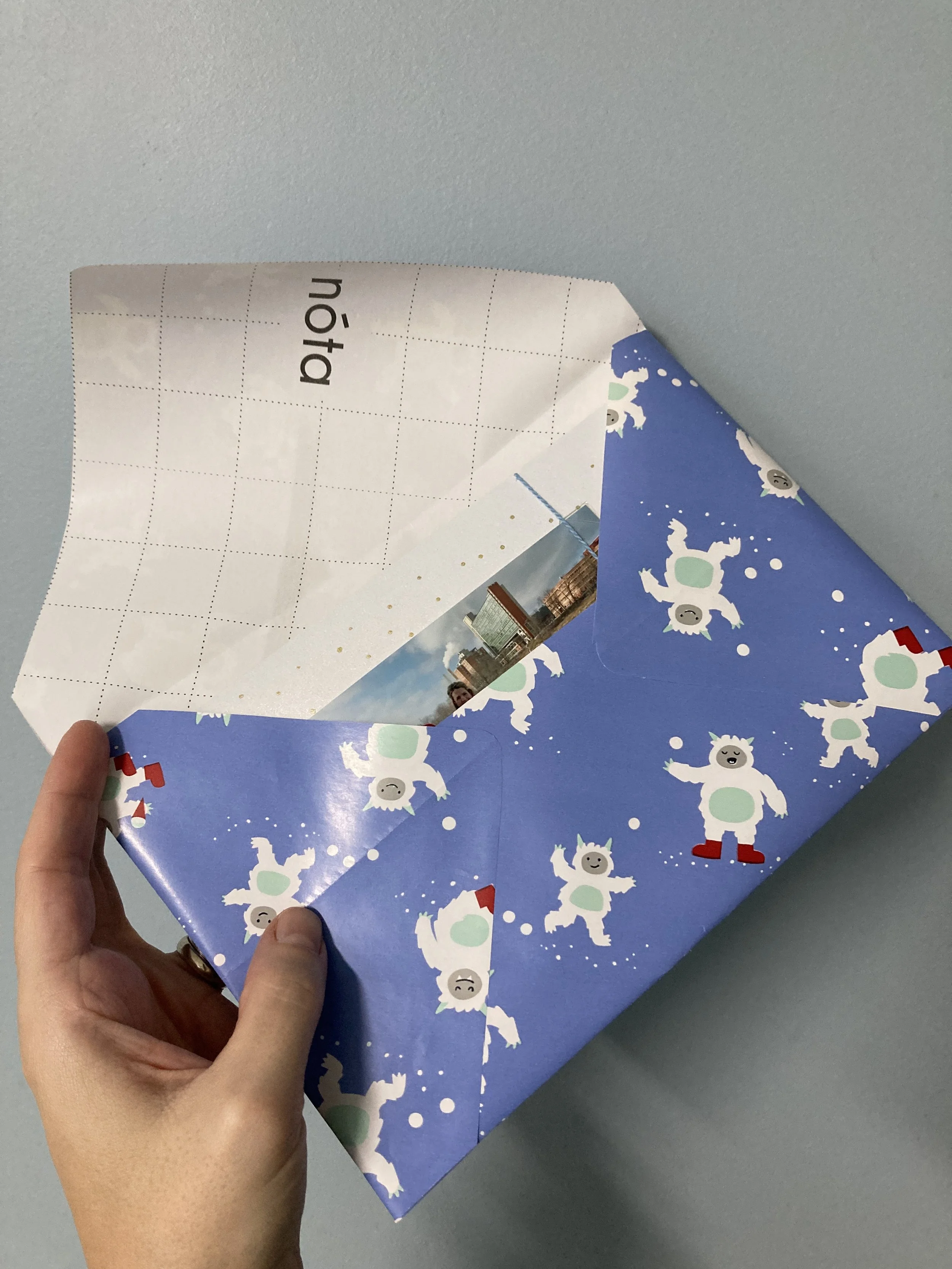
Cards are divisive. The postal service has only to go on strike for a debate to flare up dramatically in the news. Cards are important. Cards don’t matter… Cards take time. My grandma could dash off a stack of 80. Or was it 100? But cards are like everything else: cookies and food and Christmas trees…  home-made or store-bought or real or fake. There are hundreds of permutations for celebrating Christmas and just as many ways of dispersing one’s energy for this demanding season. And so with all that in mind, juggling our own list of pros and cons, I made this year’s Christmas cards by hand and cut the envelopes from old wrapping paper. (This envelope tutorial was perfect!) At a time when AI is spinning reality to ever greater heights of improbability, a return to basics felt reassuring and solid. (I think this is what B. Dylan Hollis is getting at in his appreciation of vintage cards here on Instagram.) 

Baking

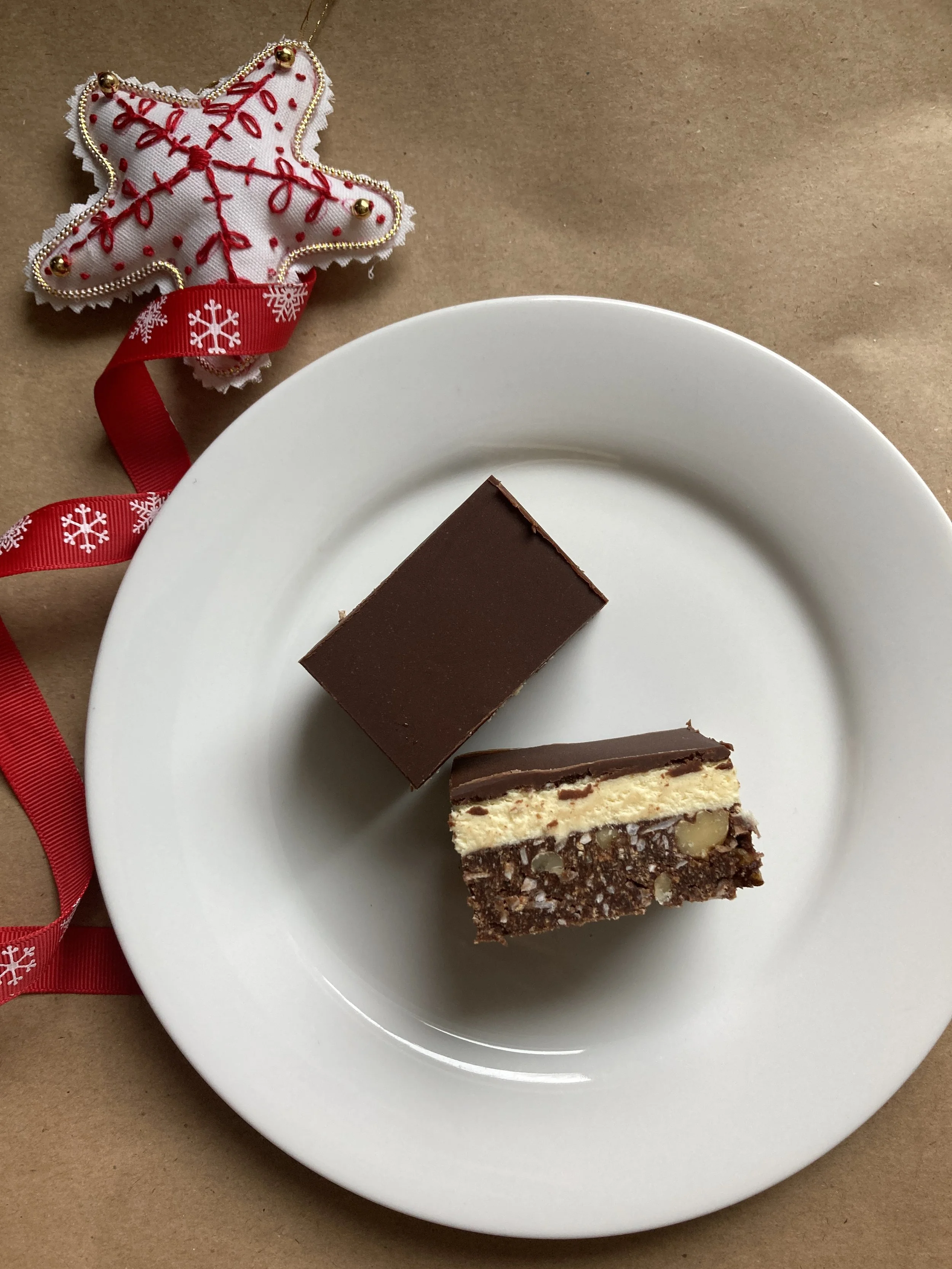
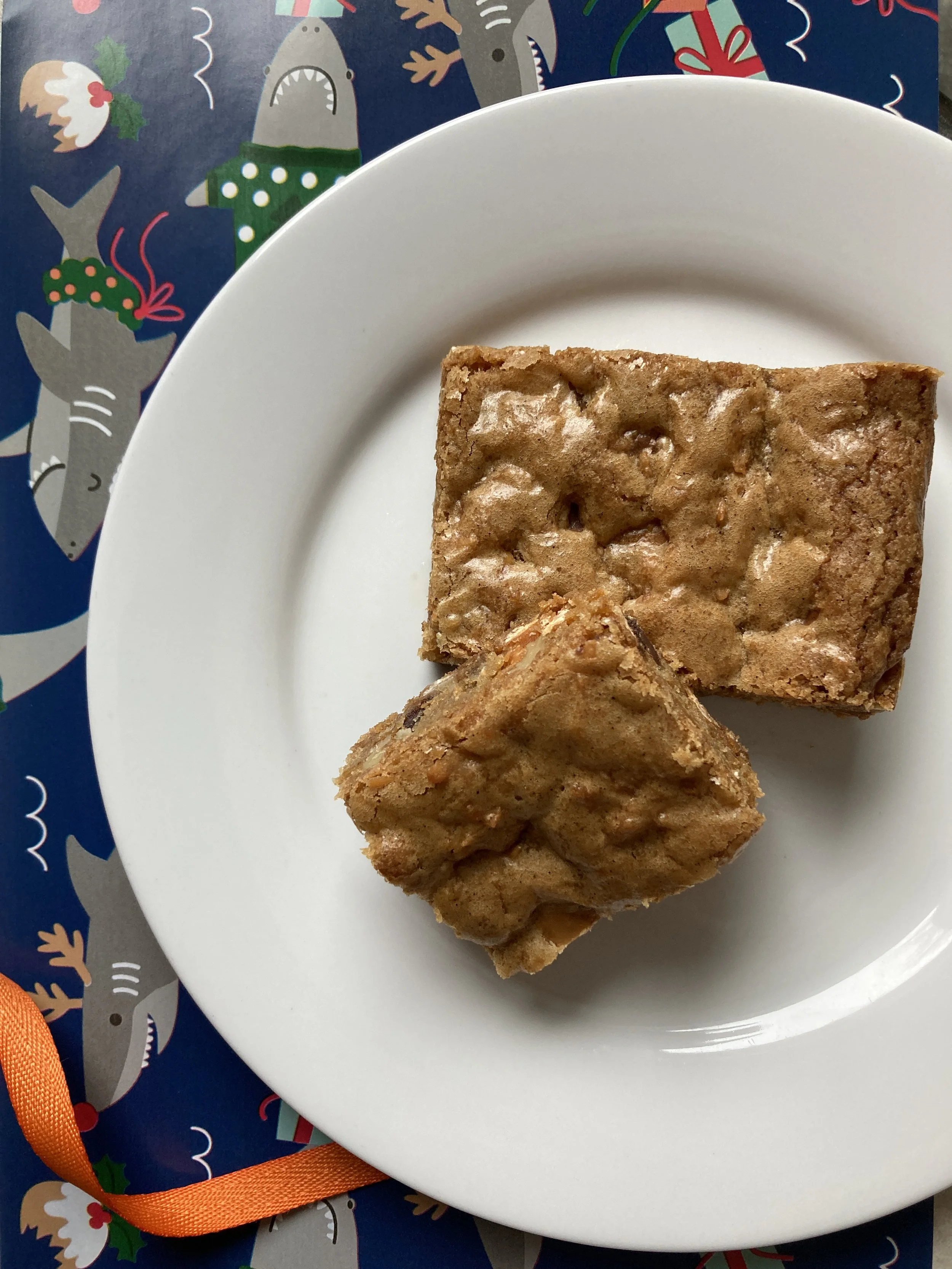
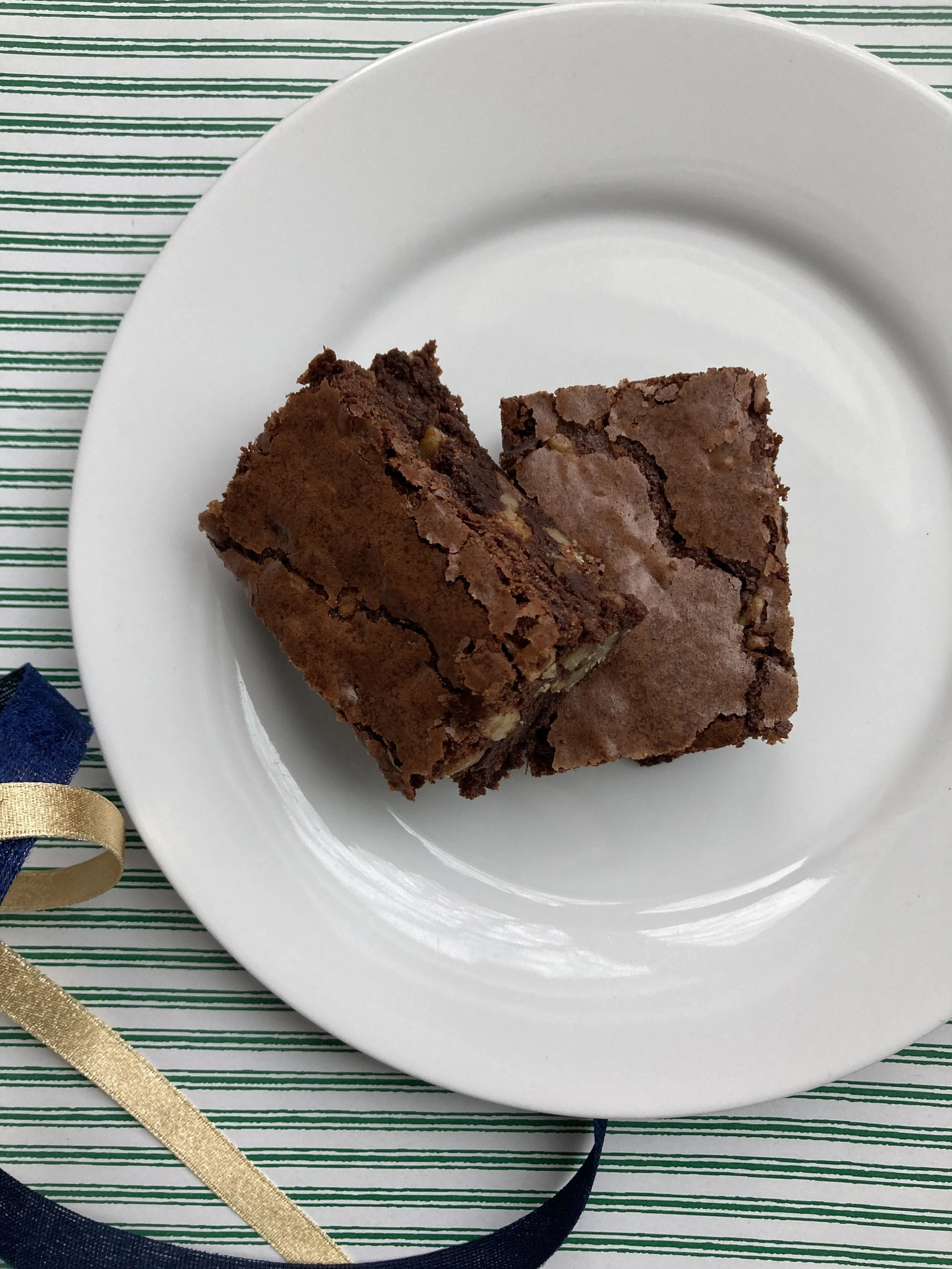
There’s a Nanaimo bar chilling in the fridge, but earlier this week, I tackled the start of this year’s baking with blondies and brownies…

Eating

Making things a little less demanding in the kitchen while I concentrate on cards and baking, are old favourites, like Jamie Oliver’s “Mini shell pasta with a creamy smoked-bacon and pea sauce.”

Postcards

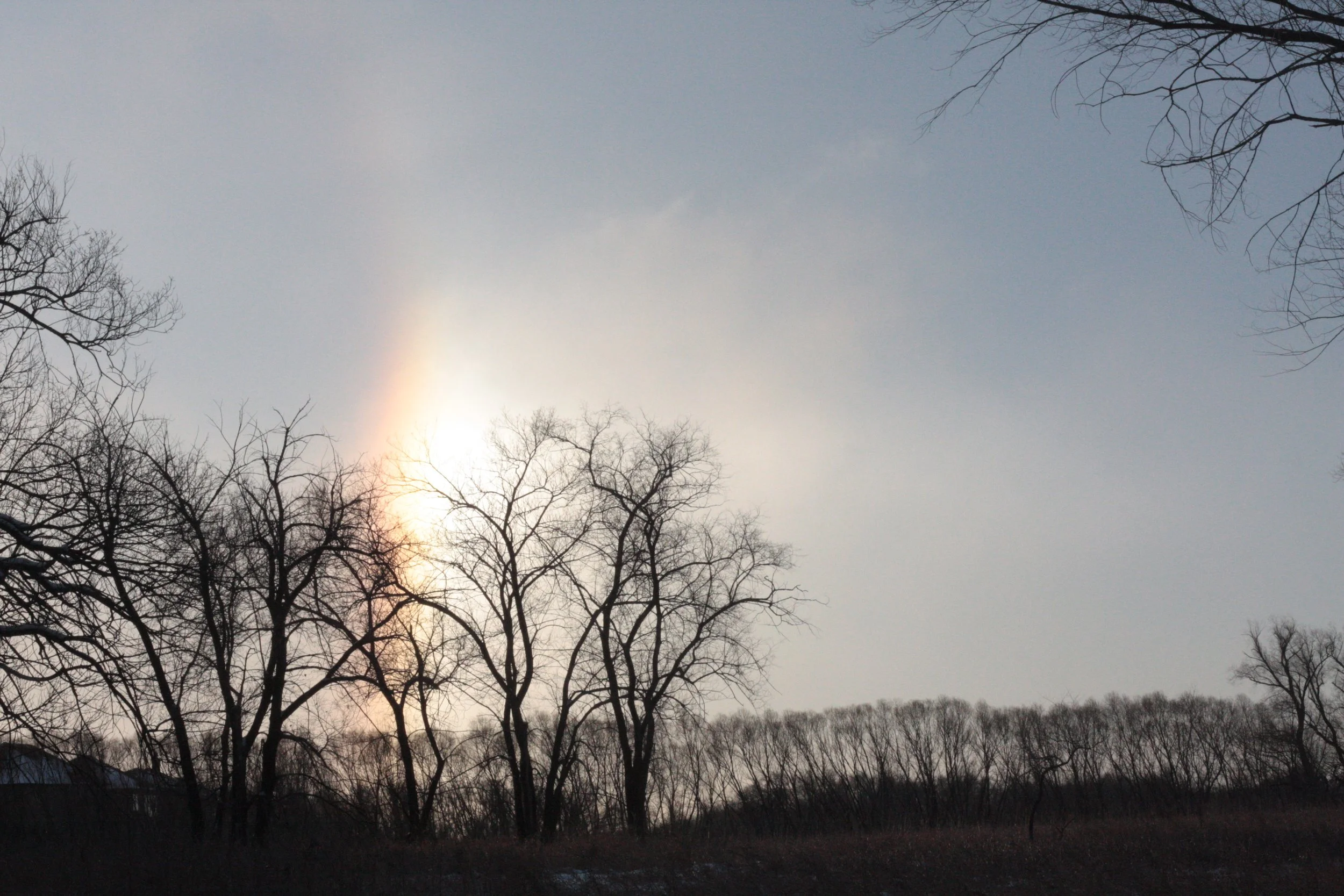
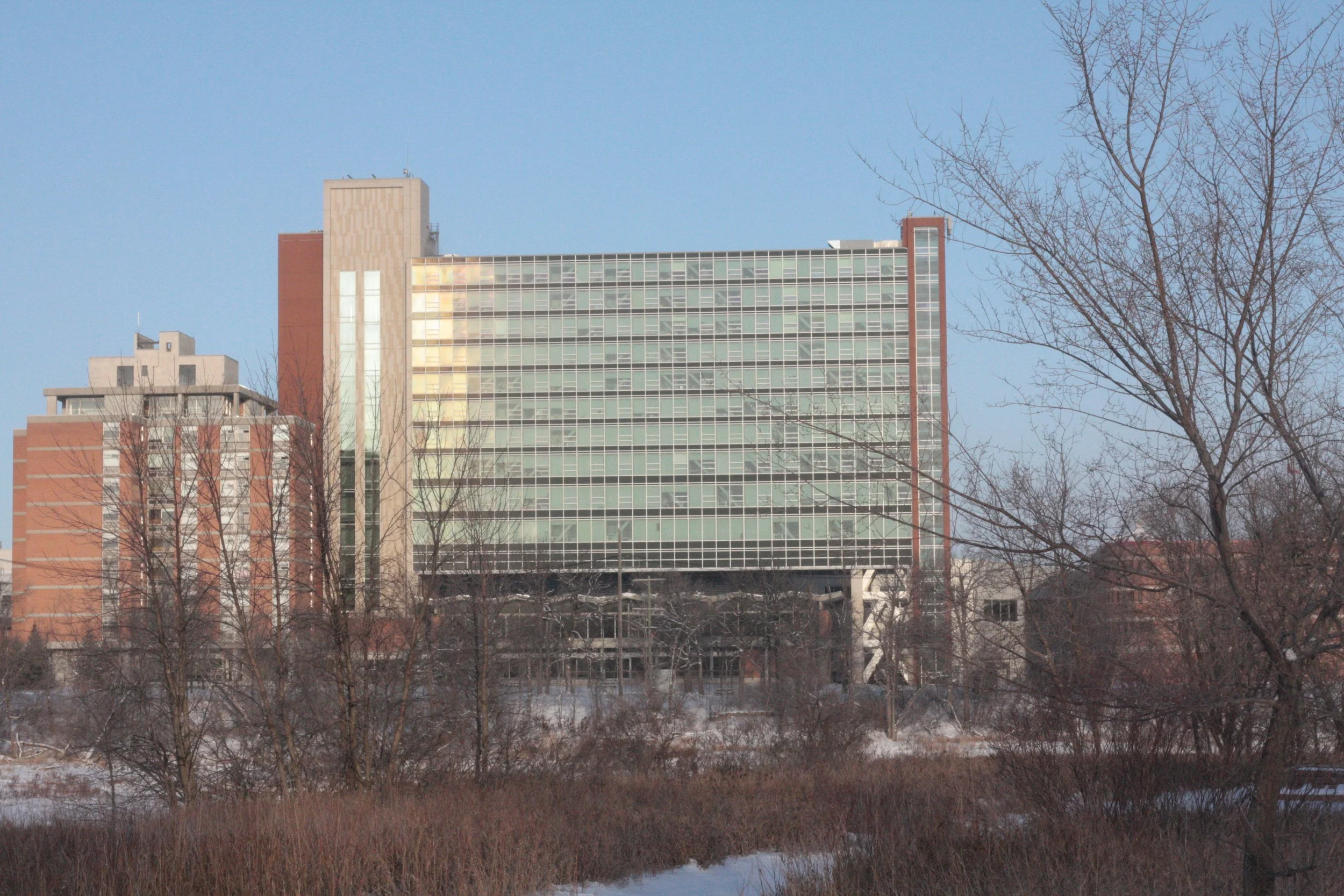
This week, there were two days featuring a sundog in the sky, and Friday’s was so big, it reflected itself on the windows of the U of M’s Pembina Hall student residence.

Happy Sunday!
A Week on Sunday (no. 40)

Teaching myself to swim

Friday was the tenth time I put on a bathing suit, cap and goggles and slid myself into a city pool with the firm intention of getting over my fear of water. As an experiment, it has been going well. My goal is to be able to swim laps with Christian. Meantime, I stay in the shallow end, learning buoyancy, while he goes back and forth and tests ever higher diving boards. I think that an account is due, a little summary of the impressions I have of the experience so far, before I forget what learning to swim felt like.

An unexpected feeling. I’ve learned that there’s a distinction between feeling “enthusiasm” for something and feeling “invigorated” by something. An idea can create enthusiasm, but it can be temporary. Its definition associates it to speech: “she enthused” or “she spoke enthusiastically”. By contrast “invigorate” feels more stable and less superficial. It is “to impart vigour to; to fill with life and energy; to strengthen, animate”. I’ve had ideas for projects in the past, talked about them, felt enthusiastic, and fed myself on other peoples’ reaction. But it quickly wears out. Having a practice, like writing or drawing, has taught me persistence beyond the idea-phase because I can see that incremental improvement happens over time, despite feelings of impatience. 

One of the first instructor’s advice I followed was Kaitlin Frehling’s video. It begins by teaching buoyancy. I wasn’t able to follow her instructions until the third visit to a pool, but finally being able to gather myself into a ball while gently exhaling under water and feeling my back bob to the surface was a brand new sensation I was thrilled to repeat and repeat. My brain forgot to be okay with this feeling by the next visit, but picked it up again fairly quickly. Feeling this happen and observing the brain learn was very invigorating!

Learning technique. Swimming is so technical that breaking it down into steps is a little puzzle on its own. There is theory and application… but a big part of learning how to apply something is learning how to digest it in pieces that don’t lead to overwhelm. When I told my sister I was teaching myself to swim, she asked me why I didn’t just take lessons. The thing is, a big part of learning to swim is just getting over my own fear of the water… I understand technique quite well, and there’s a plethora of Youtube videos for every kind of technique. 

Videos that don’t break down technique are instructive in their own way. Take “Learn to Swim as an Adult” which compresses into three episodes Harry getting over fear of water in the first, learning front crawl in the second, and going at it in the deep end in the third; all within a month. The instructor is encouraging, and Harry is a good sport, but there looms over this production a feeling of “Ugh, why won’t this just come together?” expressed in Harry’s comment “it is frustrating…”. The technique is there, but really, what Harry needs, and what the Youtube channel doesn’t specialize in showing, is a whole bunch of time dedicated to getting comfortable with being in the water. I suspect that actual footage of an adult learning to swim is boring. More fun for the viewer is the exciting montage you tend to find in movies. More useful for the adult learner are the techniques that can be applied visit to visit. The two objectives are at odds in the above example, but there are other instructors who target their audience well by giving them very small steps to try on their own.

Pausing here to acknowledge fear. I want to take a minute to appreciate various sources of encouragement… Articles like Alexandra Hansen’s “Learning to swim as an adult is terrifying, embarrassing and wonderful” for The Guardian or videos like Dan Swim Coach’s “How to Overcome Fear of Water” and Sikana’s “Overcome a fear of water” treat this feeling seriously. They also emphasize the key to overcoming it by exposure. Exposing myself to water again and again and again is a small doable step and I’m happy after every time I take it.

Breaking down technique into small and smaller steps. I’ve mentioned Kaitlin Frehling above, and have used the PDF “Beginner Swim Resource” illustrating routines you can do to learn to swim, as a guide. But I do have a slower pace… For example: week 5 workouts introduce a swimmer’s snorkel. I’d never tried a snorkel before, and I had to confront the sensation of water in my nose. I’d been avoiding this by gently breathing out of my nose underwater and not just holding my breath. The first attempt - my 7th visit to the pool - I had to get past the panicky feeling. Between weeks 7 and 8 I watched Youtube tutorials (this one and this one) on snorkel use. Pool visits then included time gradually getting used to breathing with a snorkel for 2, then 4 then 6 lengths, with flippers and then without. But I don’t begrudge the extra time I’m taking, because there’s no one to impress but myself. 

Supporting local We visit our favourite city pool Friday evenings and it feels nice to be connected in this way to a service we now support. We’re starting to recognize regulars, becoming ones ourselves… And I found swimming gear I needed from a local business called Swimming Matters. All these things are motives for gratitude!

Reading

I think the book 1177 B.C. by Eric H. Cline was recommended by a podcast guest for its final chapter detailing the collapse of civilisations and the end of the Bronze Age, because of the “eerily prescient” (in Adam Gopnick’s words) conditions it highlights.

Personally, I liked the difference between then and now that the author highlights in this passage: 

I should hasten to add that, although it’s clear that climate change and such factors as pandemics have caused instability in the past, there is at least one major difference between then and now - concurrent knowledge of events unfolding. The ancient Hittites probably had no idea what was happening to them. They didn’t know how to stop a drought. Maybe they prayed to the gods; perhaps they made some sacrifices. But in the end, they were essentially powerless to do anything about it.

In contrast, we are now much more technologically advanced. We also have the advantage of hindsight. History has a lot to teach us, but only we are willing to listen and learn. If we see the same sort of things taking place now that happened in the past, including drought and famine, earthquakes and tsunamis, then I ask again, might it not be a good idea to look at the ancient world and learn from what happened to them? Even if the various problems at the end of the Late Bronze Age were “black swan” events, as Magnus Nordenman has suggested, the mere fact that we have so many similar problems at the present time should be cause for concern.

Enjoying

This definition of taste in a substack by Henry Oliver, written two years ago, is so clear, I’ll likely go back and reread it again.

Baking aspiration

There’s nothing like a baking project to inspire confidence in pulling off your own roundup of cookies at this time of year, and I’ve been enjoying Justine Doiron’s cookie advent-calendar she made over four (!) days. (On Instagram here.)

Postcard

This week: snow on the river!

Happy Sunday!
A week on Sunday (no. 38)

Reading

Another book done from the reading list! This one a tiny book of short stories, titled Escapes, by Joy Williams. Reading her, the sensation of the short unexpected sentences in my brain is like eating popping candy... The writing seems to fizz.

From a story titled "Rot": "The Aquarium was where a baby seal had been put to sleep because he was born too ugly to be viewed by children." (p. 17)

"Health" so acutely described a tanning salon that I was jolted into the memory of having gone to one with Christian, some weeks prior to our wedding so we'd look attractively tanned for the pictures... "Aurora leads her to one of the rooms at the rear of the building. The room has a mirror, a sink, a small stool, a white rotating fan and the bed, a long bronze coffinlike apparatus with a lid. Pammy is always startled when she sees the bed with its frosted ultraviolet tubes, its black vinyl headrest." (p 115)

Perhaps my favourite passage is a character's thought about overheard conversation: "Pammy coughs. She doesn't want to hear other people's voices. It is as though they are throwing away junk, the way some people use words, as though one word were as good as another." (p. 119).

A fun read!

A poem

This is a beautiful poem: "Miss You. Would like to take a walk with you". It is by Gabrielle Calvocoressi. Here on the Poetry Foundation website.

Part of me wants to leave the poem like a gift on a doorstep with the secret anticipation of the recipient enjoying it. Another part of me wants to confess that until reading it, a poem had never made me cry. I didn't believe, till now, that poems could contain this power. It's like a little gift that arrived, that proved Patti Smith's description of a poem to be true: "… it can distill everything like a teardrop. If you’re thirsty and you get that drop of water, it suddenly becomes like a liter of water. Then you’re satisfied." (Quote taken from Patti Smith's interview here.)

AI and history

I've held the misguided belief that AI couldn't do much for the archival work inherent to the field of history, but a recent interview on Hard Fork with Professor Mark Humphries is proving that AI might become very helpful. Humphries has a substack on the subject here.

Eating

Sometimes a meal is less about the recipe and more about the pairing. This week, we tried Deb Perelman's Skillet Macaroni and Cheese - liberally messing around with the quantities of pasta vs sauce because we're not a creamy-sauce-loving family - and paired it with an almost virtuous broccoli salad by Jamie Oliver.  (See here.)

For dessert, I made these Pink Party Cookies, per my daughter's request... "Could you make a sandwich cookie, but with icing in between?" It was subsequently so fun to come upon Carla Lalli Music's recipe.  The thing with her cookbook picture, is that I suspect the saturation is heightened. If you "bake until there's a barely perceptible tint of light golden around edge, 8 minutes. Do not overbake." it yeilds a pale cookie. Mine looked anemic by comparison. But still delicious!

Postcards

This week... a look upwards, to the pretty leaf outlines of a willow tree.

The lovely golds and browns and reds…

And the dog…

Happy Sunday!
A Week on Sunday (no. 36)

I love history

When I was 20, I didn’t know that I loved history. When I was 30, I had minored in history. Now, past 40, I’m developing opinions about history. Sometimes I wonder whether I should gather all these history-related ideas together into one blog post, but I think not. I’m thinking as I go… isn’t it better to be invited on a hike and admire the view as you go along than to have a friend present you with with an album of their souvenirs? Blogging is like inviting you along…

I like it when I find myself nodding along with what a podcast guest is saying. This week it was to Paul Kingsnorth on the podcast Honestly with Bari Weiss (here). To establish your values, he argues, you need  “people, place, prayer, and the past”. About the past, you can ask yourself: “What’s your sense of the past, your sense of history? How can you live that? How can you honour your ancestors, pass things on to your children?” I think about this often and enjoy the challenge it presents.

What kind of challenge does thinking about history present? The first one is relevance. When I say relevance, it makes me think of people who say that history is boring and I so I think about the things that make history boring (like cliché) and the things that make it interesting (story) and I glow incandescent when I hear academics broach these themes exactly. I thoroughly enjoyed stumbling upon this interview between Dan Wang and Stephen Kotkin on Youtube (here).  

Cercle Molière

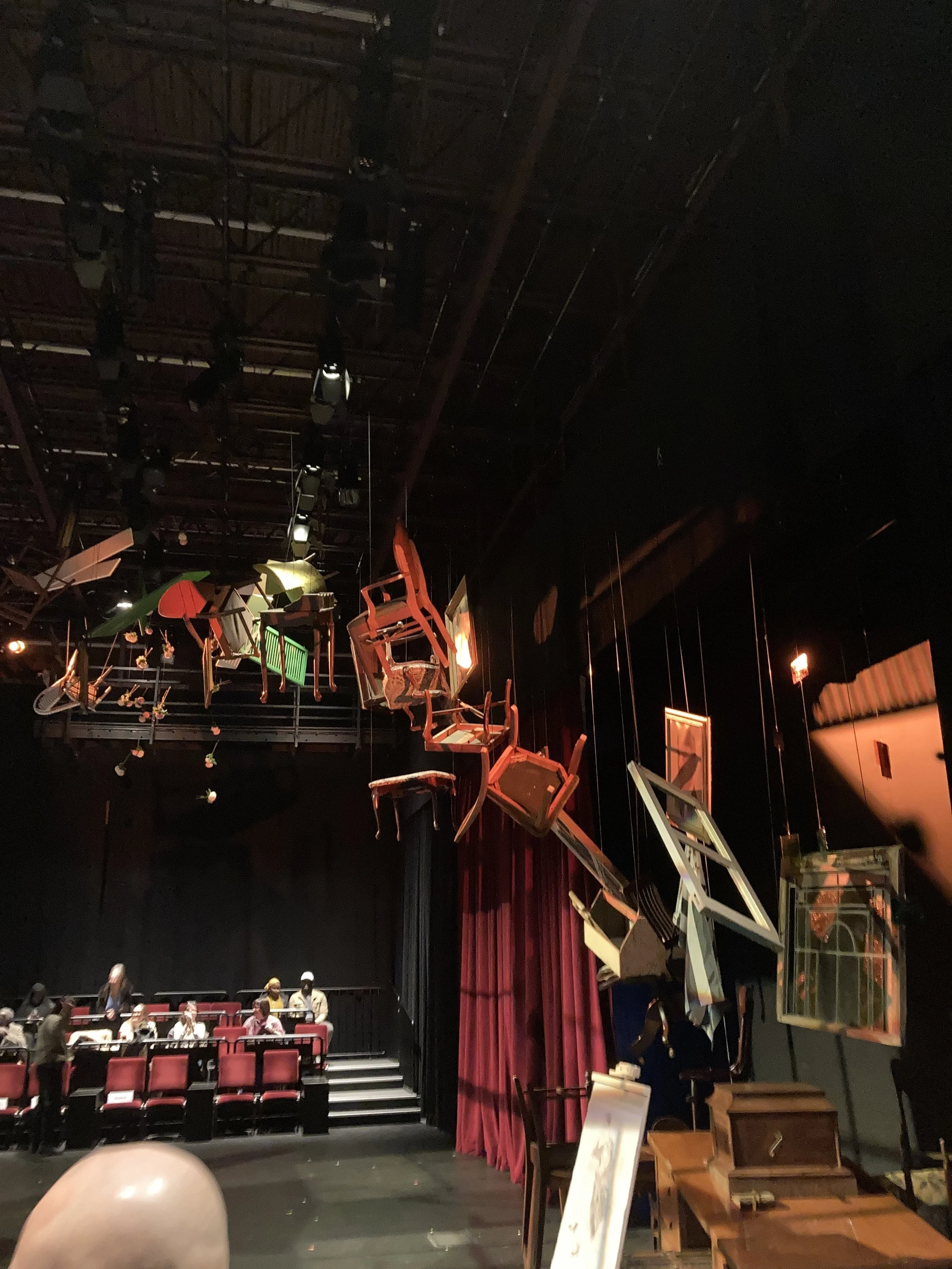
Last weekend we attended a play at the French theatre, the subject of which was Pauline Boutal’s life. (I read her biography earlier this year and I’m so happy I did - I doubly enjoyed the play!)

Going to plays in French was my husband’s idea, and this one was the first of this season… I don’t know why or how I managed to have such low expectations of theatre, but my gosh, I found myself discreetly crying actual tears. The actors disappear after we applaud at the end, and in the emotion of the moment, applause felt too little, too small an act… they deserved hugs! A round of drinks on the house! Cheers to their talent, more cheers for health and a long life!

Reading 

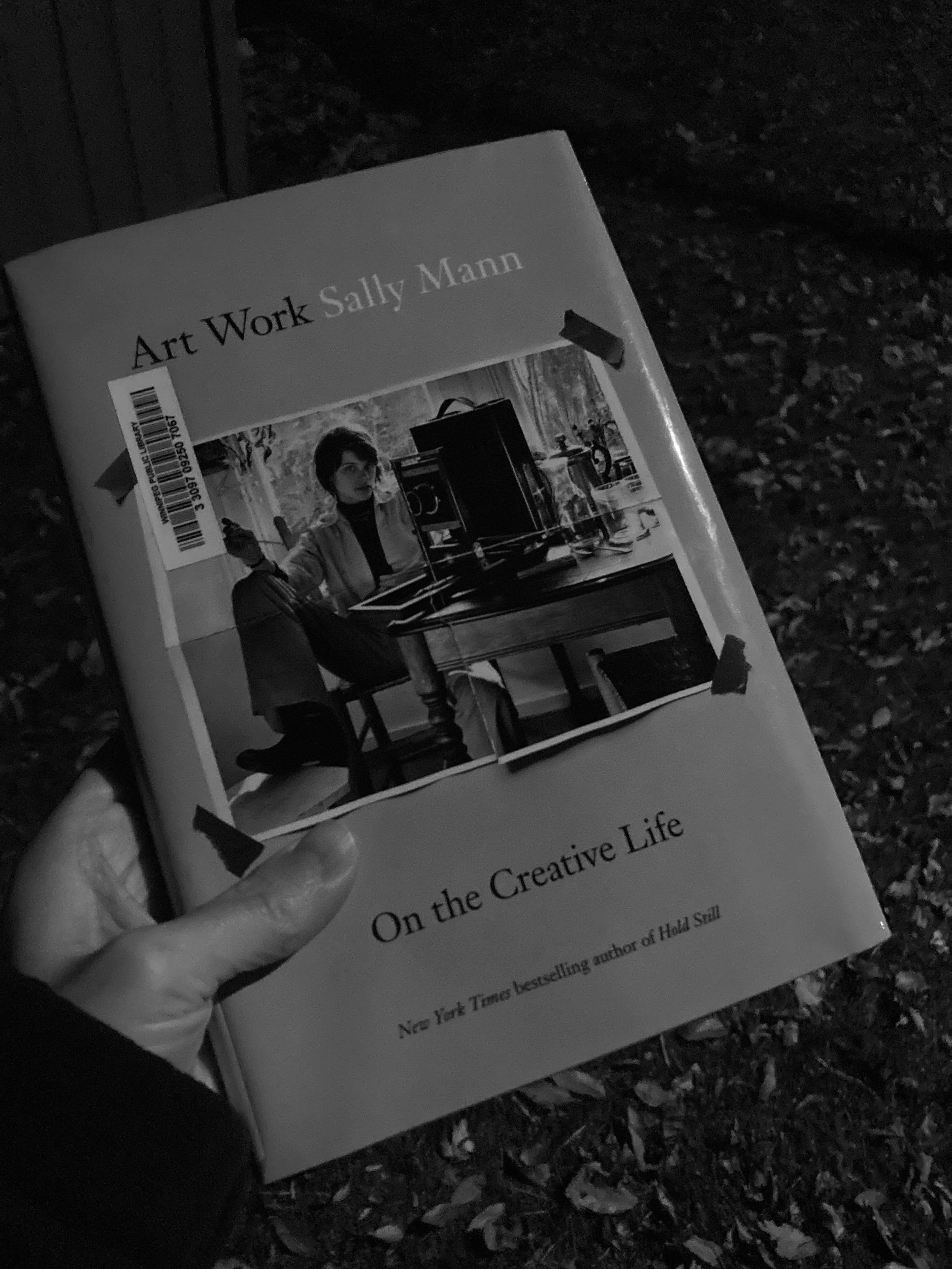
I finished Art Work by Sally Mann. It contains lots of quotes. Lots of lovely-long sentences. Advice given as if she suspected her reader might roll their eyes, but also as if she knew she had the authority to give it (that is, sometimes the tone felt self-deprecating, sometimes haughtily impatient). I liked her stories… the terrible renter fiasco, the incredible trip to Qatar. Dear Mrs. Mann: more stories please? 

The thing is, I really enjoyed reading Hold Still (mentioned here in 2018). The image of a person’s death being like a library burned to the ground has often come to mind, and it’s from the end of that book. She writes:

I have long been afflicted with the metaphysical question of death: What does remain? What becomes of us, of our being? 

Remember that song by Laurie Anderson in which she says something about how when her father died it was as though a library burned to the ground? Where does the self actually go? All the accumulation of memory - the mist rising from the river and the birth of children and the flying tails of the Arabians in the field - and all the arcane formulas, the passwords, the police recipes, the Latin names of trees, the location of the safe deposit key, the complex skills to repair and build and grow and harvest - when someone dies, where does it all go?

Proust has his answer, and it’s the one I take most comfort in - it ultimately resides in the loving and in the making and in the leaving of every present day. It’s in my family, our farm, and in the pictures I’ve made and loved making. It’s in this book. “What thou loves well remains.” […]

Love! The world needs Love!

In the kitchen

This week, I made Zaynab Issa’s “Ultimate tuna melt” from her cookbook Third Culture Cooking and the kids told me not to lose the recipe. Very high praise!  

For dessert: Apple Pudding Cake. Delicious!

Enjoying

Freakonomics podcast is doing another series and I’ve been delightedly pulled-in. All Stephen Dubner’s research into horses has reminded me of when I was young… I read Black Beauty and wanted a horse. I was a child in the middle of Saskatoon with no concept of what horse-ownership entailed. My dad discouraged the idea. He said horses could have a temperament. I figured he’d not read Black Beauty

My mom also liked horses, but from a distance. Her brother had worked with horses. We watched National Velvet together… I knew about the Triple Crown and Secretariat and nothing about The Adams Family. In teenager-hood, I read Monty Roberts’ book The Man Who Listens to Horses (which, in my flawed memory, was titled “The Horse Whisperer” but Google refutes me). Mom and I were fans of people who could perform feats in animal behaviour. Then I grew up and horses left my mind. These podcasts are a nice (current!) revisit to that world!

Writing

Really liked this substack post by Gen Zero titled “Everyone is a strategist and No One is a Writer” (via) especially this concluding bit:

As we focus on how marketing is done, substantive questions of the world itself get sidelined.

Implicit in this focus on marketing is a focus on everyone but oneself.

I’ve noticed oak galls in the past and even mentioned them here but never gave them any further thought. But woah! Wasps are involved! What a lovely substack post! (Via

Christmas approacheth

I admire a person who can make craft projects feel almost un-craft-like. I’m not sure how to explain it except that Naomi Vizcaino - with her references to the past and the originality of her ideas - makes her project ideas feel especially artistic. (TikTok)

Postcards

Here is my dog, not barking at another dog.

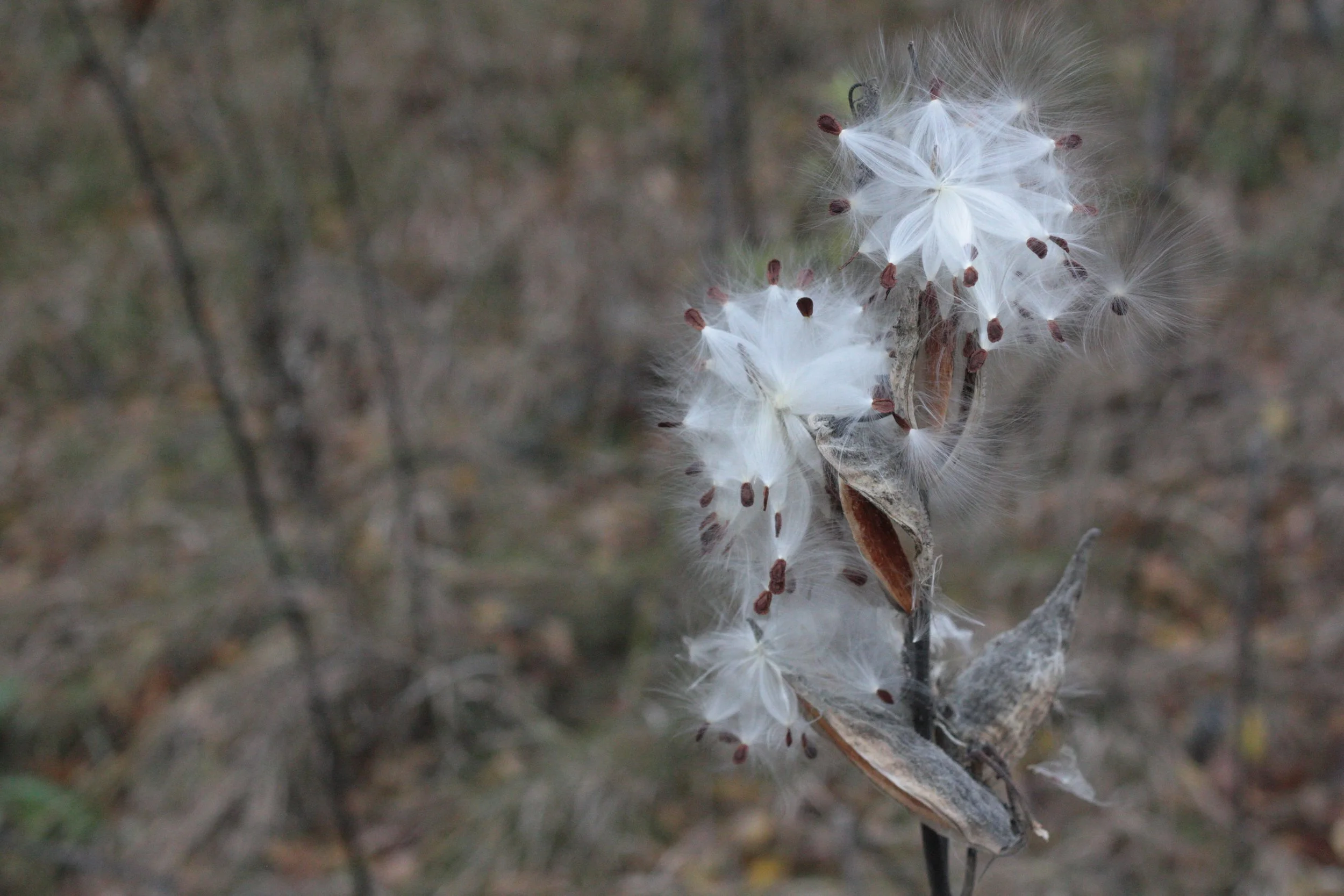
Here is milkweed with floss so soft I think of a grandmother’s hair.

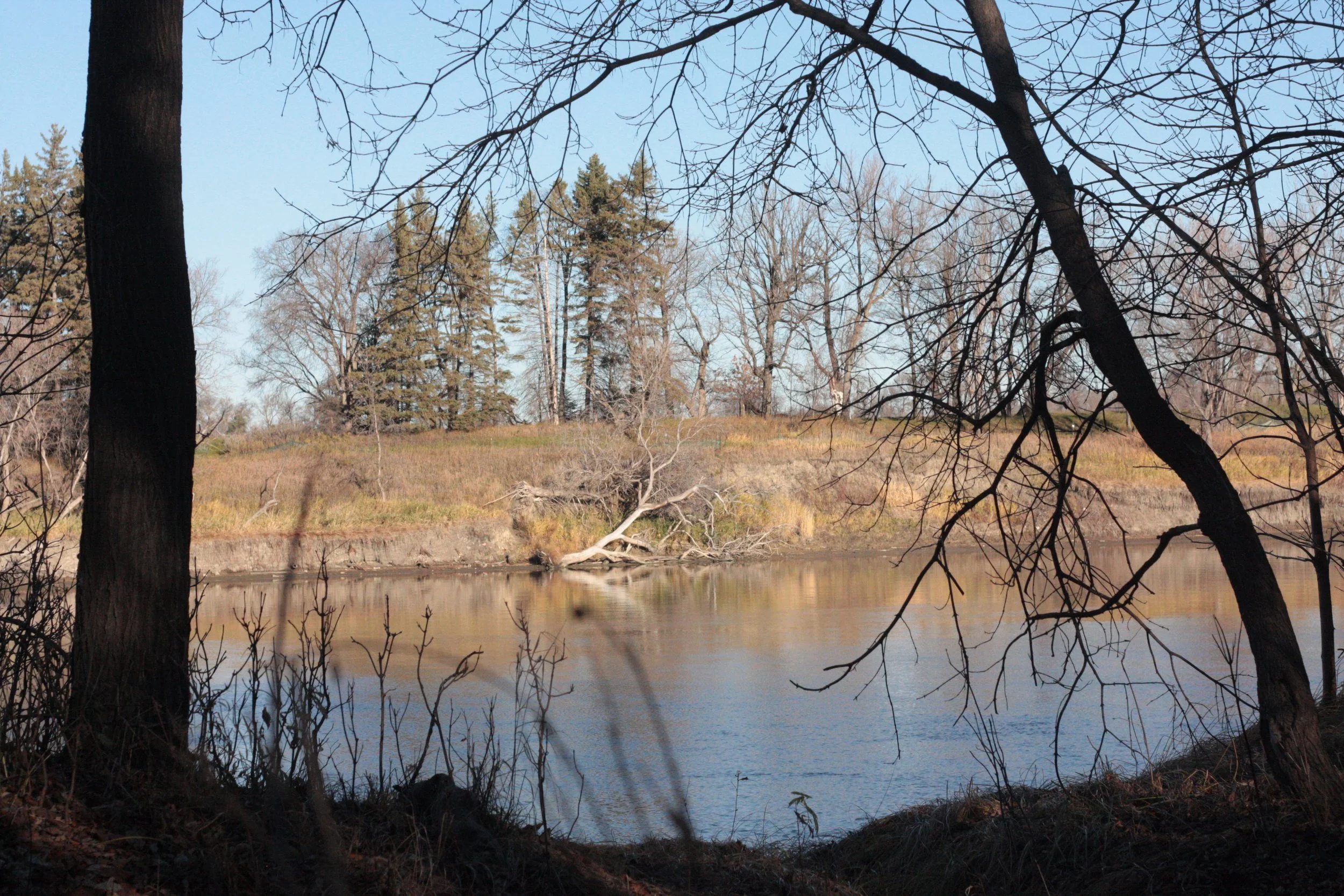
Here is a view of the fallen tree across the river.

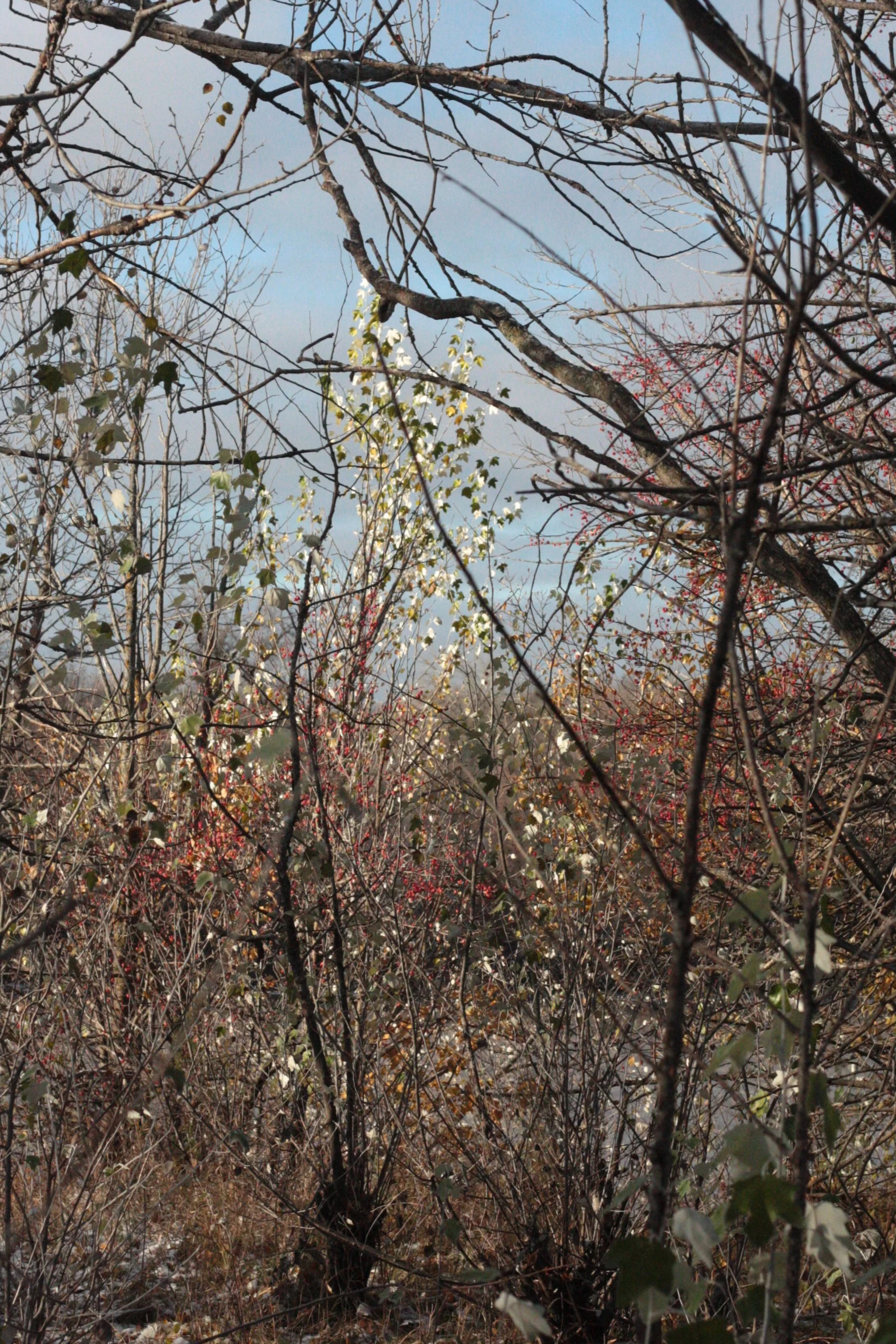
Here, through a tangle of trees, I spy some that seem almost decorated in the sunlight… red berries, leaves that shimmer…

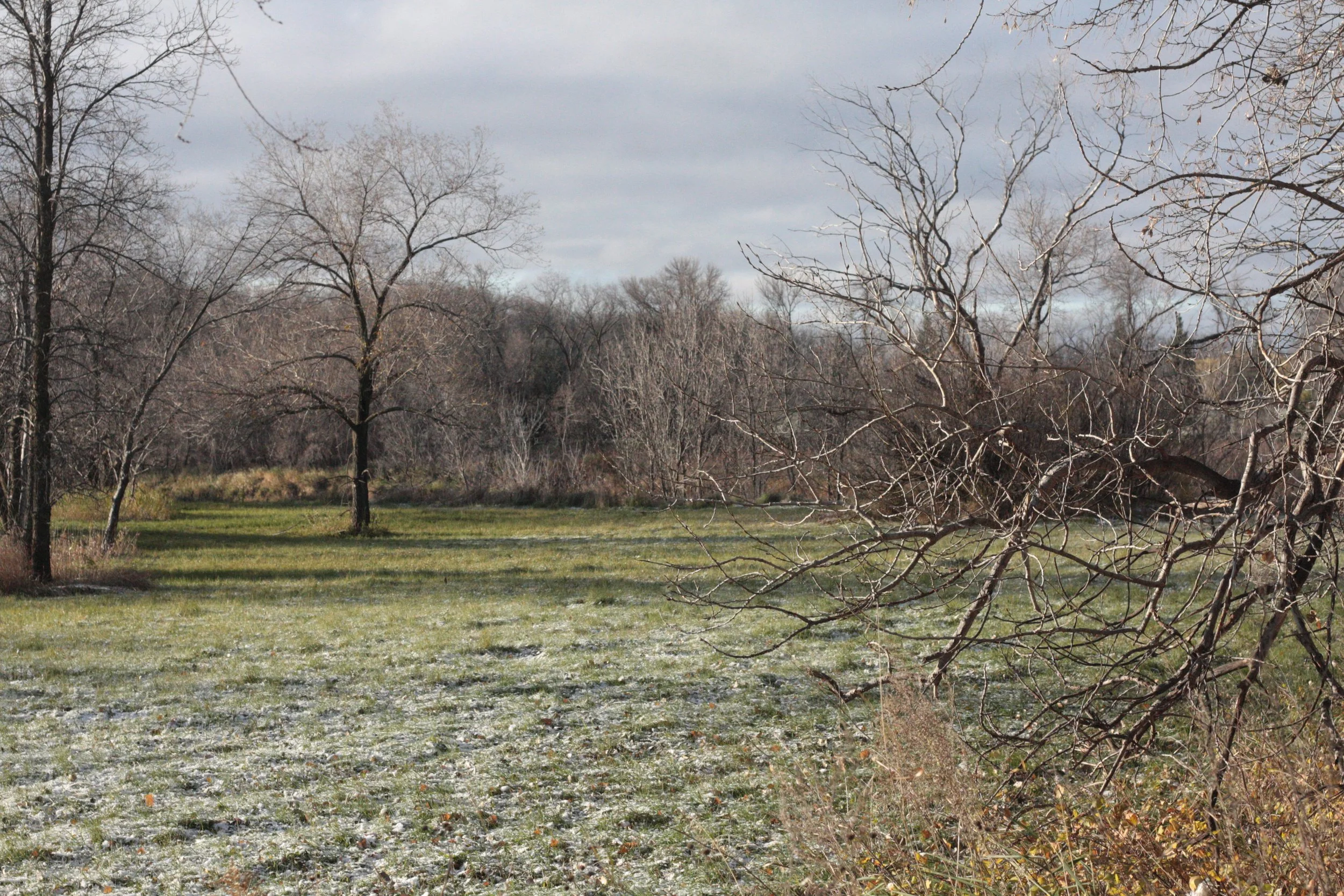
And behold! Captured here is the first snow!

Happy Sunday!
A Week on Sunday (no. 35)

Perfectionism

So I was listening to this podcast (The Good Ship Illustration) because it featured an interview with an artist I follow on Youtube, Sandi Hester. In the course of the interview, Hester put her finger on why I enjoy watching her Youtube videos so much… She says:

You just get to be a fly on the wall over the years that I’ve been a professional artist, just working through [negative self-talk] and working on muscles to think rightly about my creative process. It’s not as draining anymore. I don’t feel like every single piece I create has to be a masterpiece.

I think negative self-talk and perfectionism are two sides to a coin, but each one reminds me of people who’ve discussed these two aspects on two different podcasts. The first is Stephen Dubner on Design Matters back in September (I mentioned it here) when he was reflecting on having worked with Angela Duckworth: 

The very basic thing that I came away with is that […] I know the brain is a muscle. I know that. But I never treat it like a muscle. I treat it more like a trampoline, that things will bounce off it and send you into some other direction, right? Someone will say something or do something. You will have an involuntary emotional response. And all of a sudden, you say or do something that is far from the thing that you really wish you had said or done. 

But in fact, your mind or brain is a muscle and you can control it. And I can say, you know what? I recognize what’s happening right now. I just hit a bad shot. I just gave a bad talk. I just embarrassed myself. I was just unkind to someone. And you can say, okay, that’s done. What am I going to do now? I’m going to process that for a minute, see why I did it, try to figure out how to not do that very thing again. And then I’m going to direct my mind, my brain, back to what I want to be working on. […] 

And I think that being a little bit more intentional with your brain as a muscle is a huge, easy win for just about all of us, whether it’s a cognitive thing we’re doing, physical thing, whatever. But you know, the fact that it took me 50-some years to learn that, tells me, at least for me, it’s pretty hard. 

The second is an interview on the Longform podcast from 2018 with another artist, Liana Finck. In it, she describes having evolved her drawing style, from slow and careful, to fast. The podcast host, Evan Ratliff, asks why. She answers:

[…] I decided that I didn’t want to redo things a million times anymore. It’s just, it’s a sin, I think. And so I started drawing very fast. So what people think of as my style is me drawing really fast, and it’s a way to combat the perfectionism. 

Ratliff asks why she calls it a sin. Finck says that a preoccupation with perfectionism is like circular thinking…

It’s this very, very minor thing that’s not even like a real bad thing that’s just getting in the way of you being a person. And it’s kind of a way of incapacitating yourself so that you don’t contribute to the world at all. And I think it’s a way certain people are kept down. And if you indulge in it, you’re collaborating with the people who want to keep you down or the forces that want to keep you down.

I find these thoughts so instructive.

Drawing

I find drawing from memory a challenge. It can lead me to think I have a terrible memory, and to give up (still at the stage of what Martin Salisbury calls “the inevitably demoralizing early results” in Drawing for Illustration). But Andrew Tan’s recent Youtube captures an encouraging tip.

Holiday card tip

I 100% agree with Caroline Chambers advice, having adopted the practice of asking a friend to take our picture for many of our Christmas cards in the past.  

Lamp posts (or one thing leads to another)

I liked this video spotted a few weeks ago shared online… Then Dense Discovery  shared a link to Thomas Moes’ project “52 Weeks of Obsessions” which lead to “Why did we stop building places we want to live in?” which summarizes an article by Nathan J. Robinson. 

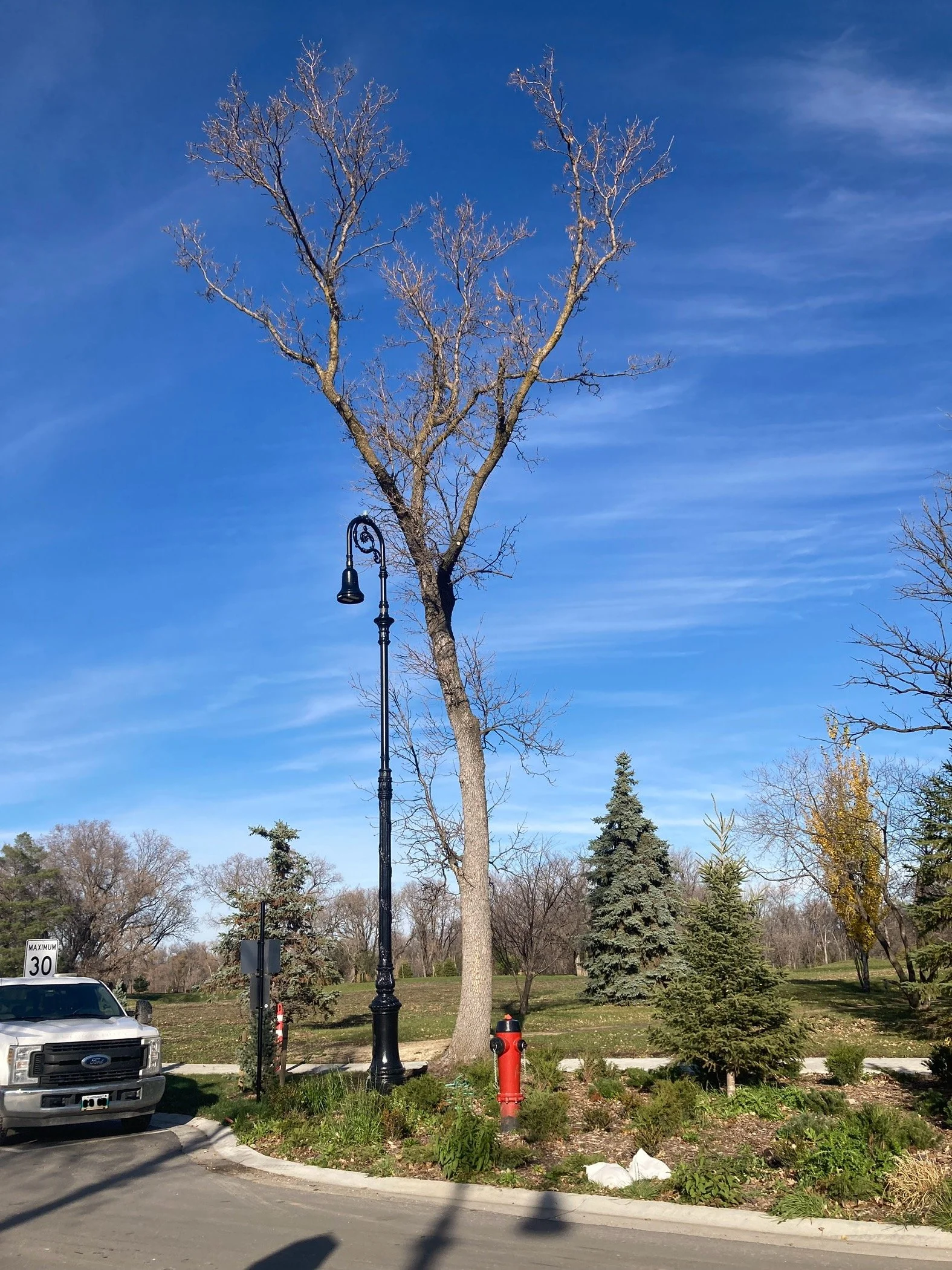
I think that’s why I’m especially happy to notice that the improvements being made on the University of Manitoba campus are looking pretty. Look at these lamp-posts! 

Eating

This week I made “Roasted Salmon with Lentils” from Dorie Greenspan’s Around my French Table, satisfying a craving for the “hominess” of this meal, which is simple and tasty. The recipe can be found here.

Postcards 

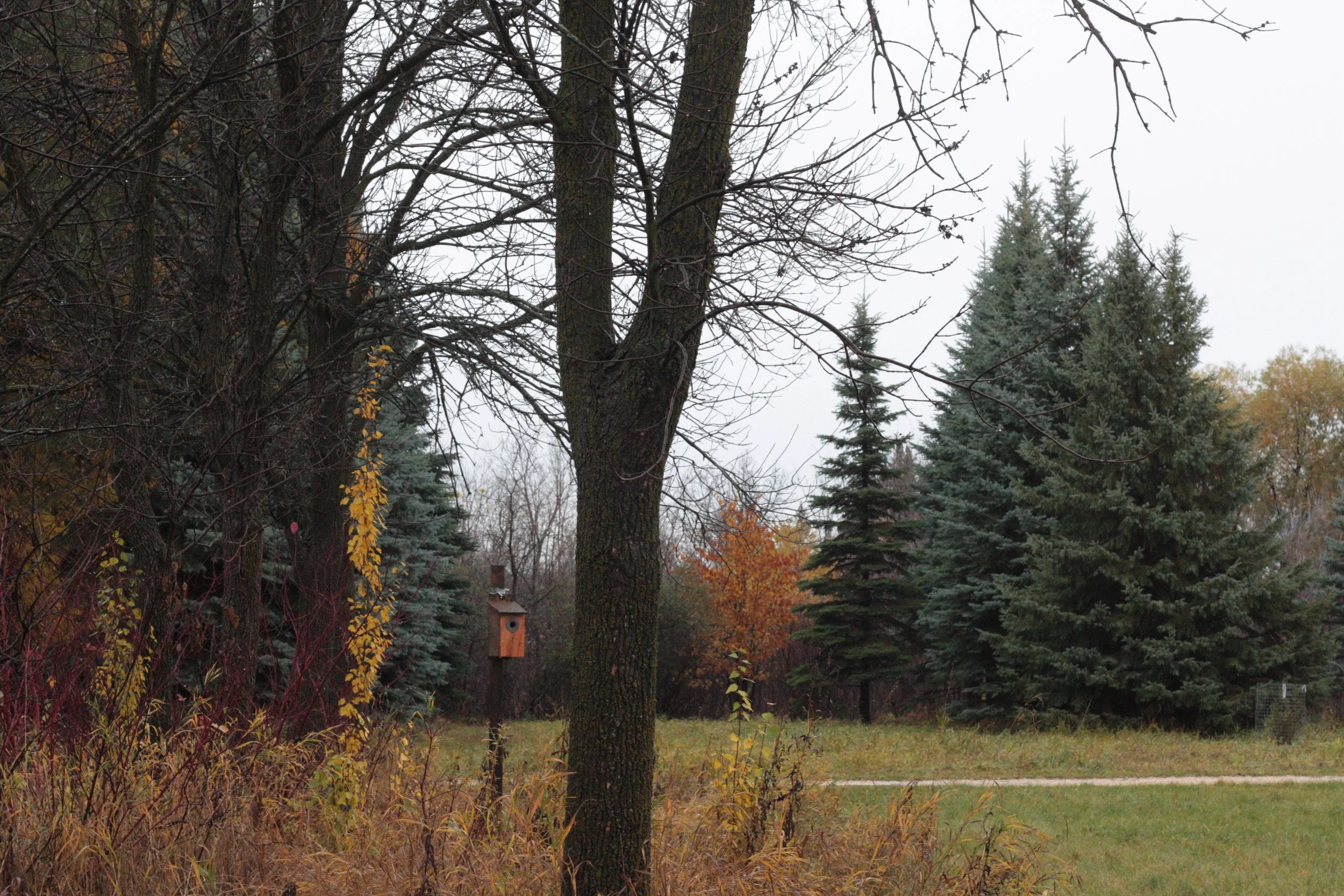
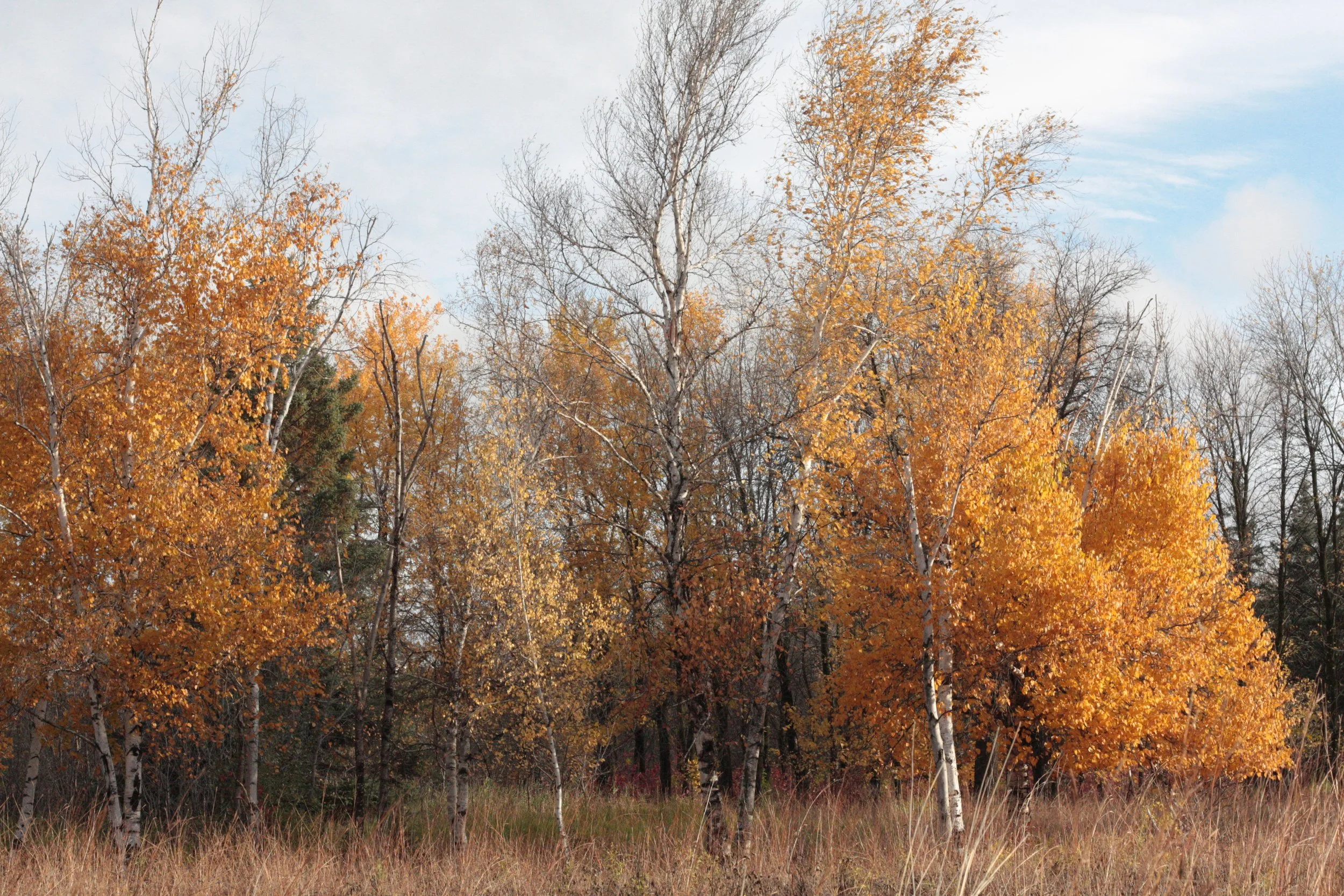
Winnipeg has been getting lots of rain this fall… I’m happy for the trees. This autumnal humidity brings no mosquitoes with it, only saturated scenes and maybe more mushrooms.

And although I should restrain myself and stick to just one postcard, I can’t help but include these willow trees… Their slender silvery leaves almost make them look soft from a distance. But their trunks? Their strangely wavy branches? It looks like they caught cotton candy clouds in their net.

Happy Sunday!
A week on Sunday (no. 34)

Death by execution

I finished reading A Place of Greater Safety this week and transcribed a dozen passages. The book is very long, and having to edit my own thesis makes me reflect on how much of a labour it must have been for Mantel to edit some 800 pages. Nonetheless, there are two lengthier quotes I really liked on the subject of the guillotine. Mantel neatly describes the first execution in 1762 for which the guillotine is used:

April 25, 1762 - Scientific and Democratic Execution of Nicolas-Jacques Pelletier, highway robber.

There are bigger crowds than for any ordinary execution, and an air of anticipation. The executioners, of course, have been practising with dummies; they look quite buoyant, and they are nodding to each other, putting each other on their honour not to make a blunder. Yet there’s nothing to fear, the machine does everything. It is mounted on a scaffold, a big frame with a heavy blade. The criminal ascends with his guards. He is not to suffer, because in France the age of barbarism is over, superseded by a machine, approved by a committee.

Moving quickly, the executioners surround the man, bind him to a plank, and slide it forward; swoop of the blade, a soft thud, and a sudden carpet of blood. The crowd sighs, its members look at each other in disbelief. It is all over so soon, there is no spectacle. They cannot see that the man can be dead. One of Sanson’s assistants looks up at him, and the master executioner nods. The young man lifts the leather bag into which the head has fallen, and picks out the dripping contents. He holds the head up to the crowd, turning slowly to each quarter to show the empty, expressionless face. Good enough. They are placated. A few women pick up their children so that they can see better. The dead man’s trunk is cut free and rolled into a big wicker basket to be taken away; the severed head is placed between the feet.

All in all, including holding up the head (which will not always be necessary), it has taken just five minutes. The master executioner estimates that the time could be cut almost by half, if time were ever important. He and his assistants and apprentices are divided over the new device. It is convenient, true, and humane; you cannot believe that the man feels any pain. But it looks so easy; people will be thinking that there is no skill in it, that anyone can be an executioner. The profession feels itself undermined. Only the previous year, the Assembly had debated the question of capital punishment, and the popular deputy Robespierre had actually pleaded for it to be abolished. They said he still felt strongly about the question, was hopeful of success. But that deep-thinking man, M. Sanson, feels that M. Robespierre is out of step with public opinion, on this point. (p 416-7)

Then, 300 pages later, we, the reader, are in 1793 and Mantel enters the head of the executioner and delivers his point of view. It's not neat anymore.

His overheads have gone up shockingly since the Terror began. He has seven men to pay out of his own wages, and soon he will be hiring up to a dozen carts a day. Before, he managed with two assistants and one cart. The kind of money he can offer doesn’t attract people to the work. He has to pay for his own cord for binding the clients, and for the big wicker baskets to take the corpses away afterwards. A first they’d thought the guillotine would be a sweet, clean business, but when you have twenty, perhaps thirty heads to take off in a day, there were problems of scale. Do the powers-that-be understand just how much blood comes out of even one decapitated person? The blood ruins everything, rots things away, especially his clothes. People down there don’t realize, but he sometimes gets splashed right up to his knees.

It’s heavy work. If you get someone who’s tried to do away with himself beforehand, he can be in a mess, maybe collapsed through poison or loss of blood, and you can strain your back trying to drag him into position under the blade. Recently Citizen Fouquier insisted they guillotine a corpse, which everybody thought was a lot of unnecessary work. Again, take someone who’s crippled or deformed; they can’t be tied to the plank without a lot of sweat and heaving, and then the crowds (who can’t see much anyway) get bored and start hissing and catcalling. Meanwhile a queue builds up, and the people at the end of the queue get awkward and start screaming or passing out. If all the clients were young, male, stoical and fit, he’d have fewer problems, but it’s surprising how few of them fall into all those categories. The citizens who live nearby complain that he doesn’t put down enough sawdust to soak up the blood, and the smell becomes offensive. The machine itself is quiet, efficient, reliable; but of course he has to pay the man who sharpens the knife.

He’s trying to make the operation as efficient as he can, get the speed up. Fouquier shouldn’t complain. Take the Brissotins; twenty-one, plus the corpse, in thirty-six minutes flat. He couldn’t spare a skilled man to time it, but he’d got a friendly spectator to stand by with his watch: just in case he heard any complaints.

In the old days the executioner was esteemed; he was looked up to. There was a special lady to prevent people calling him rude names. He had a regular audience who came to see skilled work, and they appreciated any little troubles he took. People came to executions because they wanted to; but some of these old women, knitting for the war effort, you can see they’ve been paid to sit there, and they can’t wait to get away and drink up the proceeds; and the National Guardsmen, who have to attend, are sickened off after a few days of it.

Once the executioner had a special Mass said for the soul of the condemned; but you couldn’t do that now. They’re numbers on a list now. You feel that before this death had distinction; for your clients it was a special, individual end. For them you had risen early and prayed and dressed in scarlet, composed a marmoreal face and cut a flower for your coat. But now they come in carts like calves, mouths sagging like calves’ and their eyes dull, stunned into passivity by the speed with which they’ve been herded from their judgement to their deaths; it is not an art any longer, it is more like working in a slaughterhouse. (p 724-5)

The idea of capital punishment, and the use of a guillotine, can feel distant, but the latest season of Revisionist History and the discussion of capital punishment by lethal injection seems to be showing that the idea of having "improved" it is illusory. 

Mr Enzo

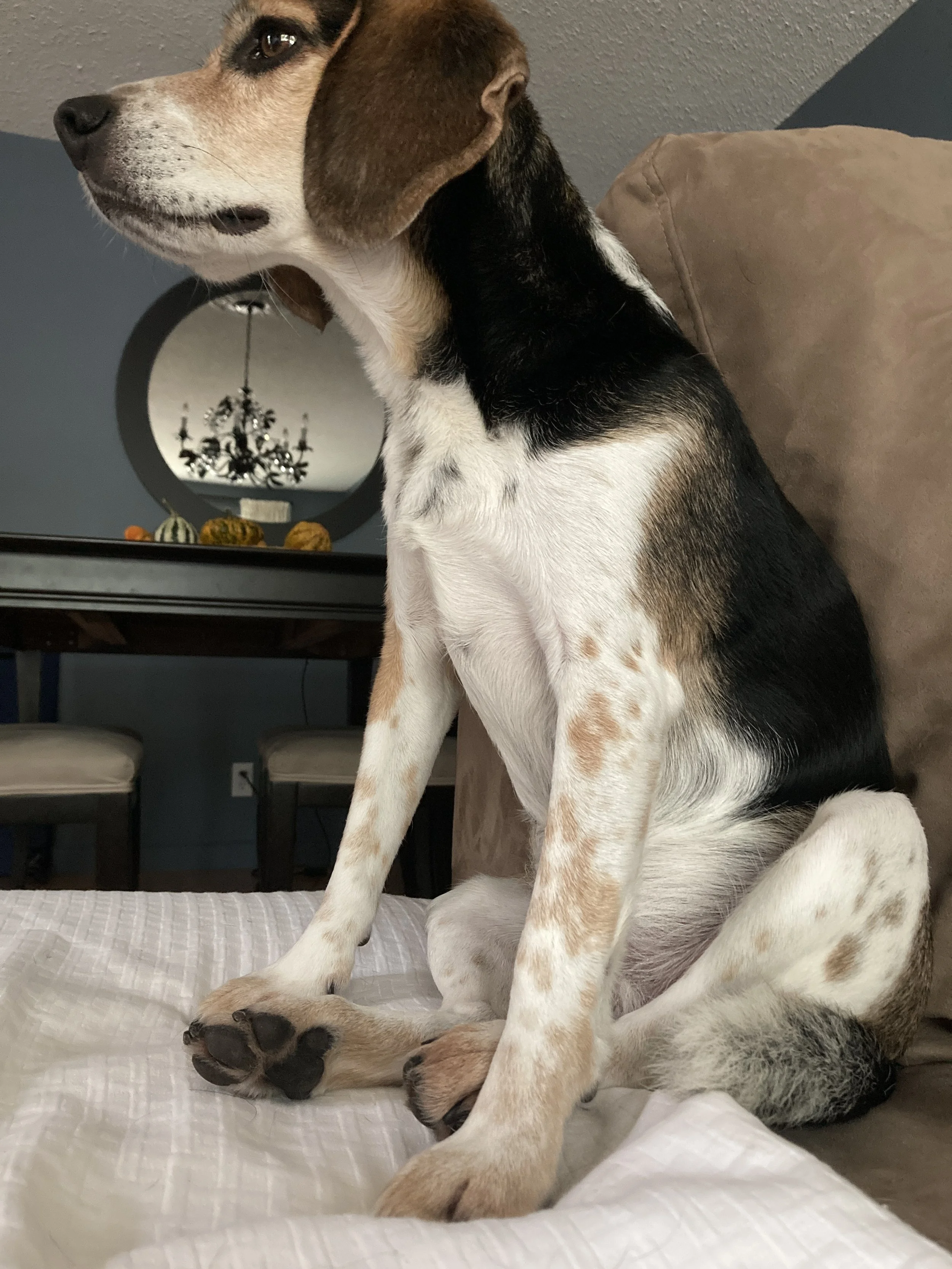
Our dog sits tall and dignified, and places his paws so neatly between his front legs. See our collection of decorative gourds on the table? But wait... is that a freely roaming cat outside? Is that terrier wearing A RAINCOAT? Forget the pose! Forget the neatly placed paws! It's time to howl with indignation!

He is the dog who thinks we buy pillows from IKEA just for him.

Overheard

On People I Mostly Admire, guest Frances Arnold describes when she became interested in chemistry:

I think I got a D in Chemistry when I was at Princeton, and I wasn't at all interested in it, so I didn't spend any time with it. But then when I was a graduate student and I loved enzymes, Chemistry suddenly became fascinating. So it was the context. We don't give young people enough context for them to become fascinated about getting into the nitty gritty.

Feeling vs Acting

On a rebroadcast episode of Freakonomics, titled “Can We Break Our Addiction to Contempt”, guest Arthur Brooks describes what he means by love:

What I'm talking about is the love that we manage, that we make metacognitive. So love is a verb. It is to will the good of the other as other. What is love not? It's not a feeling. And this is incredibly important to remember because in our modern culture, we tend to [...] over valorize feelings, which tends to throw us like bits of jetsum on the surf. And we're getting thrown around a lot, but it makes our lives have less quality, quite frankly, and it makes us bitter and angry and it makes us suffer a lot more than we need to.

Sometimes, to break loose of a bout of procrastination, I google for help. This Harvard Business Review article had the reminder I needed... I shouldn’t take myself seriously when I don't “feel” like doing something... I should just do it. Just like Kate Bingaman-Burt writes, “You don't need to feel creative to be creative”. (Here)

Food

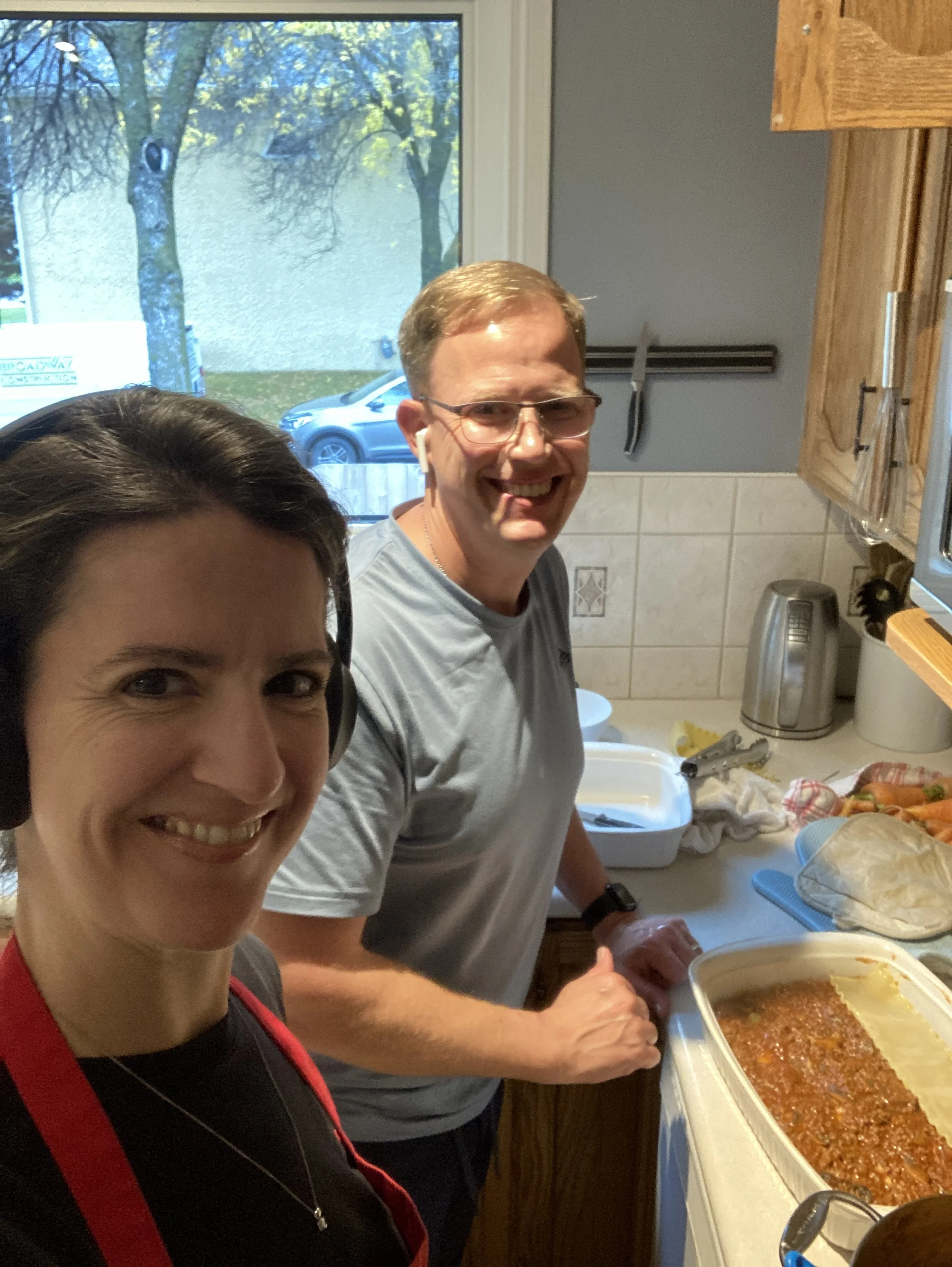
Two weeks ago, we celebrated Thanksgiving (on Sunday October 12th!) and 10 minutes before our guests arrived with their well-wishes and bottle of wine, the power went out in our neighbourhood. We were surprisingly well-prepared (stuffing made the night before, pie chilling in the fridge since the morning, scalloped potatoes assembled, chickens buttered and stuffed with onions) so that all we did was transport everything to Christian's mom's condo and cook it there. And good thing... the power was out from 3:50 to 6:20.

Here we are each with our own set of headphones, listening to our own thing, as blithely unaware cooks prepping the components of a meal ahead of time. (Christian is assembling a lasagna for the next day.)

For dessert, we had A Pumpkin Chiffon Pie from Canal House Cooks Everyday, made with a regular pie crust (rather than the ginger snap one suggested). Our family and guests prefer it to the traditional pie that calls for cream cheese in the filling, because this version, made with gelatin and egg whites, feels much lighter. (Recipe here, thanks to The Splendid Table.) 

In the spirit of Halloween

The pop-up store by the same name contains not even a glimmer of the delight I feel watching this short video (Instagram) of Jessica Lowe’s creation of an armadillo costume for her 7-year-old.

Postcards

It's such a pretty time of year at Henteleff Park...

Condo-building progresses with The Banks at 1918 St. Mary's Road and 1920 SMR apartments right beside. 

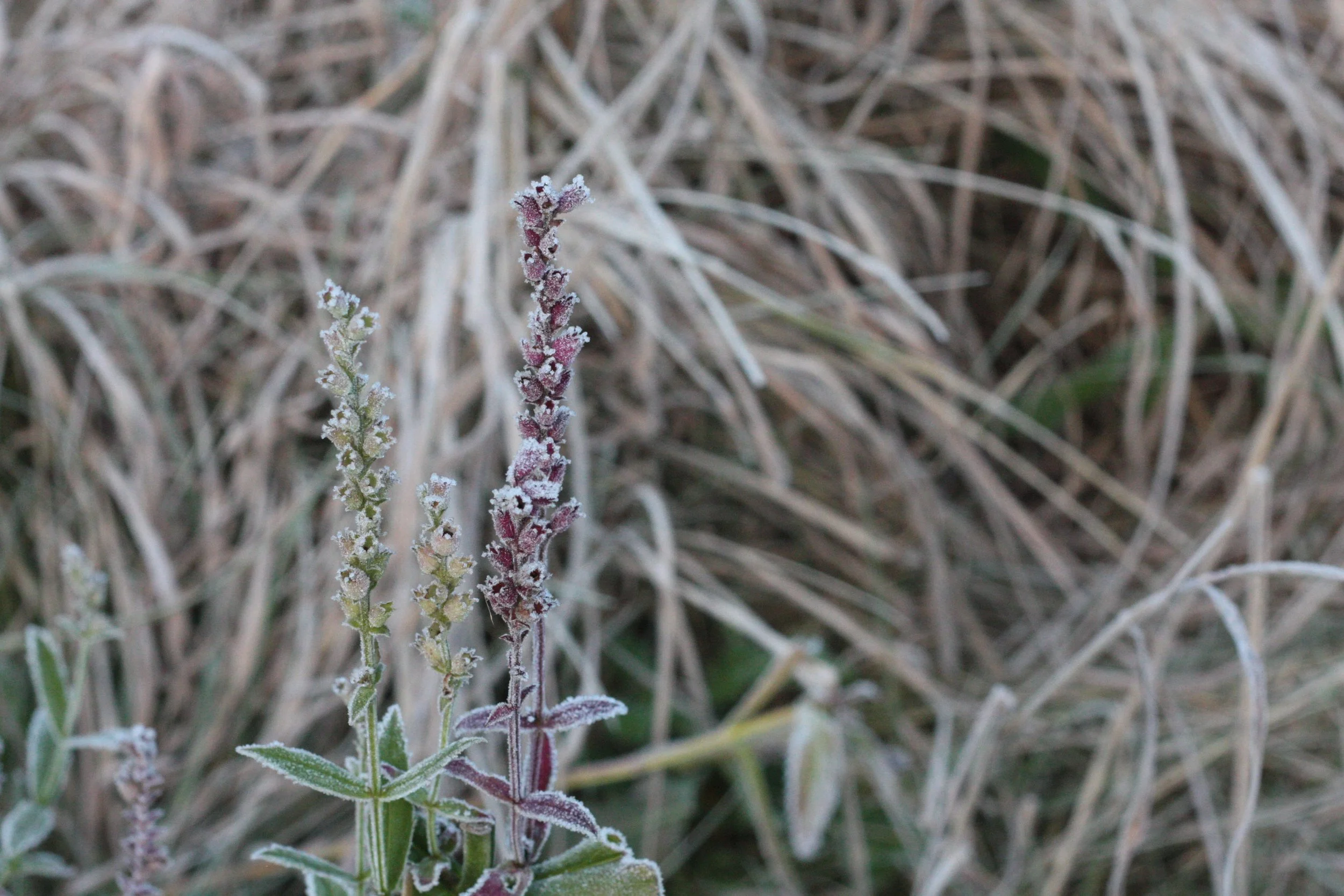
Frost has fringed these flowers so prettily!

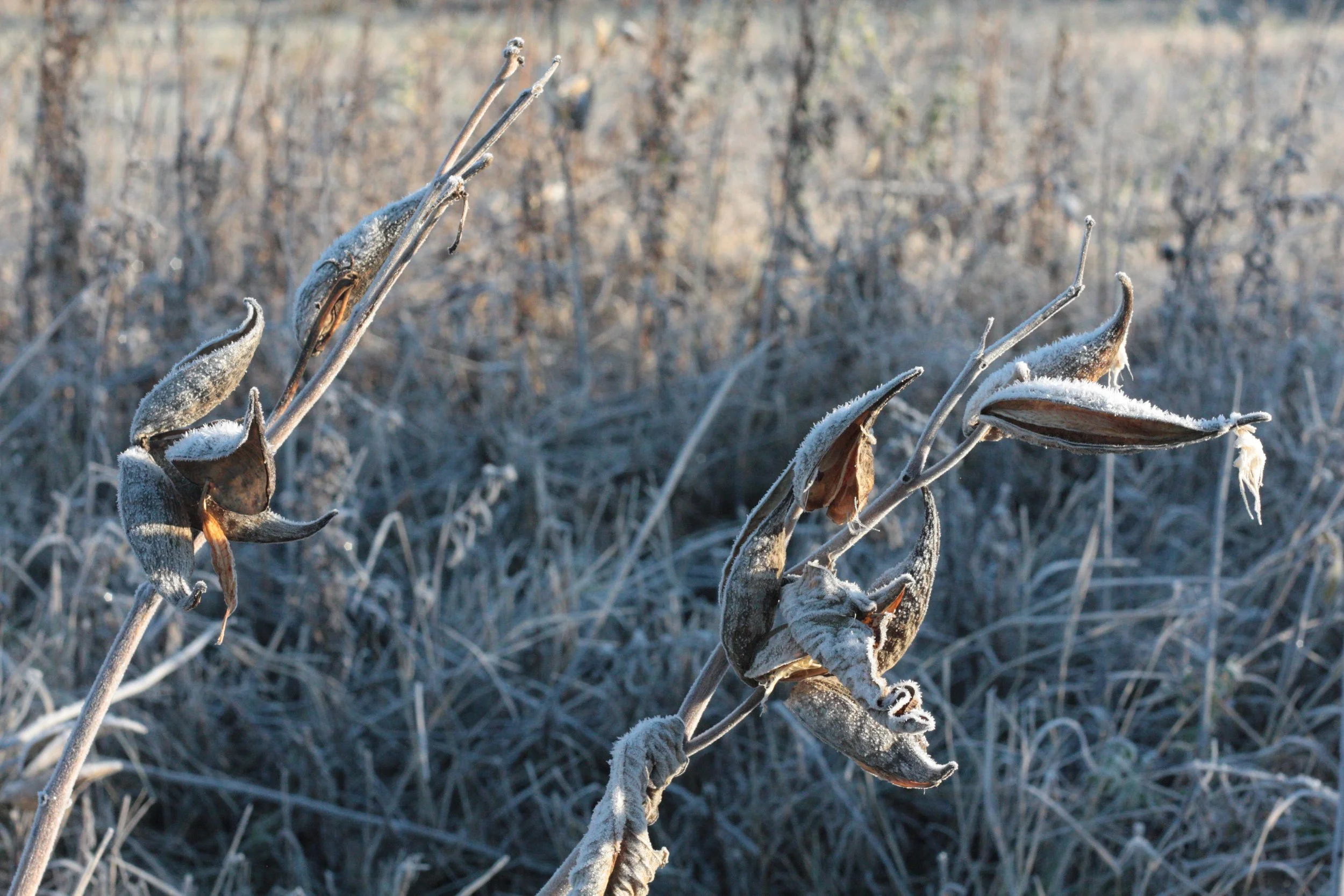
The milkweed looks lovely in its decay.

Happy Sunday!
P.S. A little thought for my brother-in-law who's hunkered-down in Port Antonio as the island faces hurricane Melissa. (We visited in 2024.)

A week on Sunday (no. 33)

Grace

Recently, listening to the latest season of Revisionist History (The Alabama Murders) Malcolm Gladwell describes a particular group of Protestants (Church of Christ) as being especially strict. One of the words he uses, in making his point, is “grace”. He uses it in contrast to shame, or rather, he says that when you feel a lot of shame, it can sometimes be because there is a lack of grace:

When you’re in a context of overwhelming shame, it can do terrifying things to the psyche.

In the absence of any sort of constructive grace, and I don’t mean by that, some flabby sense of, oh, everything’s-ok-grace, but some sort of constructive sense of grace, […] it can quickly lead you to all sorts of madness. […]

What [Lee C. Camp] was saying, and what many others in the Church of Christ came to believe, was that their church, particularly their church in that era, 40, 50 years ago, did not understand grace.

[…] Because in the absence of grace, there is no relief from transgression.

But grace is greater than just “relief from transgression”. It reminded me of the end of an episode of This is Actually Happening… A doctor named Tony Dajer talked about a patient he helped on the day of the Twin Tower attack. The patient had been transferred to another hospital and Dajer decided to visit him, to “have a face, to know of somebody that we had taken care of that I could get to know a little more.” The patient had been rendered paraplegic, and Dajer feared that the patient’s wife would be distraught… Instead,

the wife shows up, and it was probably the most unexpected moment of grace in my whole life. She was just, “look, you saved him. Whatever time I had with him, without you, he wouldn’t even be here” and just left us speechless. She was radiant with gratitude and love and “oh, my God, what you guys must have gone through on 9-11,” and “thank you for saving my husband.”

The husband died a few months later, but the doctor and that woman kept in touch. Dajer says:

she visits every now and then, and it’s a touchstone that keeps me connected and forgiven and understanding of what happened. […] What she showed me was that even in the depths of her grief, that somehow her love for him spilled over to us was almost a miracle. That sense of her taking care of us when it’s supposed to be completely the other way around was what was so powerful.

I have never seen another human being so represent what grace means. It’s a human standard that because she can do it, means it can be done, and it is possible to be that way.

The definition of grace in the OED starts with its theological origin. It is “benevolence […], bestowed freely and without regard to merit”. And benevolence is the “disposition to do good, […] to promote the happiness of others”. Grace can also be the expression of gratitude (Thanksgiving is “action de grâce” in French, a literal “giving grace”!). Considering all this, grace feels like an especially potent word and something to aspire to. Grace heals… not just the person who receives it, but the person who chooses to bestow it.

Whereas that doctor found that it stopped him in his tracks, an experience which he gifts listeners of the podcast with the words to translate the intensity of the feeling, I think we aren’t granted such profundity every day… Most days, I suspect, grace flows, if it is unobstructed, like a little stream. I think it can look as mundane as a man taking care of his father with Alzheimer’s, a strength hidden in the willingness of his care for his family despite the merit of his freedom having been unfairly judged. That’s what came to mind listening to In the Dark’s season 2 update, here.

(Grace, previously mentioned.)  

Keeping a diary

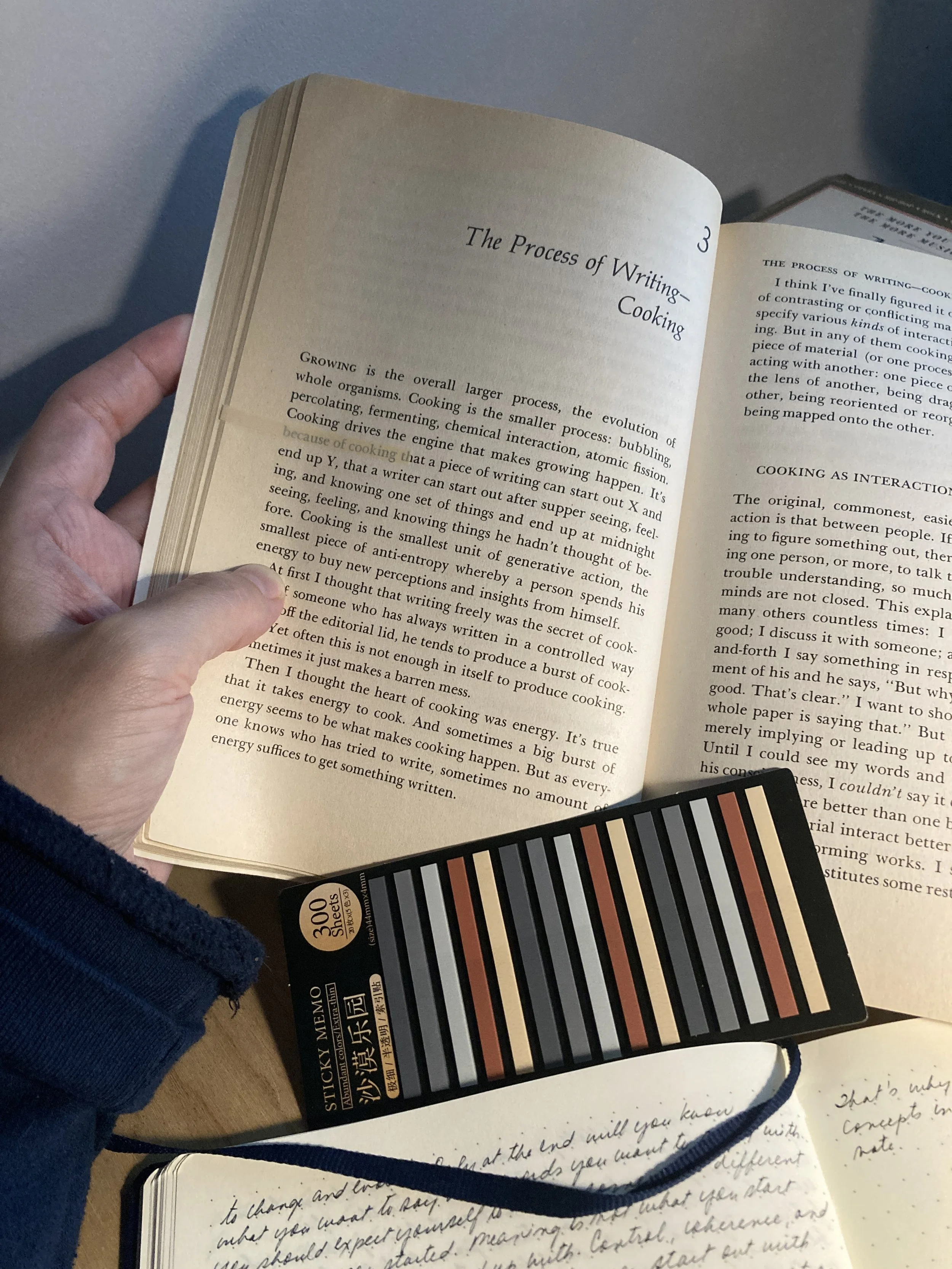
I liked what Peter Elbow writes about keeping a diary in his book Writing Without Teachers:

One of the functions of a diary is to create the interaction between you and symbols on paper. If you have strong feelings and then write them down freely, it gives you on the one hand some distance and control, but on the other hand it often makes you feel those feelings more. For you can often allow yourself to feel something more if you are not so helpless and lost in the middle of it. So the writing helps you feel the feeling and then go on to feel the next feelings. Not be stuck. (p. 56)

(I also like how the colour of my sticky notes perfectly matches the pages in this book!)

Food (the subject)

Sometimes, things connect in a delightful way… First, there’s the mild curiosity over the old recipes you can come across while browsing newspaper archives. You kind of wonder, half in passing, if that dish, whose black and white picture is rendered in ink blots, would actually taste good today. 

This recipe, featured in July 1956, is a frozen dessert. It has a crust made of pulverized sugary cereal and butter. The filling is milk, cream, almond extract and instant pudding whipped together for a minute and then set to freeze for 4 hours. It is called a Frozen Royal Pie. Who knows? Maybe it’s delicious! (This is also the newspaper edition that features Christian’s grandpa’s death on page 4.)

Then second, by chance, a podcast asks the same question, going further into the past, and answering with a bit more academic rigour. (At one point in the podcast, the guest, Marieke Hendricksen, muses about one of their experiments, “it also brought home to me that because people ate so many fermented foods, they must have had a higher histamine tolerance than we had.”)

But wait! There’s a third link! There’s this story of Rosie Grant (This is Taste podcast) who collected recipes carved into gravestones and lovingly gathered them into a cookbook titled To Die For: A Cookbook of Gravestone Recipes. She’s been documenting her discoveries (Instagram: Ghostly Archive) and when asked about any changes of perspective she had since beginning the project, she answered:

Oh my gosh, so much appreciation for our home cooks. […] On the flip side [of professional chefs] there are people who are just like everyday cooks who really love food. 

They use food to show love. They use it to celebrate someone’s birthday or to celebrate a holiday and bring people together. And there’s a real, like a labor side and gift side to it as well. […] 

Every day I just feel like I have so much appreciation for even my own family members who use food to not only nourish me, but give me some of my best childhood memories to connect me with others. 

I like food best when I’m with a loved one or friend and we’re having dinner or we’re cooking. It’s just given me a lot more of a sense of how it connects us together.”

Eating 

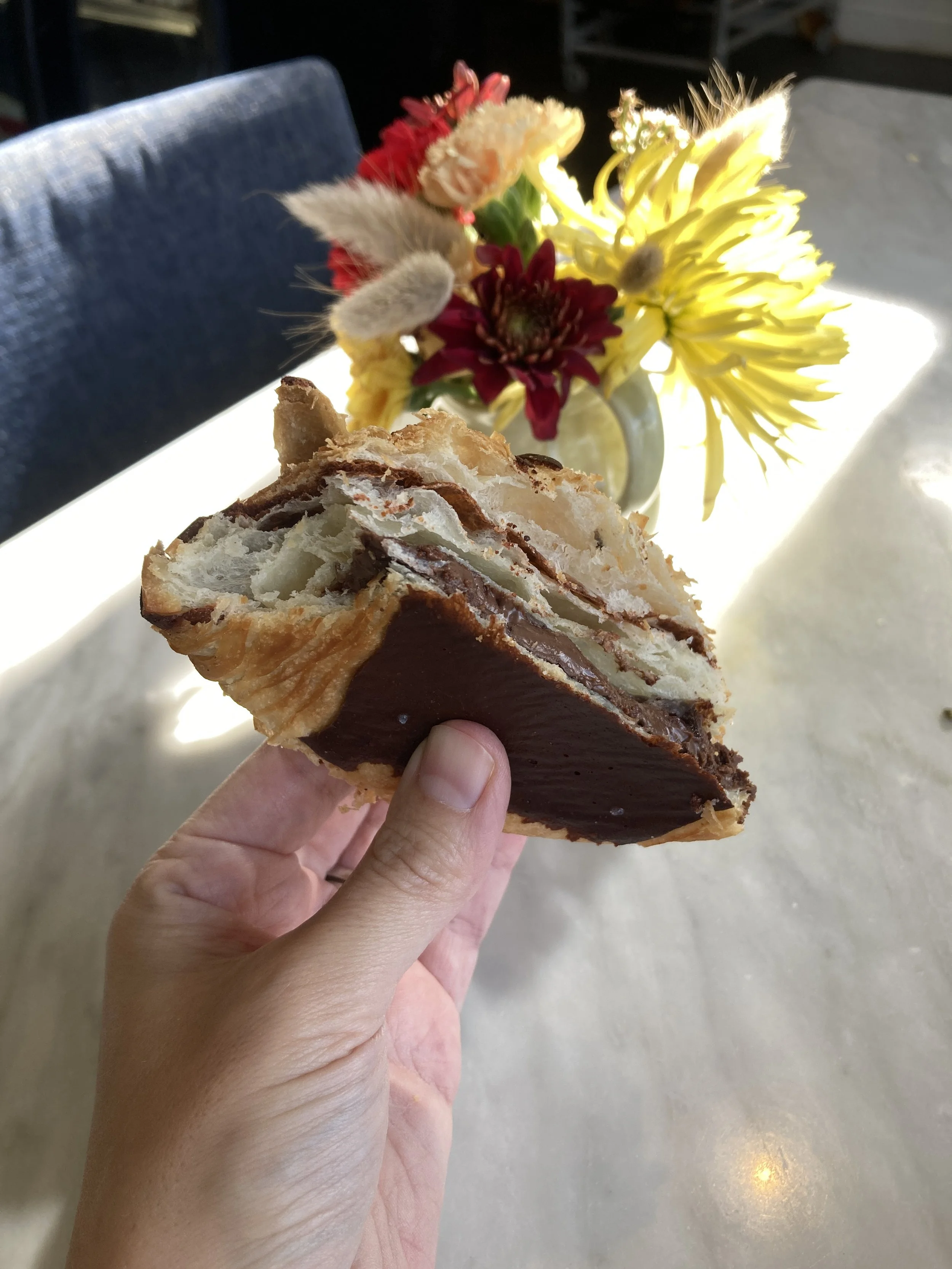
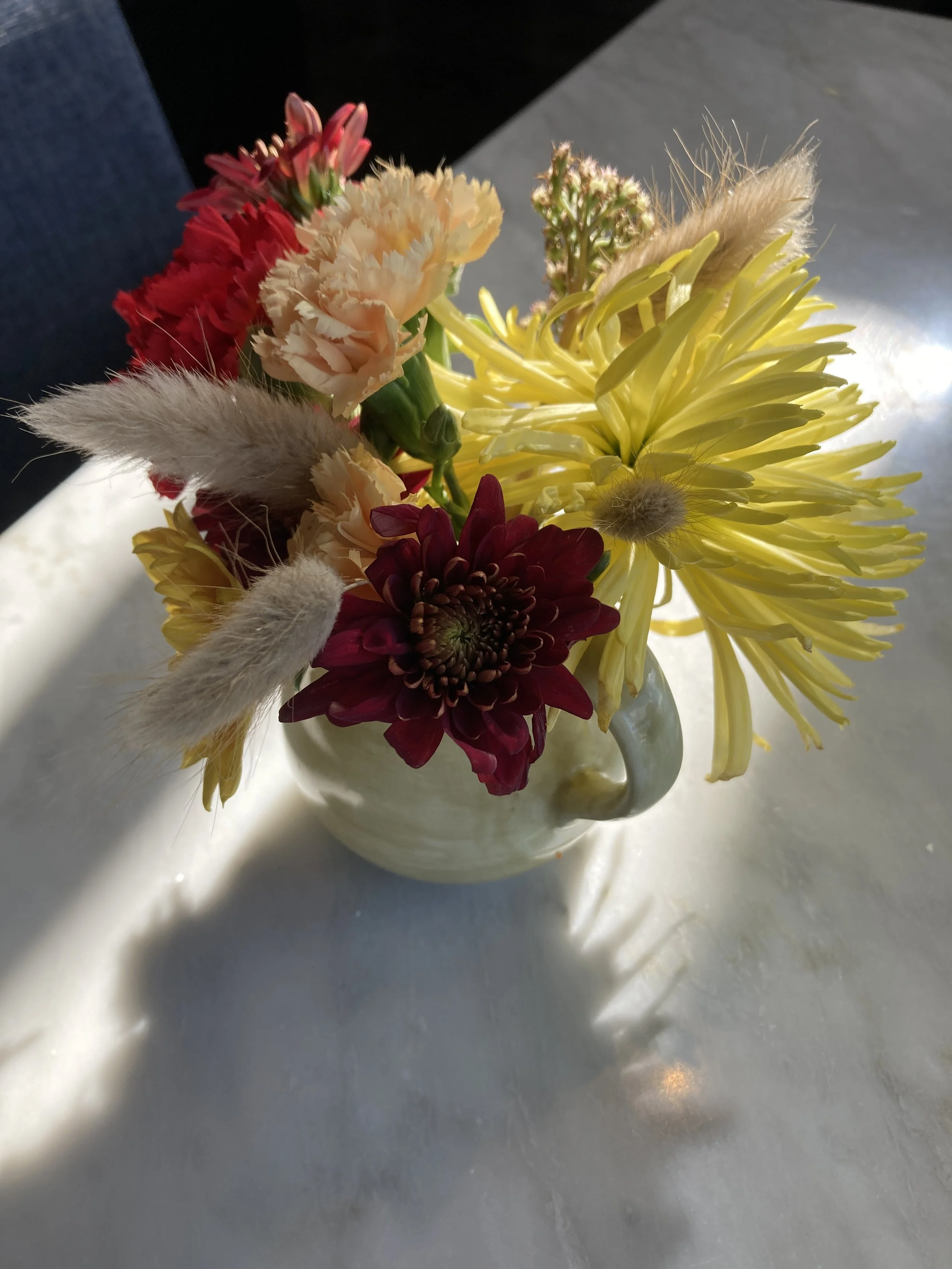
Would you like to see this Nutella croissant from Le Croissant, where I was invited for lunch earlier this week? I was one bite in to my half before my (kind, less voracious) lunch partner suggested a picture of our meal. It was too late for the muffuletta sandwich… But the table decorations were cute!

This week, I made Tikka Masala from The Huckle and Goose Cookbook, a recipe filed away for occasions when I’d need to use up garden tomatoes that were all together ripening, ripening, ripening.  

The boys tried one of their uncles’ favourite desserts… a slice of Wafer Pie from Salisbury House (Instagram). It might not win top spot in their heart, but they didn’t detest it either.

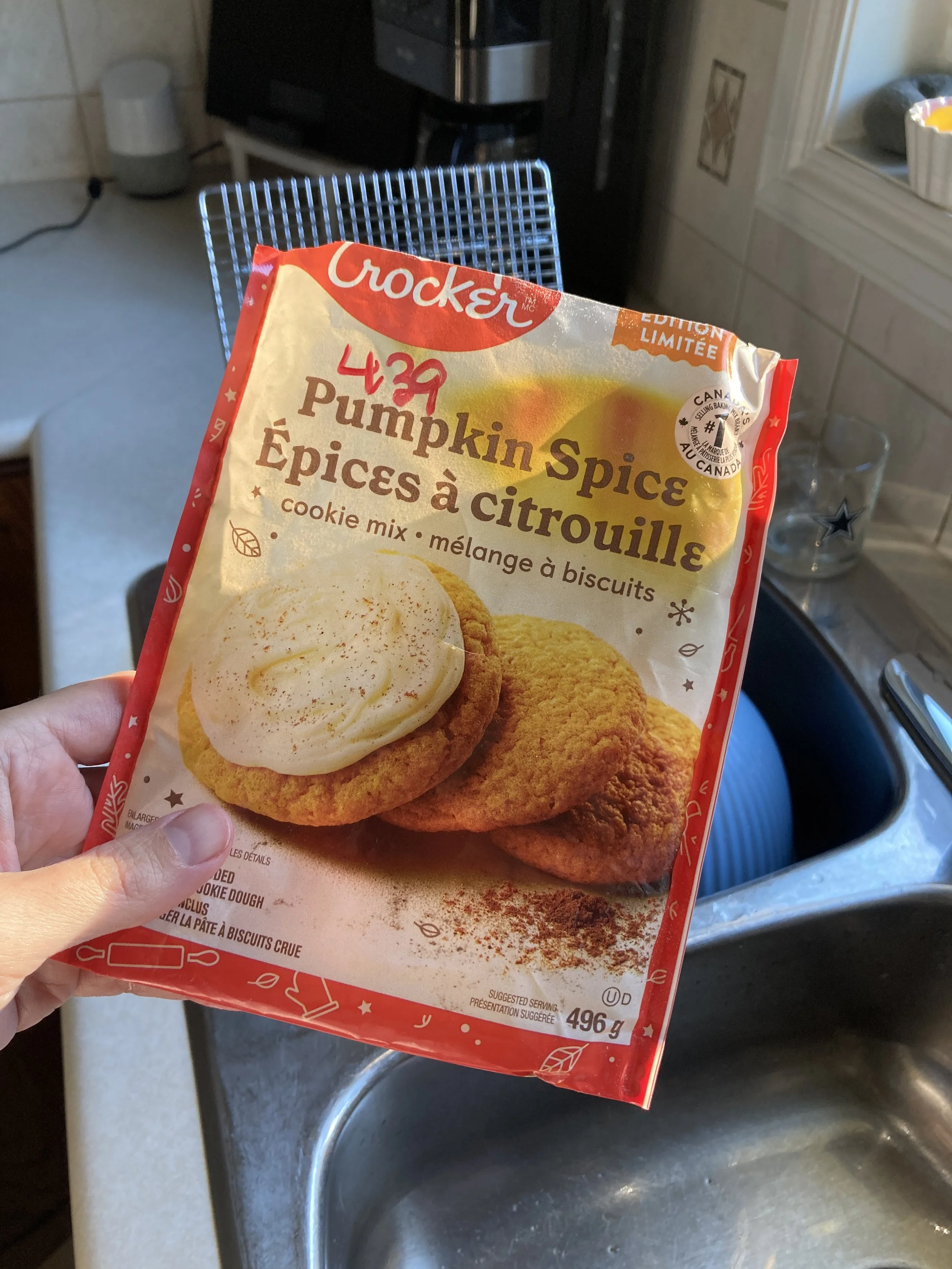
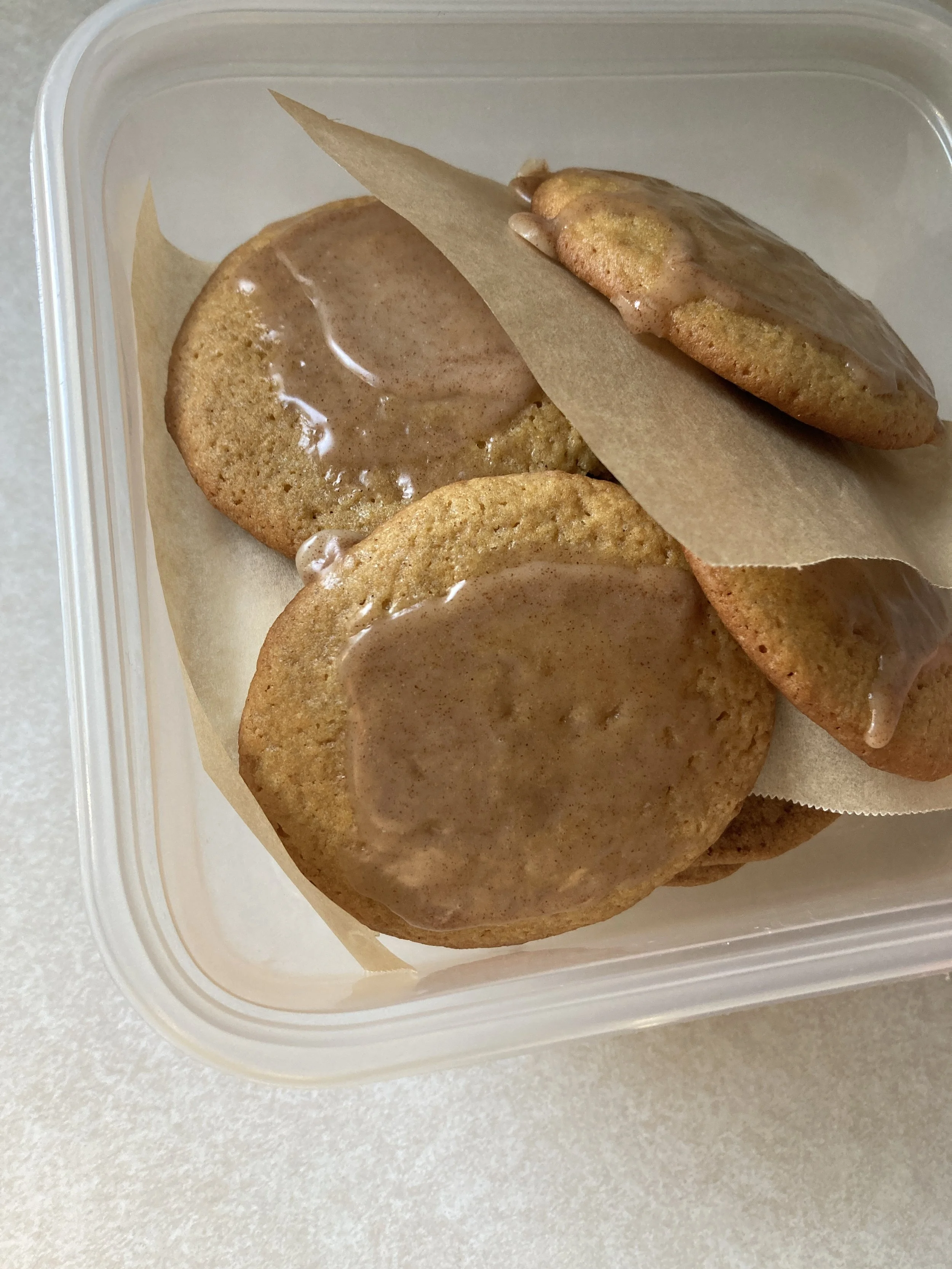
And, in the spirit of the season, I picked up this cookie mix from the Bruxelles General Store last week, made it and served the cookies with a cinnamon glaze to the kids gathered at our house for a playdate. 

PostcardS

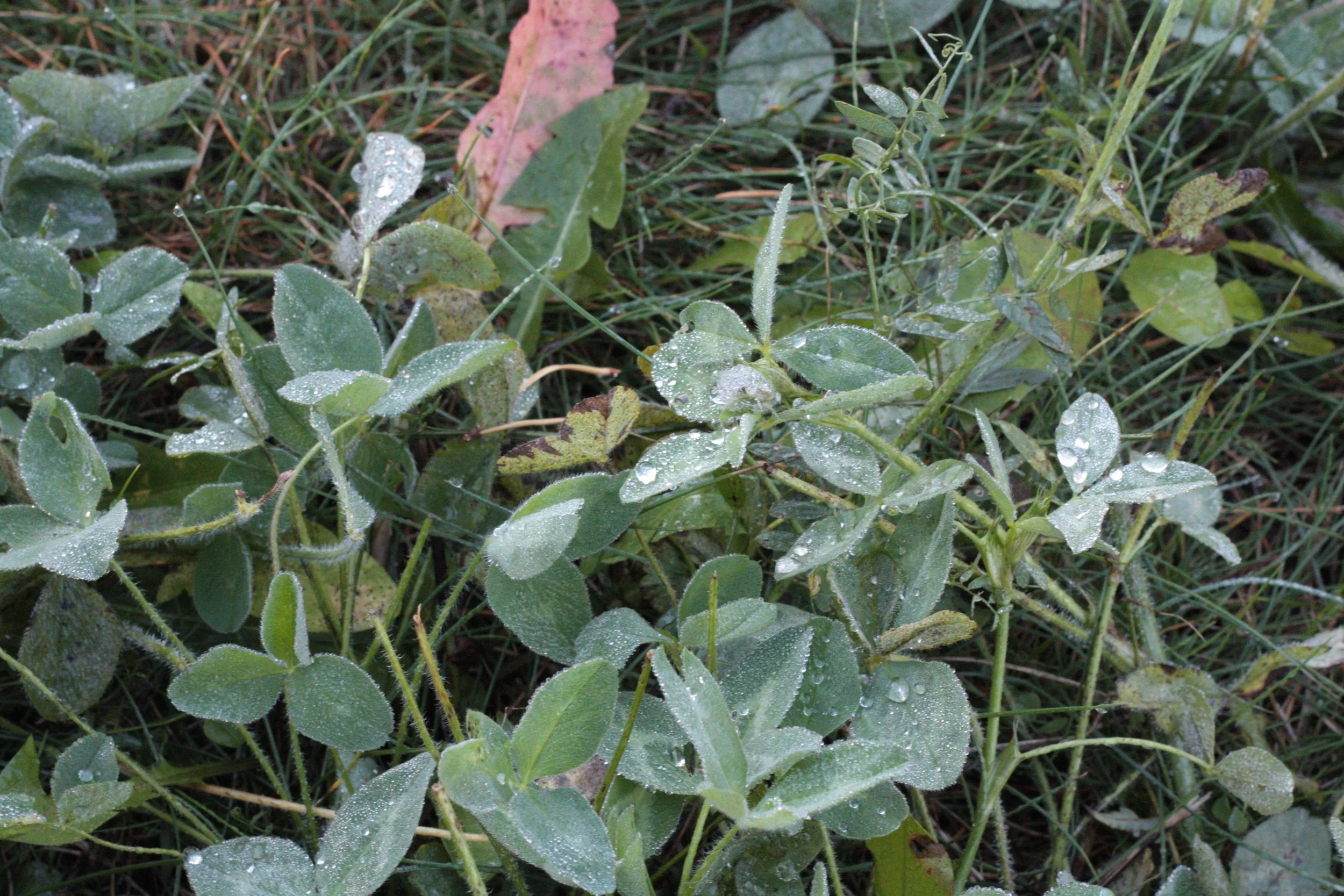
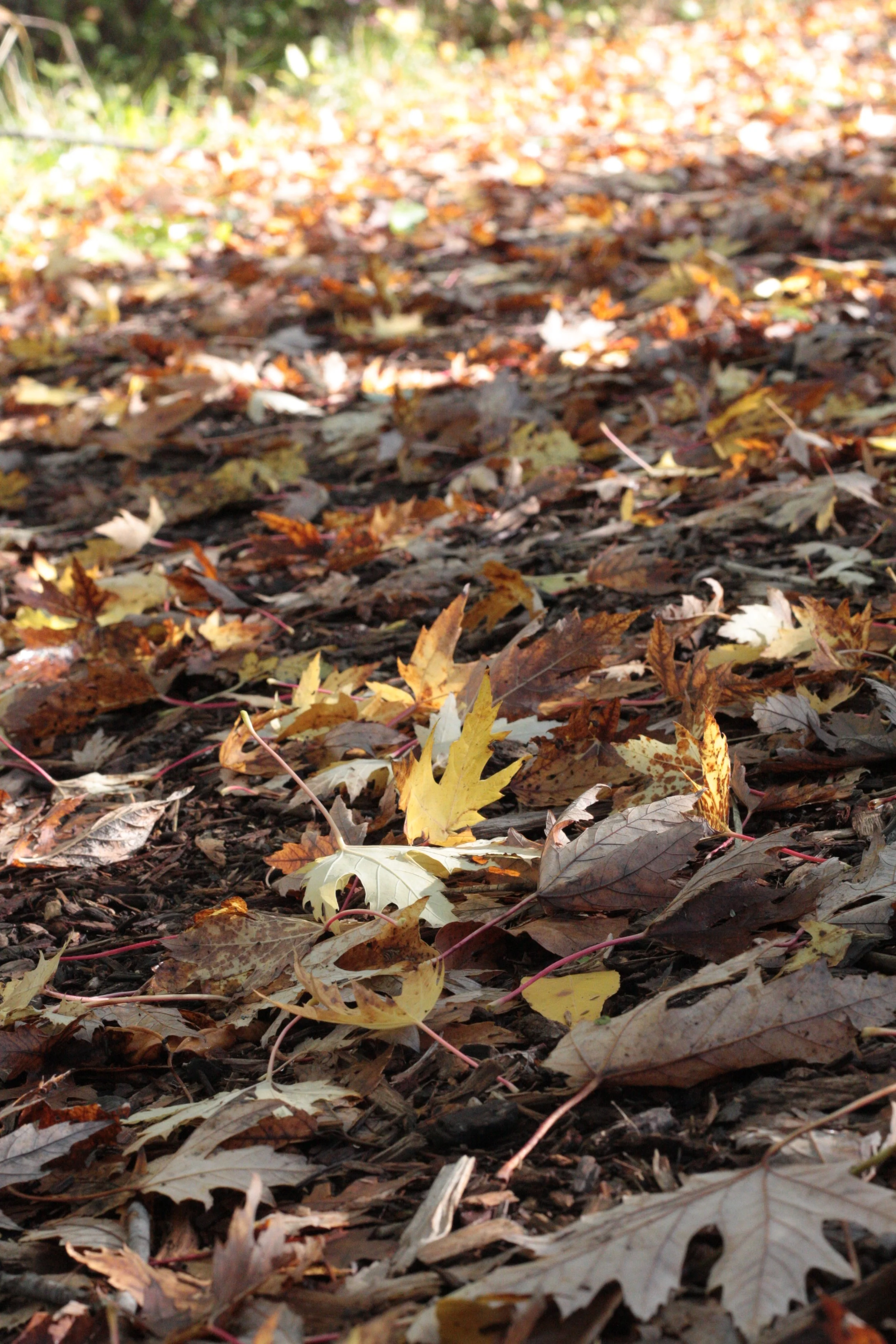
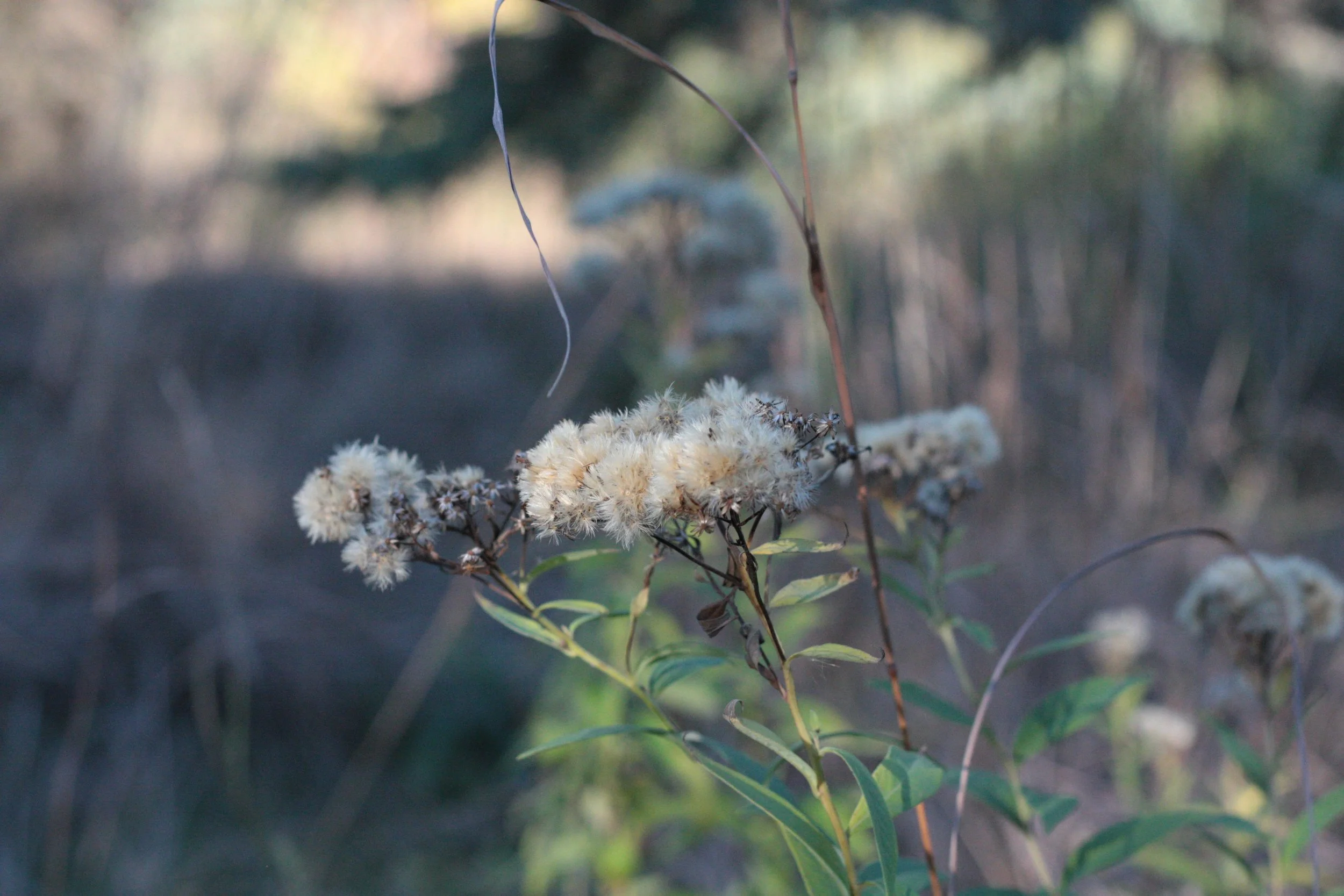
Fall is advertised for its colour, but pictures from walks this week advertise its texture instead… the silver pearls of a heavy dew, the ragged cutout shape of maple leaves on the ground, and the fuzzy softness of a plant going to seed…

Happy Sunday! Happy Thanksgiving!
A week on Sunday (no. 32)

Quote

Listening to an interview with Arundhati Roy lead me to reading her short essay titled “The End of Imagination”. Published in 1998, she wrote it in response to India's testing of nuclear weapons. 

I liked these two paragraphs in particular:

Railing against the past will not heal us. History has happened. It's over and done with. All we can do is to change its course by encouraging what we love instead of destroying what we don't. There is beauty yet in this brutal, damaged world of ours. Hidden, fierce, immense. Beauty that is uniquely ours and beauty that we have received with grace from others, enhanced, re-invented and made our own. We have to seek it out, nurture it, love it. Making bombs will only destroy us. It doesn't matter whether we use them or not. They will destroy us either way. (...)

The nuclear bomb is the most anti-democratic, anti-national, anti-human, outright evil thing that man has ever made. If you are religious, then remember that this bomb is Man's challenge to God. It's worded quite simply: We have the power to destroy everything that You have created. If you're not religious, then look at it this way. This world of ours is four billion, six hundred million year old. 

It could end in an afternoon.

Picturesque

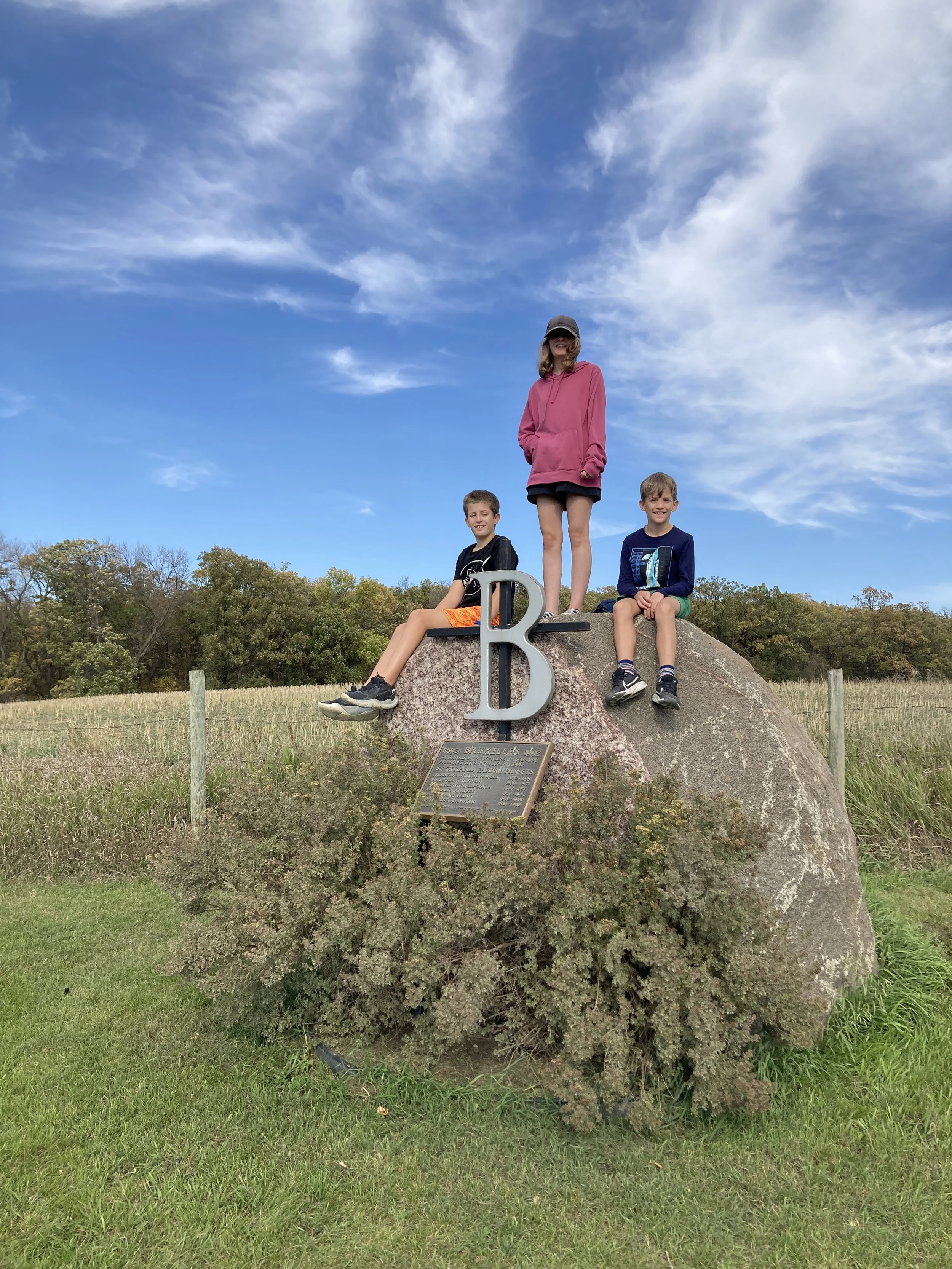
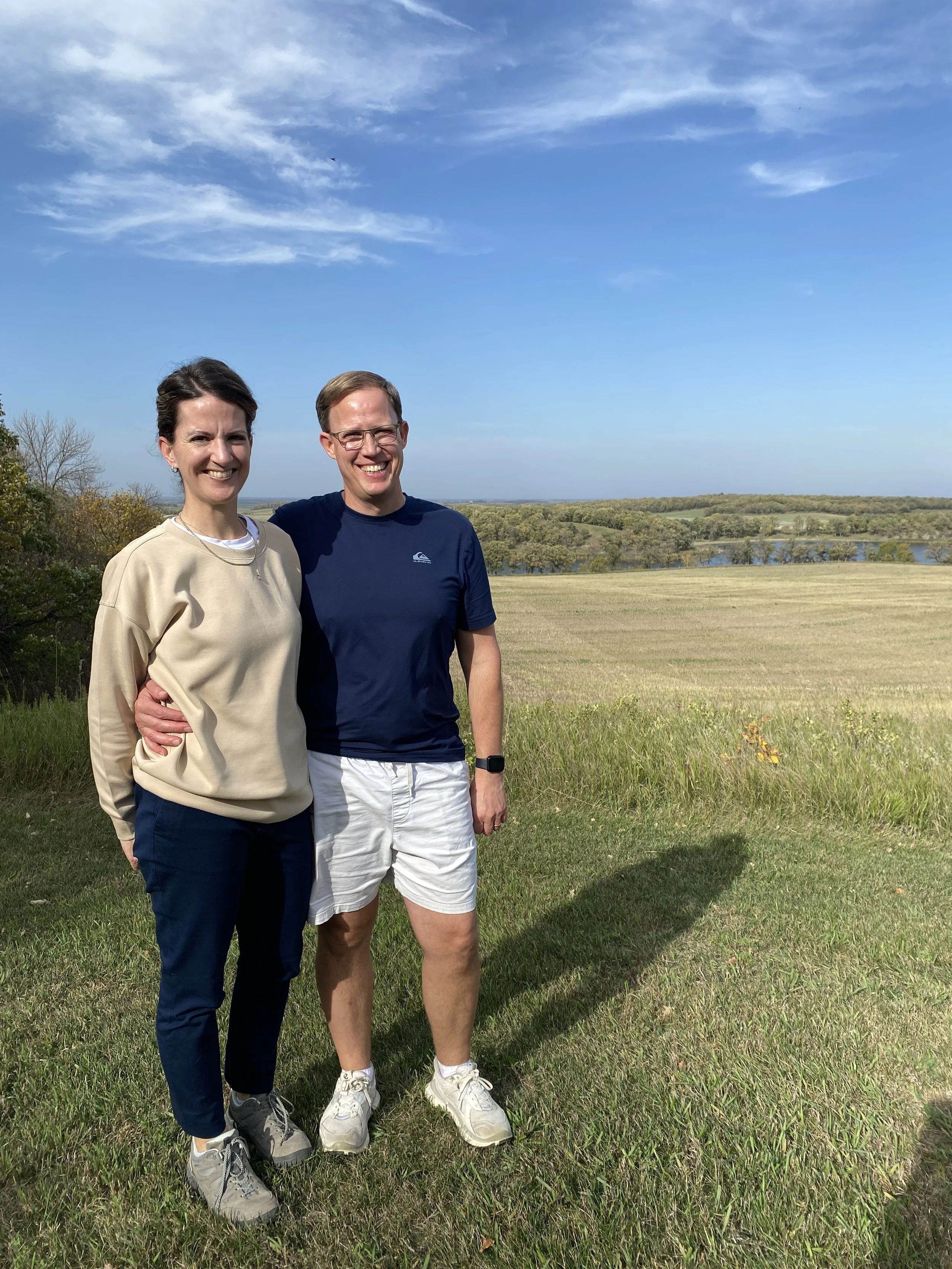
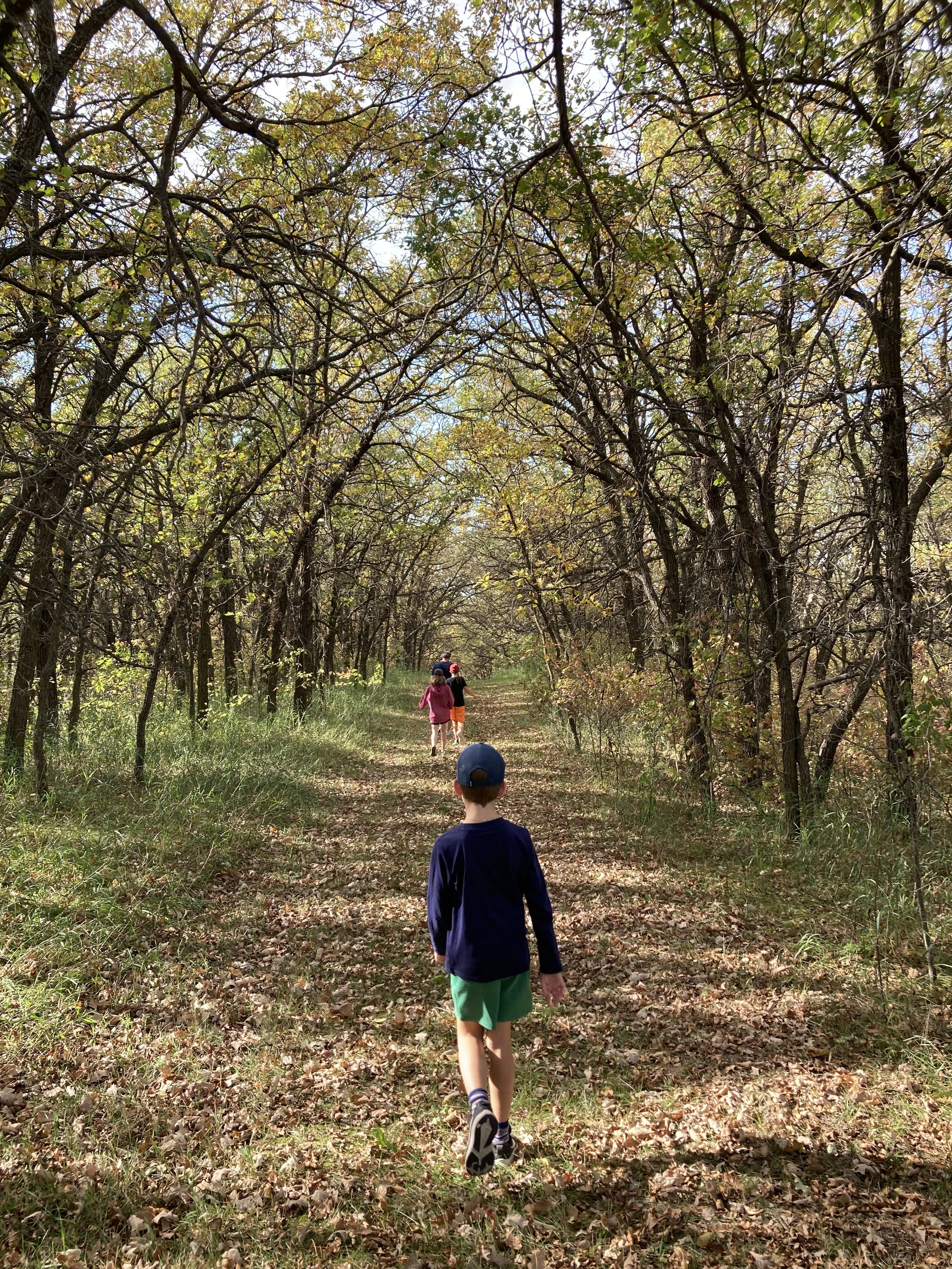
I remember a university class in English literature that featured poetry by Wordsworth and Byron and the idea of their seeking "the picturesque". On Tuesday, we went on a similar quest and visited Bruxelles, a town with a church resembling Aubigny's, and a small grocery store. We found the rock indicating the town's original location, climbed the hill where the town began and commented on the view.

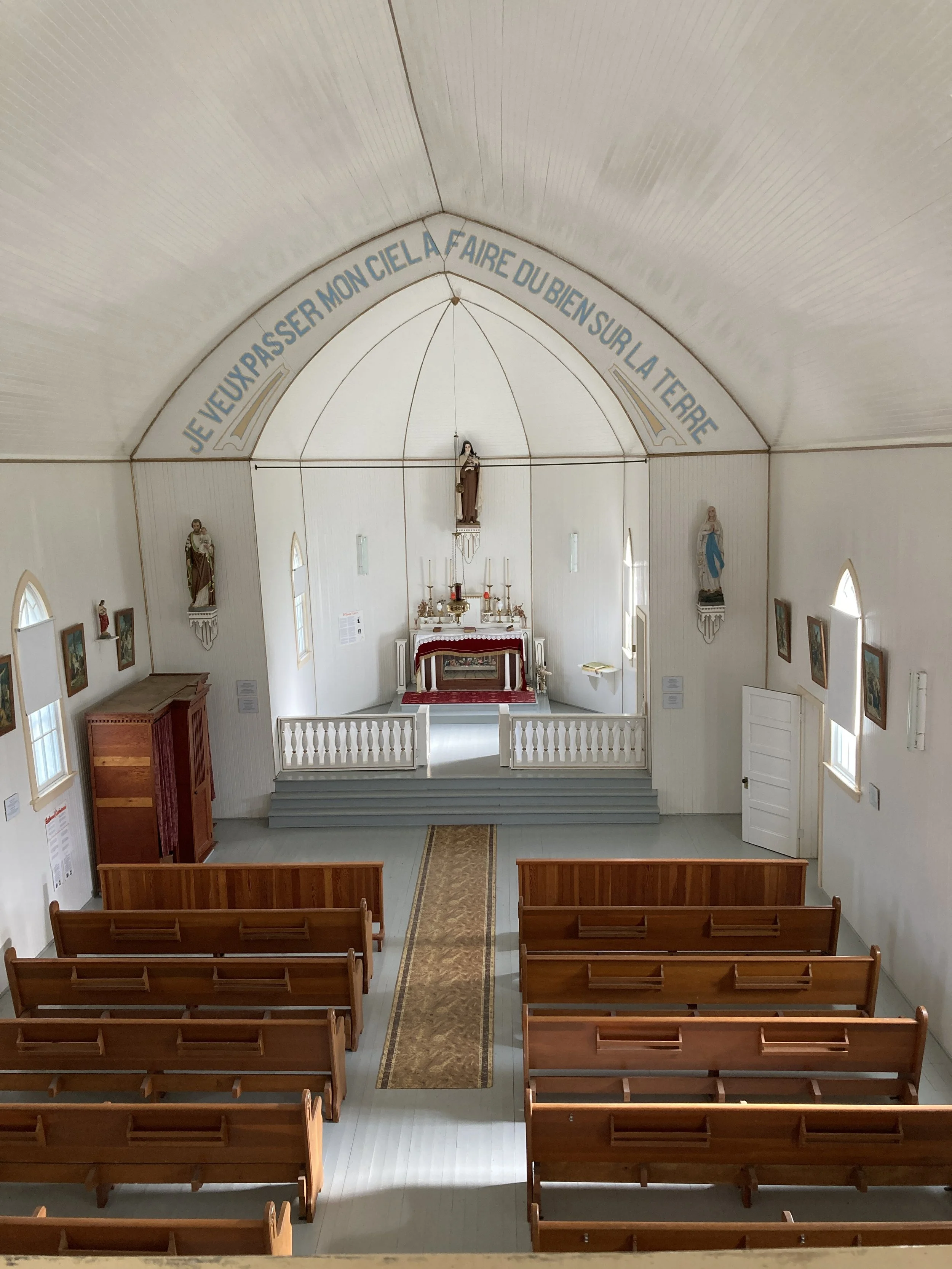
(This was following the footsteps a friend and I traced together last year.) We visited Cardinal too, where the little church is maintained, just like it was when we visited 21 years ago as a couple.

And then we struggled a little to find St. Lupicin, eventually did, and then went up and down the scenic, sunken, winding Snow Valley Road. Along it we discovered Leary's Brickworks, obeyed the sign and looked it up later. It's a long defunct brickmaking business that nonetheless has some attractive ruins. (The chimney seen from the road could be mistaken for a piece of modern art.)   

Happiness

It's easier to be annoyed and grim and dissatisfied and worried and blue and verklempt than it is to be happy and hopeful. I think that's why I so appreciated this bit from the Blackbird Spyplane newsletter that quotes an article (from May of 2020) on P.G. Wodehouse, whose author, Rivka Galchen, writes: “Wodehouse had a rarer trait, too: a capacity for remaining interested and curious, even in a setting of deprivation. His resilient happiness, to me, remains heroic, and more essentially who he was.”

Blackbird Spyplane authors Jonah and Erin agree with Galchen. In thinking about happiness they write:

[…] there are different forms of happiness, aren’t there?

In the same way that extravagance isn’t inherently immoral, neither is happiness inherently moral. And it feels reasonable to suggest that, in order for happiness to count as moral — which is to say, for happiness to count as truly nourishing — it must have a pro-social component. It’s got to be based in an awareness, rather than an avoidance, of how much we owe to others.

Their reflection makes me think about another example Galchen offers of Wodehouse in her article... In the diary he kept while interned in a German-run camp in 1940, he writes “Met cook and congratulated him on today’s soup. [...] He was grateful, because his professional pride had been wounded by grumblers saying there wasn’t enough. He said he could have made it more by adding water, which would have spoiled it.” 

It's that tiny act of gratitude, the example of going above what I could imagine my own natural inclination to grumble, or be quiet, how that lead to a moment of... what? Beauty? Kinship? Surprise? However it might be defined, it contains a bit of delight that would otherwise have been absent... would have been denied the chance to exist. 

TV watching

We started watching Friday Night Lights in May of this year, and could reliably count on feeling relaxed with this series "that centered itself completely on decency" as Glen Weldon says here. Having finished (appropriately) on Friday, we started The Eternaut and some minutes into this sci-fi that begins with mysterious atmospheric conditions, a storm broke over Winnipeg with thunder and lightning, making it feel particularly eerie.

Baking

I'm always willing to try a new recipe if it leads to more effectively tackling garden produce, and Deb Perelman recently published a chocolate version of her Ultimate Zucchini Bread. I baked it on Wednesday and served it on Thursday and took a poll on Friday and the family agrees... it did not beat the UZB! But hey... it's not like they're complaining about the leftovers... 

Postcard

It's the time of year when the trees de-leaf and reveal... the river beyond.

Happy Sunday!
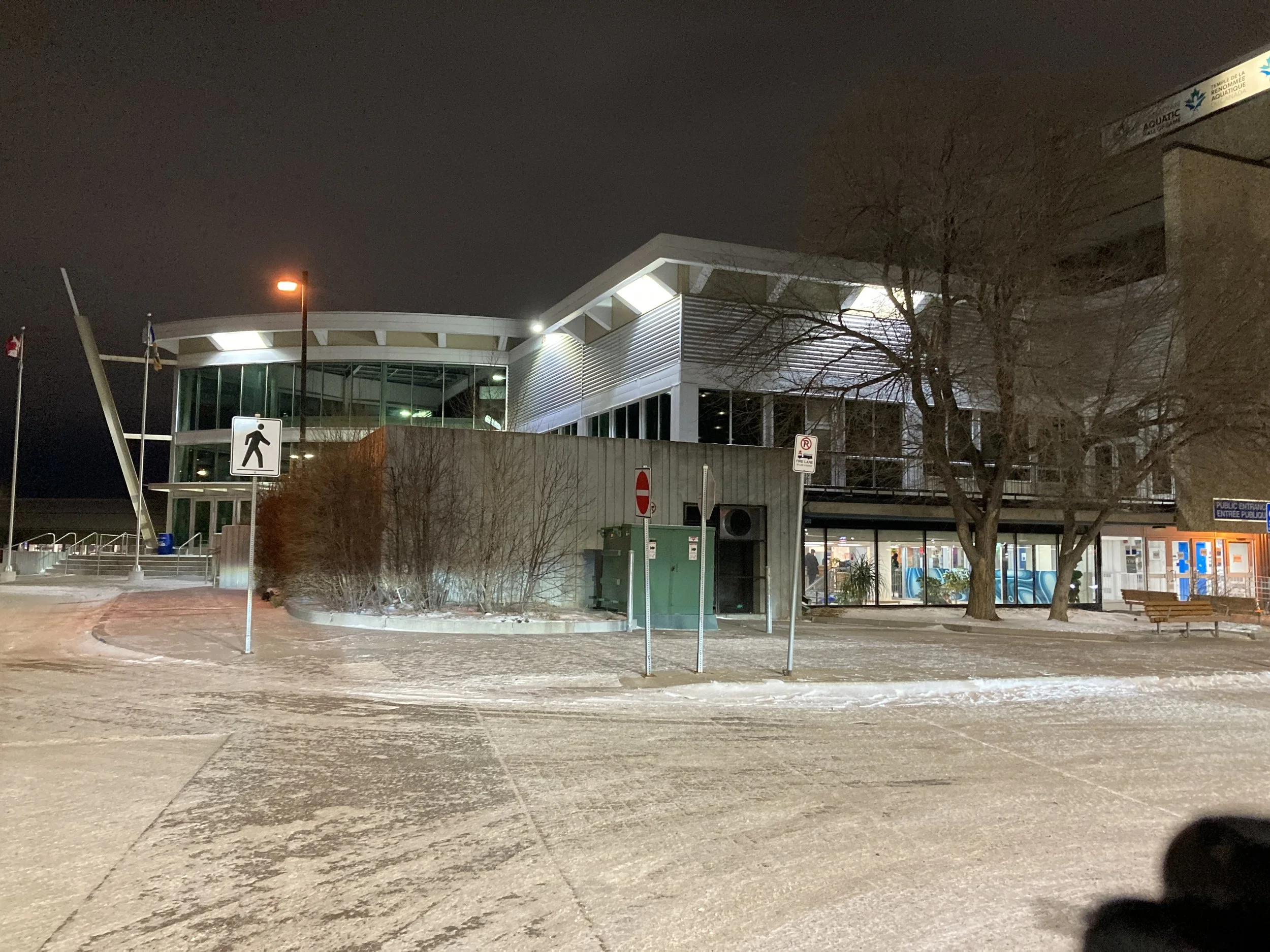
A week on Sunday (no. 31)

I don’t have much to list this week, except the the simple things gathered on the daily morning walks… Like milkweed seeds, once dried after a rain, that show such silky softness:

Or, a landscape transformed by fog…

Suddenly, in the moistened air, strands of spider webs are revealed everywhere…

Now it’s the wild field that is aflame, and the river behind it has disappeared:

The sun’s rays become a gentle softness…

The next day, walking the same path, you can gaze up, startled by the contrast of yellow and blue, and find the sky cleaved in two, and seagulls so high that in the camera viewfinder you can mistake the glints of sunlight on their wings for leaves being blown off the trees…

These are the little things that, being so anodyne, are what soothe the soul.

Happy Sunday!
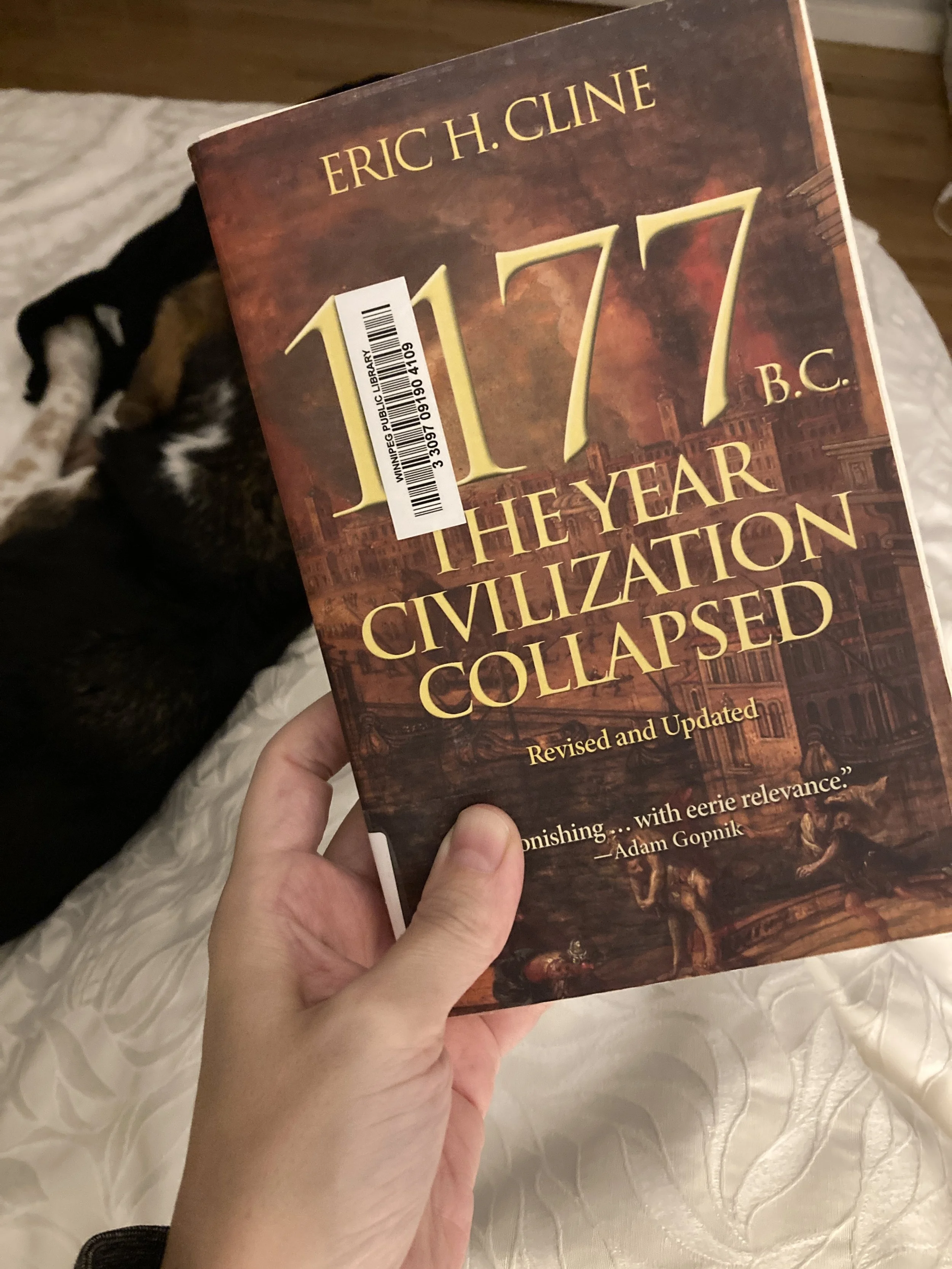
A week on Sunday (no. 30)

Intro

The past week was a busy one, and on weeks like that, it's less about enumerating the things that leant it weight, than about gathering the moments of light that peeped through.

Listening

My podcast feed has been full of inspiring interviews...

First, there was Stephen Dubner on Debbie Millman's “Design Matters” podcast who said:

Some things are abundant that are bad. But then there's one thing that I think is rare, is too rare, that's a good thing, and that thing is courage. I just think people need to understand that they need to give themselves permission to be courageous about everything, about who they are, about what they make, about what they think." [...] "I think courage is the precursor to confidence.

He also talked about using the brain as a muscle and choosing not to ruminate. 

Second, I've been enjoying seeing Samin Nosrat's return to the public eye with the publication of a second recipe book. Even more, I've appreciated how kindly she's shared pertinent bits of her biography with hosts. Recently, there was an episode on Milk Street Radio for example. 

The third interview encapsulates the gratitude I have for podcasts. Life can be so busy as to prevent me from reading for fun, but podcasts such as the ones mentioned are a gift... just like Terry Gross says on Sam Fragoso’s podcast “Talk Easy”, when she thinks back to radio shows she enjoyed:

I also realized when you're doing something that isn't really engaging your mind, how wonderful it is to have something to listen to, that your eyes aren't required for, but you can feed yourself on it. It keeps you emotionally and mentally fed. 

Floral

Fall bouquets can be vibrantly filled with orange and red... or they can take on more muted tones, like this one, with ornamental kale and cabbage.

Eating Out

There are many good lunch spots in Winnipeg, and most of the fun is in getting around to experience for yourself a random TikTok recommendation. This week friends and I went to Next Door at 116 Sherbrook for the first time. It was a 10/10 for atmosphere, kind staff and delicious mango jam!
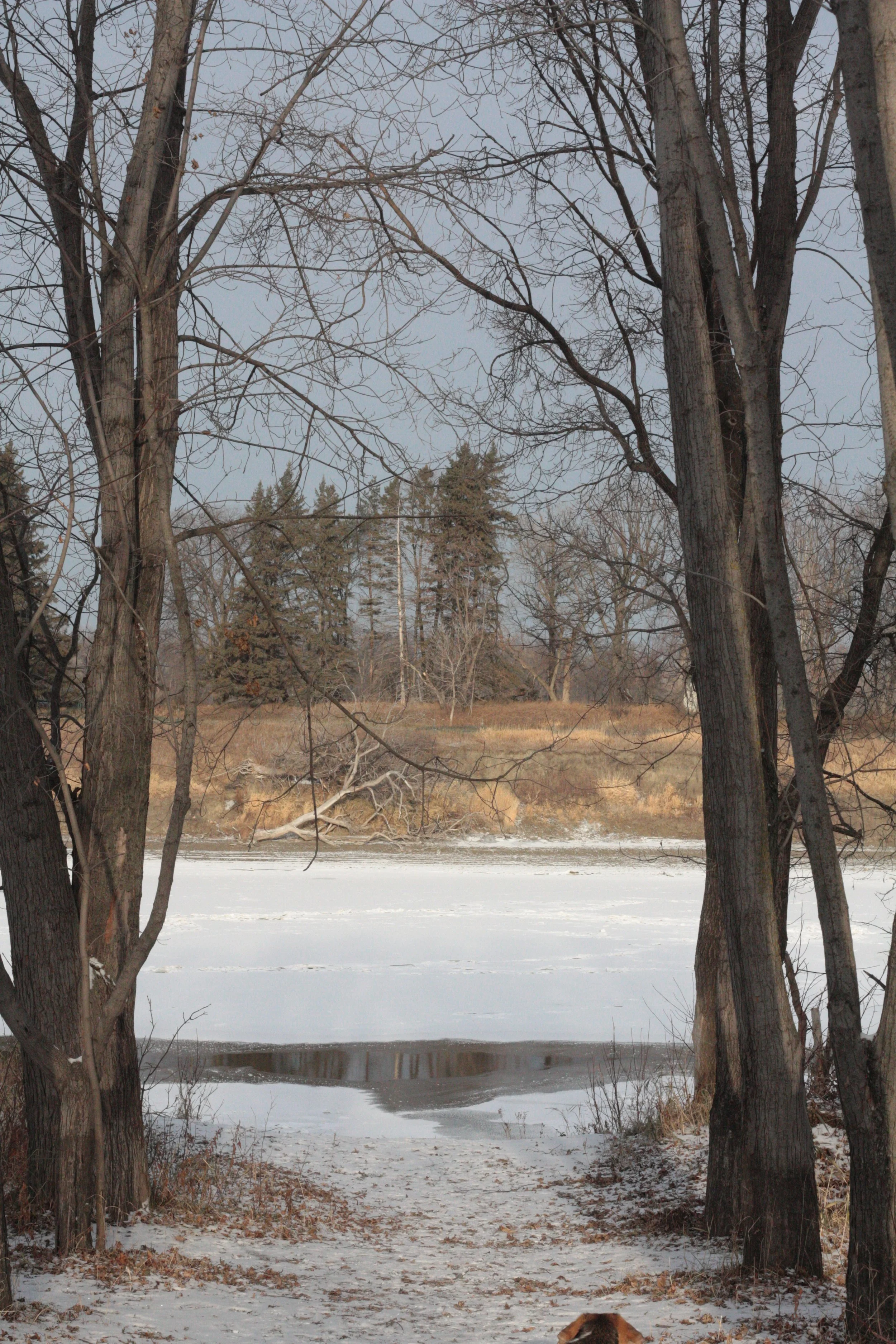
At the opposite end of “lunch out with friends in an artsy part of town” is an old establishment uniquely favoured by my mother-in-law... It’s Red Top on St. Mary’s Road, where she is such a loyal customer that they will fry up a plate of eggs and sausage for her at 6:45 in the evening. It was a surprisingly cozy feeling to be sitting in a booth while darkness descended and the skies continued to rain down on us. (The sausage btw was my favourite ever served in a restaurant so far...)

Postcard

Isn't fall pretty here?

Hope you are well. Happy Sunday!

A week on Sunday (no. 29)

Intro

Life's little upheavals that take me away from the finely-honed desk routine, that - granted permission in the name of flexibility - impinge on otherwise "ruthlessly managed" spare time, leave me sometimes in a restless craving for creativity. In fact, I think that's an understatement. 

When I can't sit and write, the air suddenly feels thinner. 

The strange thing is that at a remove from this practice, I get a little delusional... I start having doubts, like, "Surely, this writing is frivolous!" But then I start feeling ill and joyless and I have to rush myself back into this practice. The very thing you're reading is my cure against narcissism; it is an inherently humble way of sharing what I’m doing and thinking about.

Daytrip

Upheavals in my life aren't bad... summers in Manitoba are amazing and to be taken full advantage of. We joined friends for a little excursion to Steep Rock

where we ate lunch

borrowed a paddleboard

and watched the sun set.

And various other things...

Our godson made the local French-community newspaper La Liberté and I sent him pictures of us reading the article, as well as this little spoof:

Normally Christian plants a cherry tomato plant beside the garage door, but this year, the tomato size turned out to be unexpectedly small. They're a candy-tomato variety that are eaten like tomato-flavoured blueberries.

Leave them out on the counter to dry, and your son might rearrange them like so:

Enjoyed

This Canadaland episode on the Hudson's Bay history, apparently now for sale, had Taylor Noakes on as a guest, and at one point, commenting on Canada's history, he said: “I personally think that [...] a lot of Canadians, unfortunately, are really not comfortable with the complexity of Canada's history. I mean, this idea has practically been hammered into our own heads for decades that our history is not interesting.” 

That “not interesting” bit is kindling to the fire of any historical research I do!

In the latest episode of What It's Like to Be... Dan Heath interviews a speechwriter. I liked the whole episode, but I especially liked how the guest, Stephen Krupin, in answer to what “aspect [he] consistently savors” says:

I love in the writing process when you feel a puzzle piece clicking into place. Either a narrative device that through trial and error you discover and it holds the whole speech together, or a detail in the research or from history that vividly tells a story or an anecdote that serves as a perfect metaphor or maybe a counterintuitive twist that surprises the audience. When you find those and you think “this is something I can build everything else around”, or, “I can nail an ending, or nail the end of a section”, that feels really good.

Eating

For the longest time, my lunch has revolved around two eggs.

But recently, to follow in my fibre-preaching husband's footsteps, to not let this bag of Red River Cereal linger in the pantry and expire, I switched the main component, and now lunch looks more like this.

It feels healthful.

While I feel the same as Adam Roberts does about people's dietary restrictions... that they can be viewed “as fun, creative challenges,” I like to think that the attitude can be expanded to encompass my own family's food preferences. A recent win in favour of this point is Christian's comment that the only recipe in his whole life in which he actually likes black beans, is Deb Perelman's Swiss Chard Enchiladas. (You can have a peek on Amazon). (And yes, I've mentionned them before!)

Postcards

At the end of summer, plants look a little discheveled. The green has faded, and weeds, having claimed a space in the sun, stand about as tree leaves gather along the path they border.

The berries are abundant and colourful this year.

And some mornings this week have been so calm that the river was transformed to glass.

Trees are turning yellow, and geese are arriving…

Happy Sunday!
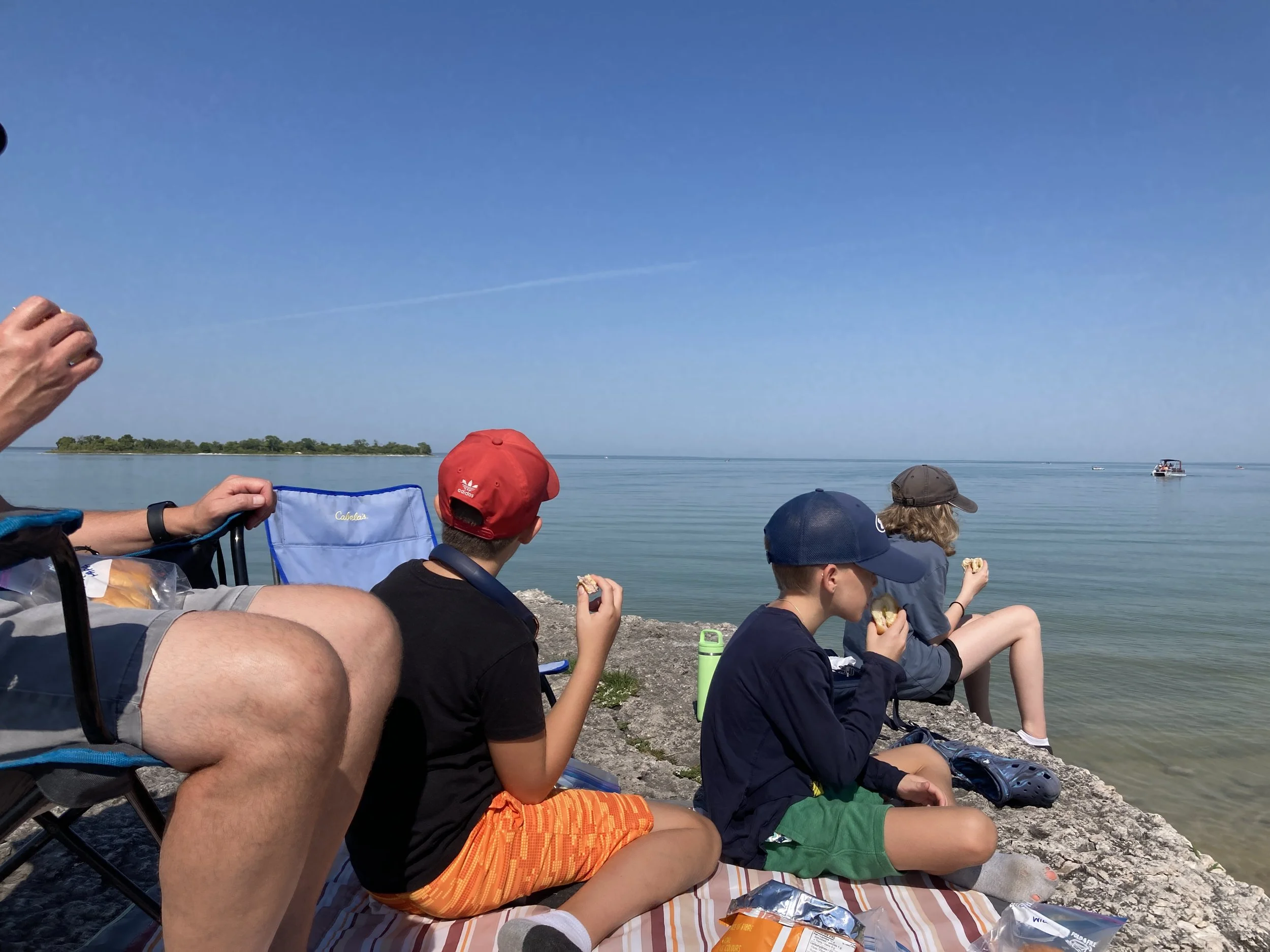
A week on Sunday (no. 28)

Lowly (Earthworm-Inspired thoughts)

Memories are a funny thing… a link from Jodi Ettenberg’s newsletter Curious About Everything to an article about earthworms vividly reminded me of having seen a (Canadian? National?) Geographic Issue with night-time earthworm-catchers on the cover. I’m sure of it! So sure of it that I feel old, and that the link in Ettenberg’s newsletter is like déjà vu, and has me tut-tutting young journalists for covering the same ground. The fact that I am given to that impulse, however light-hearted, makes me regret losing the enthusiasm I could summon when I felt like the world was full of possibility for any story idea that could pop into my head. All this to say that, here I sit in my comfortable mid-life teetering between that kind of can-do energy that lit straw-thoughts on fire, and a growing appreciation for something like lived experience… the glowing embers of steady heat. 

I don’t particularly care about earthworms. Why would that supposed (Canadian? National?) Geographic cover from when I was young struck such an impression on my imagination? “The worm hunters of Ontario’s” author Inori Roy does mention the spices and their having been imported from Europe… something I hadn’t known before until I read Candace Savage’s book Prairie (previously mentionned). On the prairie, ants are the dirt-moving stars: “So, despite everything we've heard to the contrary, the presence of earthworms in the soil is not always a mark of good health. Across much of the Great Plains, it is a prime indicator of disturbance. In arid regions, the work of digesting organic matter is assigned by nature not to tender worms but to the invincible legions of drought-hardy microorganisms. (...) Given their impact on prairie soil, it could almost be said that ants are the earthworms of the Great Plains Grasslands.” (p 93)

(This local artist made really cute worms a few years ago… See here.)

Attempting to find that cover in the archives, I came across this recent article titled “The silent migration beneath our feet” and felt, after having read it, a little bit of that old enthusiasm flicker. It ignites when the world feels big and unknown again.

Reading

I’m almost 200 pages into A Place of Greater Safety and rarely share books mid-read. However I couldn’t restrain myself from making a few observations. First, I find Hilary Mantel’s writing so funny. Take her depiction of Robespierre, who, from what I remember, became some kind of fanatic in the French Revolution, but here, is introduced to the reader as a young man with a careful diet and a demanding dog: 

…he eats some fruit, takes a cup of coffee and a little red wine well diluted. How can they do it, tumble out of court roaring and backslapping, after a morning shouting each other down? Then back to their houses to drink and tine, to address themselves to slabs of red meat? He has never learned the trick.

After his meal he takes a walk, whether it is fine or not, because dog Brount does not care about the weather and makes trouble with his loping about if he is kept indoors. He lets Brount tow him through the streets, the woods, the fields; they come home looking not nearly so respectable as when they went out. Sister Charlotte says, “Don’t bring that muddy dog in here.” (p 99-100)

The examples are too numerous really… Heading out on a little family road trip to the beach and chuckling over this paragraph obliges me to read it out loud:

The next year he caught smallpox. So did the girls; as it happened, none of them died. His mother did not think that the marks detracted from him. If you are going to be ugly it is as well to be whole-hearted about it, put some effort in. Georges turned heads. (p 11)

Incidentally, this book set against a view of Lake Winnipeg, is very pretty.

It’s very entertaining, but I catch myself wondering, a little suspiciously, if I want to trust this author? What an amazing talent, to tell me this story, as if she’s beside me, confiding all these details to me with a sly smile, delighting in my disbelief.

I broke away from the book to try and find her in “real-life”. I listened to a lecture. I thought I might catch a nap, but was instead fully awakened to subjects I love: writing, and the differences between historians and novelists who write historical fiction. She talks as I imagine she writes: smilingly. 

Eating

We pulled up some potatoes from the garden, mashed them and served them alongside Julia Turshen’s Rascal House Cabbage Rolls from Simply Julia, and these have been declared the best version of cabbage roll so far. Hooray for good recipes and Jardins St. Léon that sells Savoy cabbage! For dessert we served Panna Cotta with Rhubarb Compote (à la Catherine Newman), following the original, smaller amount recipe from Splendid Table.  It was a nice meal!

Decisions, decisions

I liked Elspeth Kirkman’s tips on making decisions on TikTok and have often used them myself. I’m not sure if I’m more decisive, but at least I don’t dither so long.

Postcard

A week ago we spent time at Albert Beach. As we were leaving, the sky looked like this:

Happy Sunday!
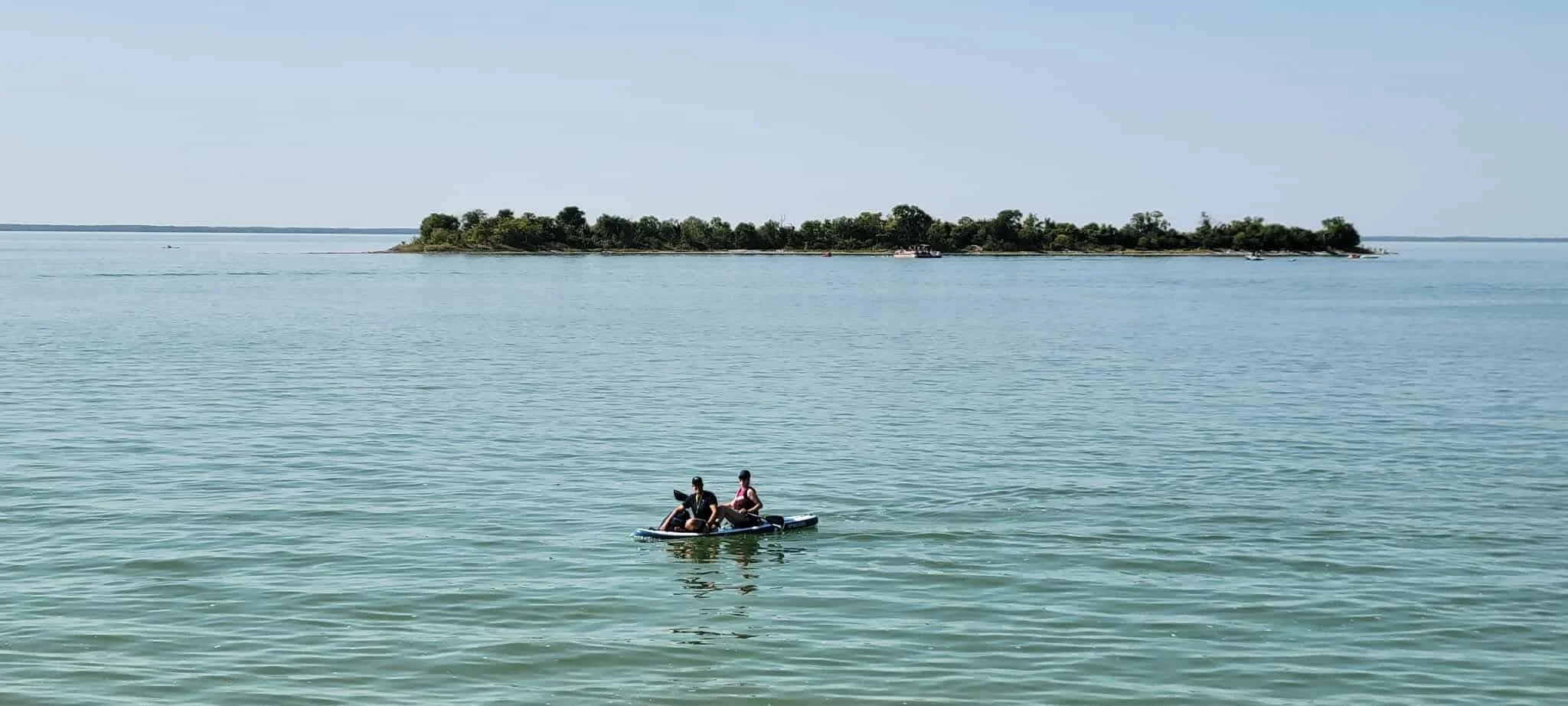
A week on Sunday (no. 26)

OOTD

Christian and I were invited to attend the wedding of a couple from Congo who settled and raised a family in Winnipeg. My wardrobe felt inadequate to provide the colour I was searching for for this joyful occasion and so I left my outfit fate with the thrift store gods and took myself browsing on Monday. Thrifting with such conditions isn’t easy… I checked dresses, skirts and blouses and was hours into this hunt when I started on pants, before landing on these, Diane von Furstenburg, my size, for 12$. I paired it with a blouse I had seen earlier and considered the hunt a success.

Reading

I finished a massive 1261-page book of William Trevor’s Collected Stories, begun months ago when the weather was cold and the skies were clear. (The book is so big that when my 87 year-old mother-in-law spotted it on my lap, she asked if it was a dictionary.)

Collected stories have a chocolate-box-like quality to them, and I find that I often forget a story after a little while, despite enjoying the experience of dipping in and letting my mind settle into a scenario. One story that does stand out in its entirety is titled “Her Mother’s Daughter” - its ending so perfect in its poignancy. Or perhaps I just found the themes relevant. 

But more often than not, it’s sentence here or there that I particularly like… Like, in “The Teddy-bears’ Picnic” where Trevor writes, “Their choice of decor and furniture was the choice of newlyweds who hadn’t yet discovered a confidence of their own.” Or, in “In Isfahan”: “Normanton wandered away from it, through dusty crowded lanes, into market-places where letter-writers slept on their stools, waiting for illiterates with troubles.” Another book off the list, done!
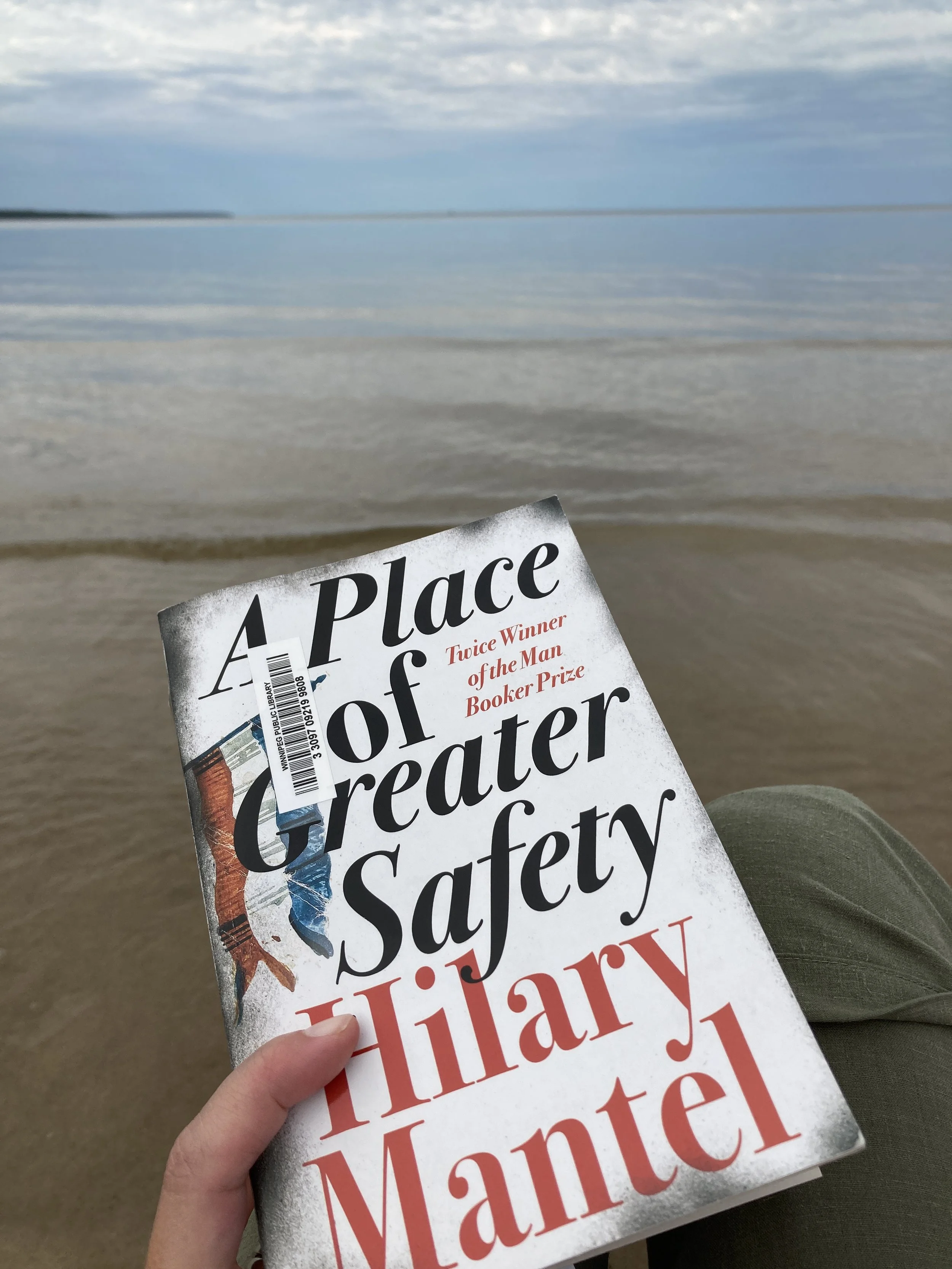
Satisfying

TikTok is full of satisfying videos… like the lawn-mower owners who clean up an overgrown yard (SB Mowing), gift wrappers (Bee and Blooms) furniture flippers (Build it like Becker) and sometimes the unexpected wedding dress restoration… 

Perhaps I find them pleasing because the hands-on-ness of their subject is in contrast to research. This (it’s kind of long…) Youtube titled “Why Are Movies About Research So Addictive” in Patrick Willems’ dissection of how Hollywood has found a way of portraying an almost un-portrayable job. (Via

Postcard

In lieu of the usual horizontal format, a nice vertical view of Albert Beach at the end of a nice afternoon, courtesy of Christian!

A week on Sunday No. 24

Decluttered

I was about to write how good it felt when I recently decluttered my closet. But something made this “does it bring me joy”-type session particularly satisfying… I think it’s this layered excuse - I hadn’t decluttered in years, because I’d been avoiding shopping (going months without buying a piece of apparel) because there was no time (shopping is intimidating, thrifting is a fun if laborious hunt) because there was no use (I was intermittently on some draft or other of my thesis, or research, down in the basement, hardly venturing out for anything more than strictly practical…). But this week some mysterious tipping point was reached, and I flushed my closet free of two bags of clothing.

When I look at the closet now, the image that comes to mind is of the basement in my childhood home that had an access to a pipe that would regularly get clogged. Mom would lay down newspapers for when the plumber would come, and invariably, the plumber was a man with big boots, hoisting a giant drain snake on his shoulder that rattled as he marched down the stairs. He would leave, blaming the epic willow tree in our yard for creeping its roots into the drain. 

My closet feels like a pipe that’s been unclogged. New energy runs through it.

20th anniversary

July 9th was the occasion for flowers, for lunch at a fancy place, and an afternoon at Thermea. Still spoiled 20 years on!

Baking

These are Tahini Chocolate Chip cookies from the KISMET cookbook, and they are soft and delicious. Zero complaints from the household members.

Informative

Sometimes I think back to my aging Grandmother, I’m struck by how little I understood, how little I could sympathize with the Aunt who took care of her. Adria Thompson’s TikToks at BeLightCare are a really nice resource I’ve been pleased to come across. There are things in life you have to live to appreciate.

Postcard

We are breathing the effects of climate change in the North, and a picture taken on Friday shows the smoke-fogged skies…

This milkweed is pretty cute though, with its pair of ants…

Happy Sunday!