A summary of my Master's thesis, completed in 2025

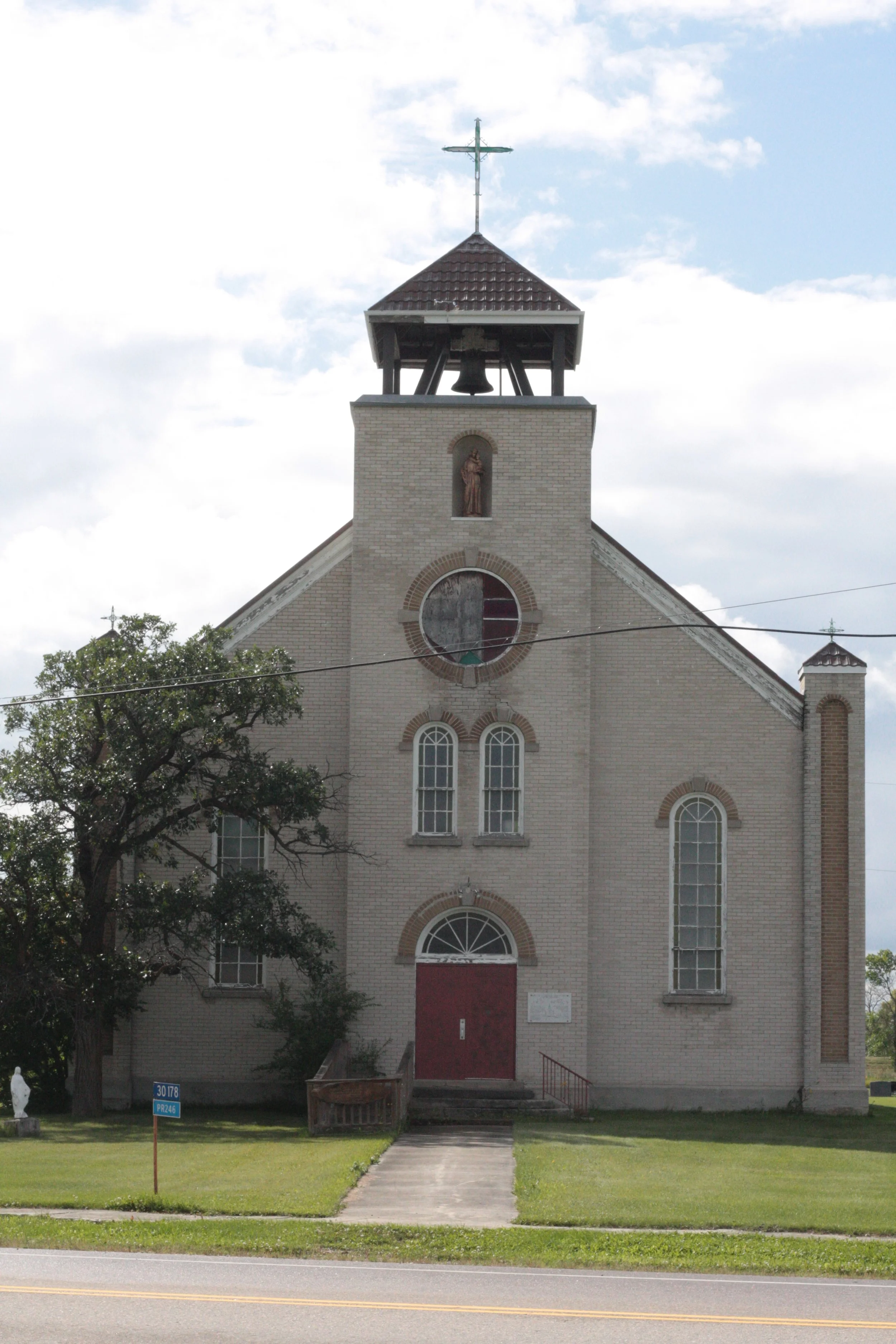
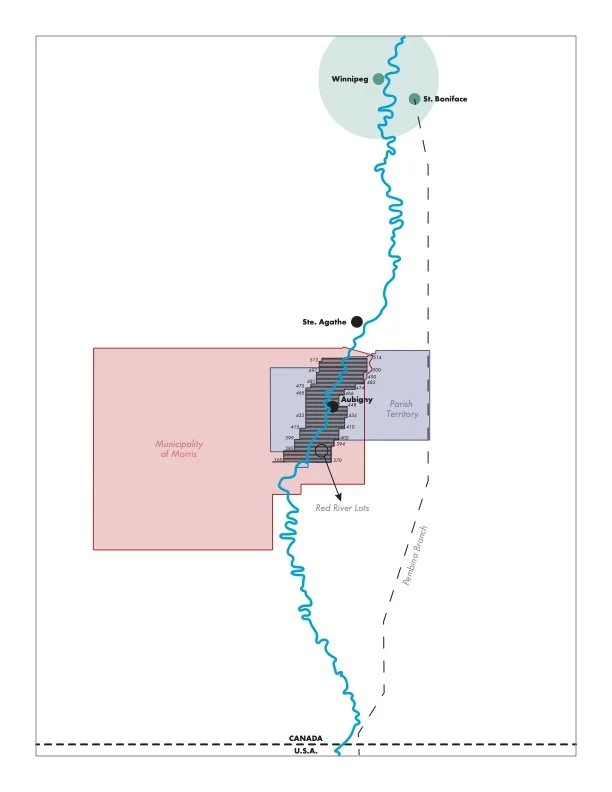
My thesis is a microhistory of the origins of a small parish 55 kilometers south of Winnipeg called Aubigny. Its church, named for saint Antoine (or St. Anthony), opened a registry in December of 1903 soon after the arrival of its first parish priest, Mathias Desrosiers. Part of the introduction to the thesis is dedicated to an examination of registry-keeping in the Catholic church; its origins in France in the 14th century and the method of its propagation in Canada. But forming the basis of the thesis are the questions that arise from Aubigny’s registries themselves. From names recorded at baptisms, burials and marriages emerge families and over time, a genealogy. Where were these families before they came to Aubigny? How did they arrive?

Chapter 1

As family histories stretched back in time, decades before Aubigny’s foundation, it was possible to organize families into groups based on the periods in which they settled within the parish territory. Thus, the first category is dedicated to the Métis families whose names are recorded in the registries. Of the five family names, four have ancestry that can be traced to the fur trade. And while microhistories can, in their tight focus, disconnect individuals from larger historical events, this is not the case for Aubigny’s Métis families. Among them are active participants in the tumultuous years of Louis Riel’s election as minister in the federal government, and a member of parliament during Manitoba’s establishment of a provincial government. Notable in Aubigny’s case is the predominance of one Métis family in particular whose descendants stretch into the 1960’s. Their name persists through decades of registry data which prompted a look at the Métis land question that forced many others to leave the area as well as a brief examination of Métis identity in Canada’s census records between 1870 and 1911. The registries, a memoir, and a local history provide little glimpses of their relationships and integration in the community.

Chapter 2

The second category of families to arrive in the parish are French-Canadian repatriates from the United States. The repatriates’ genealogy shows ancestry in Quebec, migration to the United States and residence in New England cities. Thus families are found working in mills and heads of families as laborers. They are also members of French-American parishes. Encouraging them to leave their life in the United States behind were the efforts of Manitoba’s French Colonisation Society. Le Métis archives provide an overview of the propaganda in this period and the various methods used to convince families to immigrate. It also provides a means of tracing these families’ travel routes in fair detail. Their arrival to Aubigny in the late 1870’s marked the parish’s first French-Canadian pioneers; it also marked the crest of Manitoba’s repatriation movement.

Map credit: Annaleah McAvoy

Chapter 3

Finally, the third category of families, and the largest in this parish’s case, are those who came from Quebec. Of the 19 families, ten came from the region of Lanaudière. Although travel routes were continuously improving in this period, the decision to take up farming in Manitoba was not easily executed. The Colonisation Society’s efforts ebbed and flowed and were constrained by Quebec clergy’s favourability toward the scheme. Correspondence preserved at the Société historique de St-Boniface shows how the priest’s arrival in Aubigny was partly based on a misunderstanding. It is also a window onto the financial challenge of the new parish’s establishment and growth within the St. Boniface diocese.

Chapter 4

As family genealogies filled-in, one feature stood out: a complex web of connections among families which solidified a sense of community. The fourth chapter is therefore dedicated to the ways that a registry uncovers kinship. There are the relationships that facilitate the decision to migrate, for example, and the marriages that occur among settlers to an area. As couples have children baptised, their choice of godparents from among immediate and extended family or from among friends of no apparent relation, flavour the definition of community. The registries having been maintained over a century also offered a chance to analyse families’ persistence in Aubigny.

A few thoughts conclude this thesis: it is an appreciation of pre-existing local histories, a tangible application of information from a variety of archives and databases now available, and a defense of in-depth, tightly-focused research. Perhaps by rendering a higher-definition picture of one French-Canadian parish on the prairies can the endeavour spread and sharpen appreciation for other communities’ particularities and participation in Canada’s history.

The complete thesis can be found here.

Completing a Master's degree: a retrospective

I began a Master’s degree program in September of 2019 with the University of St. Boniface. Having completed the coursework in 2020, I met with my new director of research and two committee members and when they asked how long I thought it would take me to complete the thesis, I answered breezily, “two years.” They approved. I liked writing, and I had already begun research. In fact, the main reason why I enrolled in the program, was to be able to conduct research and produce a creditable piece of writing; why not get a diploma at the same time?

The fact that I completed the program six years later, taking five years to write a thesis rather than two, is something I wanted to write about here. In particular, I wanted to seize the chance to discuss what it feels like to write a thesis, now that it is done, and why I felt I couldn’t do so in the middle of writing it. Indeed, I tried… I created a category on the blog called “Student dispatches” and figured I’d regularly write about my progress. This was the first mistake: thinking that this process could fit a word with the definition of “onward movement following a prescribed course.” (OED) Far from being the road trip I imagined, research and writing felt more like a parenthetical period in which I left the road, bushwhacked a path in the forest and set up a cabin off-grid where I drank tea every morning and hailed homing pigeons for messages. Hattie Crisell in one of her newsletters quotes David Bayles who writes “the artist’s life is frustrating not because the passage is slow, but because he imagines it to be fast.” To which she adds, “I write every day, but it takes me so long for an idea to crystallize and become substantial.” Therefore, spending so much time working on the process of producing something substantial, I could not then spend more time trying to explain that, let alone trying to understand and distill it at the same time.

Nevertheless, I did try, especially at the beginning. I quoted authors, particularly when I felt a kind of convivial reassurance. (An example here and here). Perhaps the blog-post that now feels most apt to describe the early period of research is one in which I use horse-riding as a metaphor. I’m not sure it’s the first metaphor that comes to mind now, but the feeling rings true.

One of the main reasons it took me so long to research and write, was that I prioritized my parenting responsibilities over my student role, and incidental to this were the events surrounding the Covid-19 pandemic. For a period of time, I was home with three children for the length of school-online protocols. There’s a little snapshot of that here, a humorous post about the archives being closed here, and then what it looked like when they re-opened here. Pandemic aside, if I had to cut back on time consecrated to research or writing in favour of childcare, or the regular duties of meal-planning, cooking, entertaining, and – eventually – care-giving, I refused to stress over it. Sure, I wished I could work faster and mark tangible progress, but being a student was its own pleasure and it could feel like a privilege to be able to take a break from typical stay-at-home roles to spend time at the library.

More, more, more research

What felt most challenging about writing a thesis was being confronted with my own ignorance. I can’t help but think of Donald Rumsfield’s “unknown unknowns”. For all the mockery he received, the words describing the amorphous thing I felt I was battling against ring true. In Understanding Ignorance Daniel DeNicola writes:

Ignorance devastates. Every one of us – however intelligent and knowledgeable – is bedevilled by our ignorance.

I began this project as a pretty good essay-writer. On the strength of that, I was hired as a writing tutor for undergraduate students. I thought a thesis was like writing four or five long essays. Disabusing myself of that preconception, when, for example, I would submit a draft of a chapter to my director, only to realize that I hadn’t gone deep enough in the research, felt really hard. I prided myself on research and detail, and yet, after submitting those first drafts, the director’s remarks – kind as they were, I hasten to add! – felt like I was being turned in my chair, and pointed in the direction of a curtained window I didn’t even know existed, and being asked, “have you considered opening the curtain and taking in the view over there?” This happened devastatingly at first for drafts 1-2-3 of the first chapters. I got better as I tackled later chapters (I checked for more curtains in advance!) and feedback felt less devastating.

What I now know was happening between those drafts of chapters was what Daniel DeNicola calls cogitation. He writes:

our curiosity can lead to cogitation – identifying, associating, classifying, inquiring, researching, computing, assimilating, comprehending, explaining – activities that render the unknown, known.

Thinking is hard. For me, it goes hand in hand with writing: I write to understand what I think. And it can be deceiving to suppose that all you have to do is to sit down and write… Often sitting down to do so lead to what Julia Ioffe describes:

Sometimes, just the act of banging your head on the blank page, of starting, failing, deleting, restarting, helps you figure out where the writing needs to go. Sometimes, it makes you realize that you just don’t have what you need yet, that you need to read or research more—which can easily turn into procrastination.

The frustration of being unable to simply produce 500 words on a page would lead to fumbling around for clues… “What am I not understanding? What am I missing here? Where do I go?” I found it very comforting to understand that this was normal, thanks to Virginia Valian’s essay “Learning to Work”. I wrote a short blog post on the subject in April of 2024.

Here’s an example. I had gathered a list of family names and decided to divide them into categories. One of the categories was the Métis families. In tracing their history (when they came to the area of Aubigny, how many families there were…) I looked through Federal census data and found their names. I saw that when it came to declaring their origin, the census indicated “Métis French”. I couldn’t understand the strikethrough. Why was it there? What did it mean? In a first draft of the chapter I referred to another research paper that noted the same thing in another parish and I quoted other research on Métis identity. It was vague. My director’s comments encouraged more specificity. Basically, my first draft sounded like: “look, I noticed this, and, uh… maybe it means this?” I had to dig more. I had to find more research on the subject of federal censuses and how Métis were identified in them. Time spent reading a variety of sources and analyzing census instructions to the enumerators lead to a better understanding of the context and, consequently, confident paragraphs.

Organizing an argument over multiple drafts

Another example is something Robert Caro mentions in the documentary Turn Every Page. He describes all the time spent in the archives, and how, as a project progresses, an item that was previously dismissed can turn out to be important at second glance. It wasn’t so much that I overlooked something that became useful, but rather that I had something useful but didn’t know how to demonstrate its importance.

I had already started doing research into Aubigny’s history in 2014 and I was determined to find something that would explain how the town got its name. I found a letter by bishop Langevin who writes that he gave the parish its name to associate it with a French nobleman – Jacques d’Aubigny. It felt like I had made a significant discovery, but I was unable to communicate why it was significant. A blog post from 2015 narrates the facts, but does not provide their significance. In one of my thesis drafts I thought more detail was the answer, and so I wrote Jacques’ biography. He became a monk, and I included the chronology of events in the development of the Trappist order in Manitoba. It was a quagmire and my director wanted it to be entirely cut from the thesis. However, I couldn’t let go of the chance to correct the record on the origin of the town’s name. What did it mean to Aubigny’s pioneers that their parish name was associated to that of a once nobleman, now Trappist monk? Finally I understood… All these letters detailing costs of church building, the articles describing fundraising outcomes, the evidence of the priest’s efforts to make a decent salary and Langevin’s forceful defence of the construction of the new cathedral in St. Boniface all point to the precarity of small parishes. That Langevin named the new parish after a personal acquaintance in the French community shows a roll of the dice for a chance of favouring the new foundation.

How writing is thinking

Writing drafts of chapters often followed this pattern… I would organize the facts, or explain the chronology of events and have a nagging feeling that something was lacking. Feedback would confirm it, I would momentarily feel awful, and then it was time to get back to work. It’s reassuring when writers like Elizabeth Day admit similar sensitivity. In an interview she says: “I am really quite thin skinned. I’ve worked hard on that. I try not to be, but I think a lot of writers are extremely sensitive – you have to be to let the world in.”

The lack of control is another aspect of writing that can be diagnosed in the “bushwhacking a path” metaphor used earlier. A plan was required before I could begin writing and I found this very challenging. It is what is so disconcerting about books like Doing Your Master’s Dissertation: From Start to Finish by Larry Euris Everett and Inger Furseth. Useful as a guide to analysis -

You are expected to always do your reading in a critical manner. A literature review consists of more than just a summary or a description of other people’s work. It is an analysis in the sense that you are required to extract different forms of information from the literature and assess it by asking questions and critiquing it. (p 77)

- the tips on writing are deceptively simple, like the following, “it is important that you practice writing.”

Later, I found Writing Without Teachers by Peter Elbow. He writes:

If the main advice people need to help their writing grow is to start writing and keep writing, their main experience in trying to follow this advice is the feeling of chaos and disorientation. (p 30)

Published in 1973, his book is perhaps one of the best at describing the work of writing...

[…] the ability to write is unusually mysterious to most people. After all, life is full of difficult tasks: getting up in the morning, playing the piano, learning to play baseball, learning history. But few of them seem so acutely unrelated to effort or talent. (p 12).

And,

The commonsense, conventional understanding of writing is as follows. Writing is a two-step process. First you figure out your meaning, then you put it into language. Most advice […] follows this model: first try to figure out what you want to say; […] make a plan; use an outline; begin writing only afterward.

Elaborating on this, he writes:

This idea of writing is backwards. That’s why it causes so much trouble. Instead of a two-step transaction of meaning-into-language, think of writing as an organic, developmental process in which you start writing at the very beginning – before you know your meaning at all – and encourage your words gradually to change and evolve. Only at the end will you know what you want to say or the words you want to say it with. You should expect yourself to end up somewhere different from where you started. Meaning is not what you start out with but what you end up with. Control, coherence, and knowing your mind are not what you start out with but what you end up with. […] Writing is, in fact, a transaction with words whereby you free yourself from what you presently think, feel, and perceive. You make available to yourself something better than what you’d be stuck with if you’d actually succeeded in making your meaning clear at the start. What looks inefficient – a rambling process with lots of writing and lots of throwing away – is really efficient since it’s the best way you can work up to what you really want to say and how to say it. The real inefficiency is to beat your head against the brick wall of trying to say what you mean or trying to say it well before you are ready. (p 15).

Although his argument coincides with my experience, I suspect that research directors in academic programs would be reluctant to forgo the planning stage with their students.

A nice realization at the thesis defense

In September of 2025, I defended my thesis. The University of St. Boniface is small and family-like given its place in the French community. I gave a summary of my thesis to a handful of people besides the program director, the director of research and two committee members. My favourite question was one I didn’t expect, and when it was asked, I had the strange sensation of feeling like I was a guest on a podcast… “Did anything surprise you in the course of this research and thesis writing?”

What surprised me most about the research I had done was discovering an appreciation for francophone culture. I didn’t grow up with this appreciation. I went to a bilingual school from kindergarten to grade eight and then attended l’École Canadienne-française for high school. If French was touted as an advantage for finding a job in elementary school, it was something of a moral obligation in high school… You spoke French because it was part of you (to be admitted as a student, you had to have French ancestry) and you were proud to belong to the French culture. That was an idea my mom poo-pooed with typical regularity. My dad, who was Irish, seemed more proud of having married a “French” woman and I remember him crediting my maternal grandmother for our eligibility to attend the only francophone school in Saskatoon. But we didn’t lean in to the French culture any more than that. At home, we spoke English.

Having spent years immersed in tracing family genealogies and the vagaries of immigration at the beginning of the 20th century, I’ve come out on the other side with a deep respect for the enterprise they undertook, the actors involved, and the development that unfolded. Perhaps the greatest gift historical research can bequeath are moments when people who have shaped the present don’t feel as absent as their gravestones would indicate. Finishing this program I think I feel both humbled and elated at the same time…
Biographies

While I'm writing my thesis, I like checking people's names, to see if they have interesting biographies. 

Consider Adrien-Gabriel Morice. He wrote three volumes on church history in the West in which Aubigny's name is linked with vicomte Jacques d'Aubigny. But he was an insufferable man. He joined the Oblates but could not obey superiors. He was sent to a mission where there was one other priest, a Fr. Georges Blanchet. And this is what happened:

he made life so difficult for Blanchet, a gentle man much loved by the Carrier, that later that year the priest begged to be transferred before Morice’s perpetual disagreements drove him mad. That year Blanchet ceded supervision of the mission to Morice to avoid further conflict, but he would remain there, building churches and doing housework, until his retirement ten years later. A succession of priests, finding Morice impossible to work and live with, and refusing to become his servant, chose to leave.

What a character!

On another day, I checked this railroad contractor's name to discover that his daughter was more renowned than he was... Charlotte Whitehead Ross was the first female doctor in Montreal, having taken her medical education at Woman’s Medical College at Philadelphia in 1870, while also bearing children. She came to Manitoba in 1881 where she continued to practice medicine. Her biographer, Vera K. Fast, writes: 

After assisting at a birth she would often scrub the cabin floor and do the washing, the cooking, and the baking to help the mother and family. Her daughters looked after the Ross home in her absence, although she always did the baking, which she enjoyed, as she did embroidery, knitting, and music, especially the piano. 

She was never licenced in Manitoba, and a bill to authorize her to practice in 1888 was withdrawn. I like how Fast writes:  

Undeterred, Charlotte continued on her busy rounds by horse, sleigh, canoe, and train, not defiantly, for she was no social or political activist, but simply because there was a need.

Biographies are inspiring!

Working on a Master's degree feels like learning to ride a horse

I thought that the experience of being a student would provide lots of writing inspiration, like an insider view as I explored realms of information. But it isn’t that… Being a master’s student is more about patient labour than anything else. I imagine that it’s like seeing a horse in the wild… “Wow!” you think. “What a beautiful horse!” It’s gem-stone eyes look like they beckon to you and you want to know this horse. You daydream about one day riding on its back.

Do you know how long it takes to domesticate a wild horse? I don’t. I do remember reading a book titled The Horse Whisperer when I was in high school. I thought it was fascinating. I thought I would like to train horses like this guy said he did. It seemed magical. I lived in a family that thought all kinds of things were possible.

Do you know how to train a horse? I don’t. Almost two years ago now, we bought a puppy and I cried tears of frustration over its training. It is a beagle, chosen for its medium size, its adorable face, its friendliness. A horse would be intimidating, the way zooming out from your house on Google earth is intimidating: my kingdom is a disappearing collection of pixels.

So I’m not sure why I chose this horse metaphor, except that in my imagination the information I’m handling feels about as big as a horse… not impossibly big, but still unwieldy. And then managing that information so that I can say something interesting about it, also feels like a kind of domestication. It requires organization and understanding. When I’ll have managed this, I think it will feel as if I’d mounted a horse and rode it to a destination.

In movies, characters just get on horses no problem. If there’s a problem, it might be saved for the blooper reel. Outside of movies, riders take training. Has there been a slow-tv channel dedicated to someone’s training? No. That’s because training is long and boring and has progression but also setbacks and good days when things go according to plan and days when other things interfere and the project is set aside. It is more interesting to pretend to sit in a train as it travels through tunnels and a frozen countryside than it is to be submitted to someone’s training. It is why time-lapse was invented. (No. But the invention of time-lapse is horse-related!)

To conclude, as students say when they’re finishing an essay, I’m working on my master’s degree, but writing updates on the subject is not as exciting as I thought it would be. It’s a rite of passage, a professor told me, and it’s true. It’s this academic training you submit yourself to, and it’s not meant to be very exciting.

Two history-related things

I was a teen when I watched Chariots of Fire. I loved the movie: the English countryside, the romantic scenes, the upright main character… and I wished I could run. I liked the story and I thought that the scene at the Olympics was just another scene. That scene when the trainer is in his room and sees the flags raised and knows his guy won the gold and so bites his knuckle and punches through his straw hat out of happiness… I had no idea that all this quiet celebration was because coaches were banned from the Olympics. I learned this today, listening to Michael Lewis’s podcast Against the Rules (episode: The Unfair Coach). In the episode he interviews a historian who talks about the British class system in 1924, when coaches were frowned upon.

On Steven Levitt’s podcast, People I Mostly Admire, (episode 62), the historian Brad Gregory says: “A good historian is somebody who evokes and enables us to understand that even though somebody might have lived dozens, or hundreds or thousands of years ago, the three-dimensionality, the lived-reality of their human lives were every bit as real as the lives that we’re living now. When history is reduced to lists of names and dates and important battles and treaties and so forth, that’s when the blood is sucked out of it, so to speak, and I think that’s partly why people don’t like it.“

The point is: history is full of interesting stories; research makes them come alive.

Groundhog day

I thought I’d pop out my head, like the groundhog, so busy underground, so absent-seeming on the drifts of snow. There was a blizzard yesterday, and then, just like that it stopped and the sun came through and filled the sky with a gentle yellow.

I filled up a sketchbook. It’s not really anything I want to show, even though I caught this quote by David Hockney who said: “… of course, art is about sharing”. I’m sure he’s right, and I’ll feel that way eventually. For now, I hold on to a thought from Paul Heaston on the Sneaky Art podcast: “…you become so results oriented that you would rather see no result than a poor one, and that goes back to everybody no longer being creative. It’s like, because the idea of being a failure is much more horrifying than doing something at all, that you don’t even do it.” It’s about patience. Jared Muralt in an Instagram post wrote: “Drawing mountains is like mediation for me. I constantly got confronted with my own impatience. But to succeed I have to focus on what I do and only that.”

I will pop in again to add books read to the reading list, to share pictures of the dog and a handful of quotes. For most of January, the kids were home from school. I sat at my desk for only the most urgent work. I joked in our family newsletter that my studies had been pushed so far to the back-burner as to have fallen off the stove. But in the quiet of the house right now, I can see myself picking up the contents and bringing them back to a warm simmer. It is what groundhogs do below four feet of snow.

Hiatus-ing a hobby

Oh dear! Have you come looking for new content? I’m afraid I must disappoint you for a moment… I’m not sure how long. See, there’s this degree I want to get on with. It requires data organizing and then, once that’s done, it requires about 60 solid days of writing 500 words a day. Once the words are written, I have to add the proper references, for the bibliography, and I’m sure that will take a week… And then I have to go through the stack of pages I’ve written and edit them after they’ve rested awhile. Once that’s all done, I hope to get an official paper that says I’ve earned a Master’s.

I really like writing. I like thinking of things to say and pushing past reticence into thoughts that make some sense, that give me joy just to see “published”. It has been a gentle form of accountability, of proving to myself that this is fun more than it is scary.

I might pop in sometimes though, but mostly, I’m taking a moment to focus on academics and fill a sketchbook with silly things.

Cheers!

In the archives

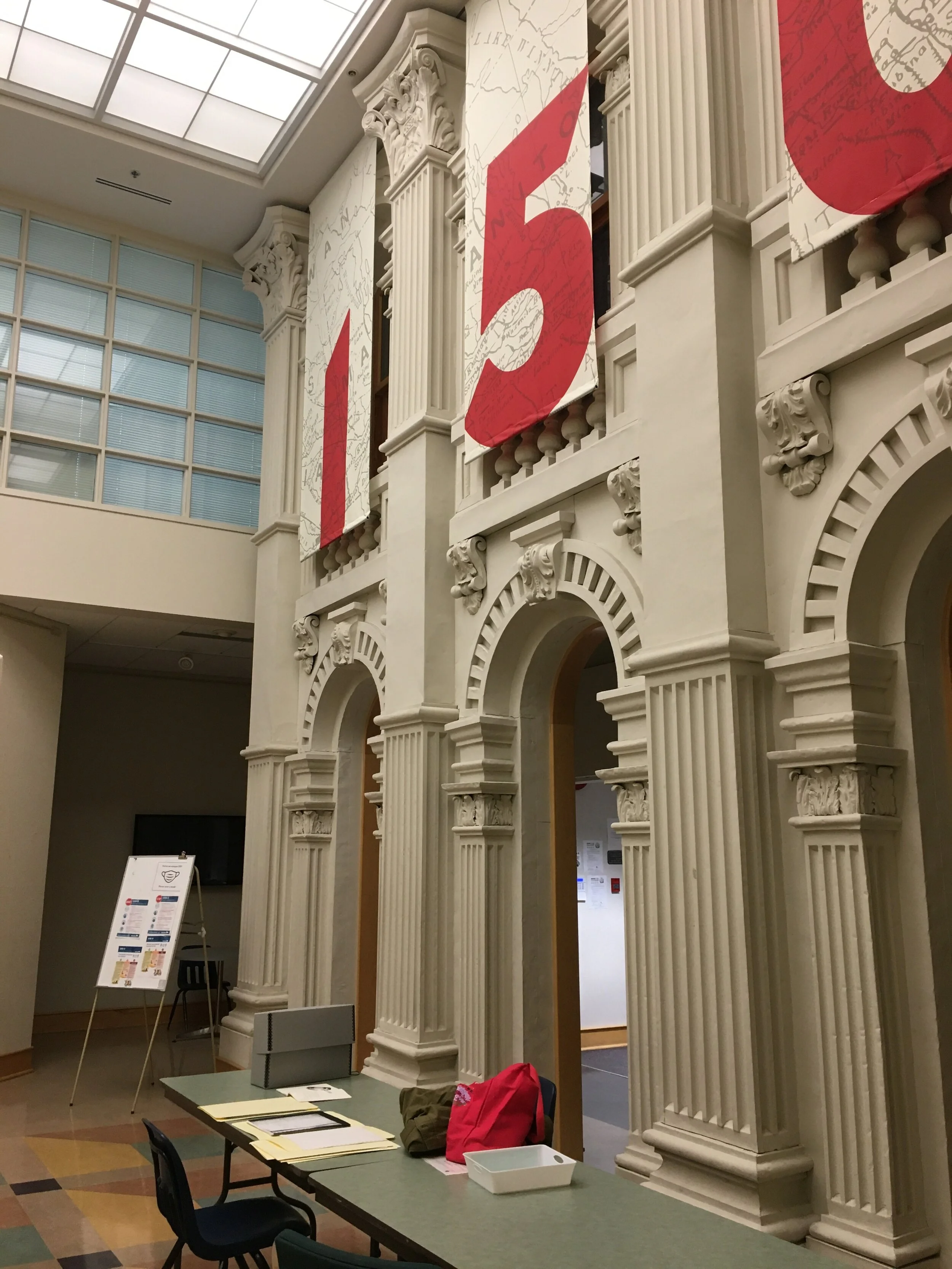
Yesterday I went to the Saint-Boniface archives. Covid protocoles make for socially-distanced desks, and yesterday my desk for reviewing documents was just outside, under the arches of a preserved wall from the Empire Hotel.

IMG_9011.JPG

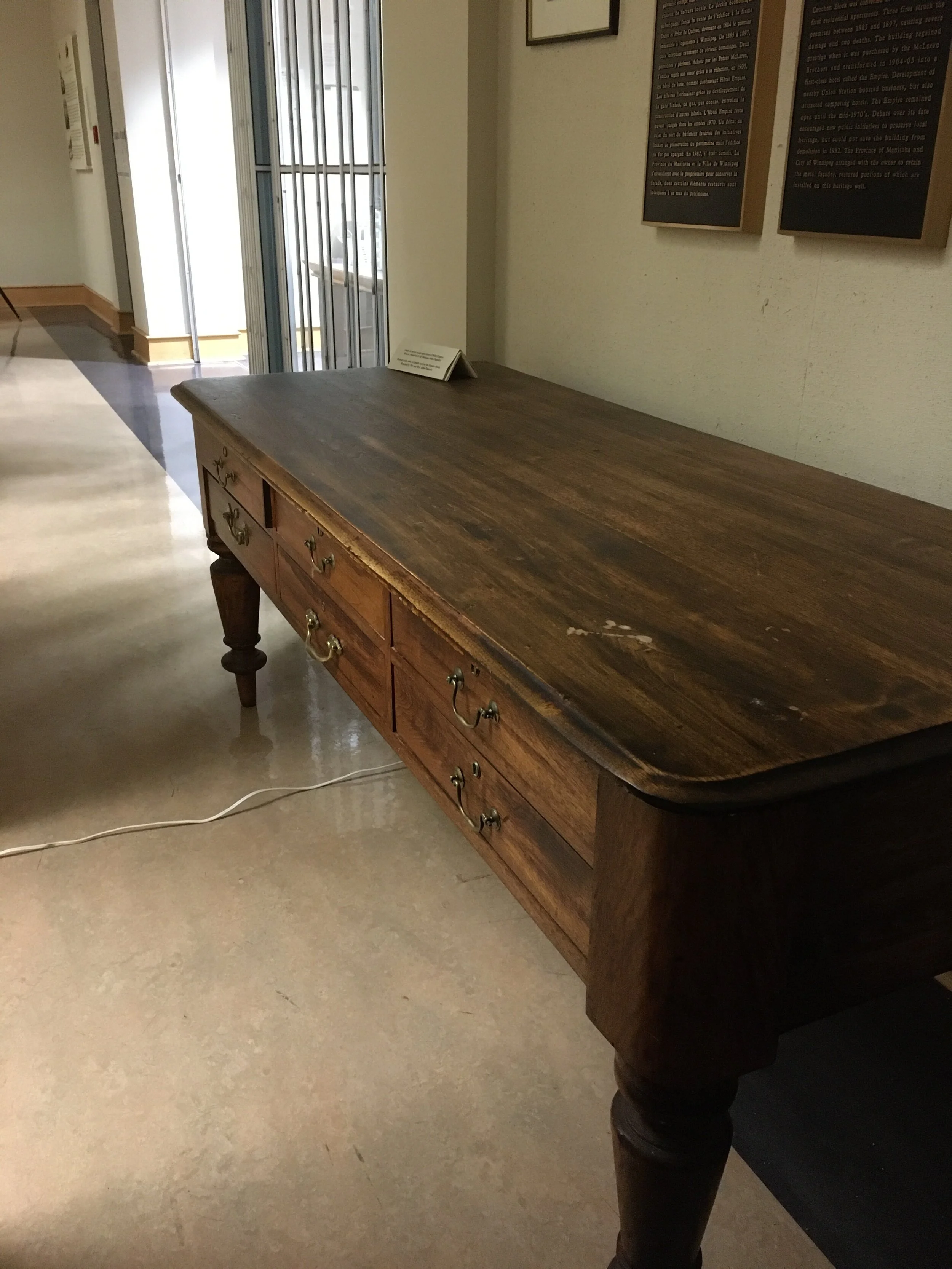
Behind me was a wooden desk, also from the Empire Hotel.

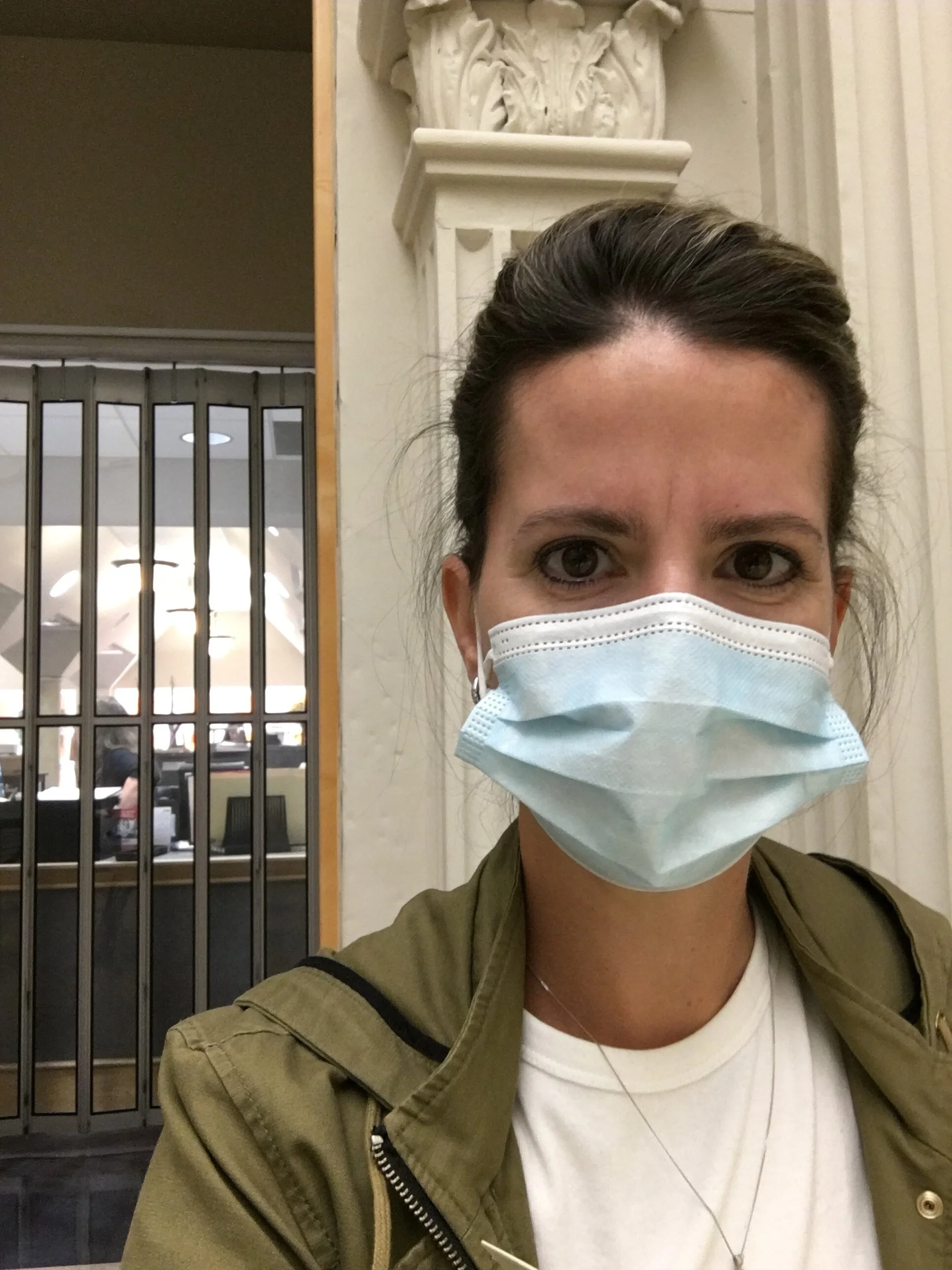
Covid protocols keep me masked. Documents are all safe from my exhalations.

IMG_9015.JPG

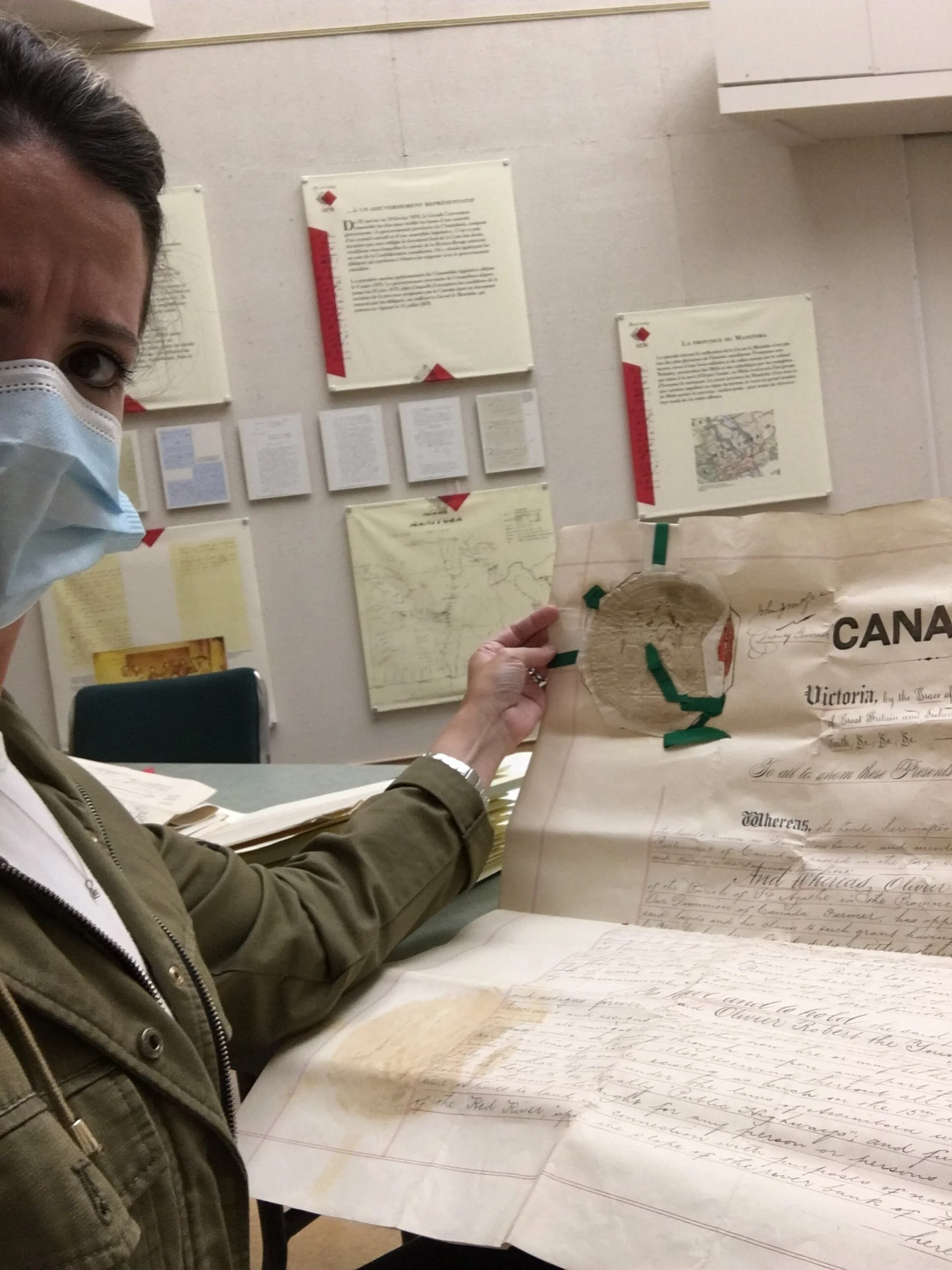
Some documents are huge!

IMG_9016.JPG

This is a land title document with an impressively huge red wax seal, covered for its protection, still bearing pretty green ribbons. Her Majesty Queen Victoria is mentioned. It is dated 1888. Not all documents are so big and land titles eventually shrunk. But I like to imagine the office where this was written, the officious people who dipped their fountain pen in an inkwell, the giant seal and the man to whom the land was granted, walking out with this massive paper, to go farm a plot in relative isolation, going to bed at night in a rudimentary wood log house.

Foreign lands

I am deep into research, trying to wrangle information gathered from archives into a neat container that one calls a thesis. I’ve come to recognize this feeling from research projects past and my favourite metaphor is one of travel…

Craig Mod in his final picture of a pop-up newsletter called “Huh” captured the feeling in a few phrases: “what I remember most about this moment is how foreign and unknowable it all felt, an impenetrable newness, and for a second five lives (Derro just out of frame) converge and information is exchanged and, with a dollop of confidence, we take the very first steps of the long walk that starts it all.”

Burrowing into the past is much like travelling to another country… You have to find your bearings - the people and the places that were different, the organizations that existed then that don’t now, the customs that were common then but sound so unusual now.

Here's what to do...

Because the kids were home from school, doing school at home, I too stayed home but did no school. Sacrificing school was fine, I told myself, because summer would come and teachers would be home too, and I’d pick up my research again like an old friend, and push ahead with plenty of time for my own study.

So bright and perky on that first day of summer, I checked in with the archives and got an e-mail after the weekend was over, to inform me that the archives are closed under provincial restrictions.

Small spaces with lone researchers are taboo places for Covid cases. Things like old paper shuffled in the silence of concentration in air-conditioned rooms, just lay welcoming viruses, you know. And then I suppose that when the province puts archives into the same category as libraries and museums, disgruntled historians are too few in number, too shy in disposition perhaps, to make the necessary ruckus required for 25% capacity… or 50.

“I’ll bet you,” my husband said, “I’ll bet you Thermëa is open.”

And he was right.

So I took my pale skin to Thermëa, with him, where we shocked our systems hot and cold and laid in the sun, where I temporarily, really, only for a moment, forgot that I could not go and spend time looking through Langevin’s letters under high-ceilinged fluorescent lights.

Gathering clay

For the heck of it, I started listening to early episodes of one of my favourite podcasts, Longform. In episode 9, Jeanne Marie Laskas describes how getting material for a story is like gathering clay:

(I talk to my students like this…) I always feel like I’m like a potter, like a sculptor or something like that. And when you’re reporting you’re going out and you’re just like, gathering clay in a riverbed, like, you just got to get all different colours and all different textures and you don’t even know what you’re going to do with it. But you need the clay! You can’t make anything unless you get the clay. And then that’s a whole stage you’re going through, and then you’re bringing that back and you got these lumps. And it’s just like, you just went to a store and bought stuff, and you’re just like, “now I have all this now!” And then you get to play with the clay! 

The metaphor is pertinent now, as I tunnel through research in order to write a Master’s thesis. The small town’s registry I’m studying has an interesting connection to the larger French community, because over the years, when the Catholic Church was the dominant influence, the community newspaper would also record baptisms, mariages and deaths. Right now, I’m noting how many of the registry entries were also reported in the newspaper in order to see if patterns emerge. I’m gathering clay.

NBD

In the ninth episode of the “Darts and Letters” podcast, the host, Gordon Katic, interviews a person who writes papers for students across a variety of academic disciplines, for a variety of programs. The anonymous guest reflects on his ability to meet his clients’ expectations by professing “a natural curiosity for subjects” and an aptitude for “pattern recognition” that can appreciate and imitate a discipline’s “jargon”.

I’m against academic dishonesty, and I’m far too interested in writing my own paper and far too poor to pay someone else to do the work. That being said, this interviewee is a surprising source of motivation… Procrastinating, like a regular student, he says, he manages to turn in lengthy assignments in a short time. It has cheered me to think of this “Bill Faulkner” reading a Master’s degree thesis or two in Canadian history, and sitting down and producing a 120-page document in a week like it was no big deal.

Humility

Somewhat hilariously, I’ve been listening to a CBC podcast based on an American podcast’s recommendation, as if things, before they should reach my ears, must be American-approved. Have you ever noticed that? Those little moments that force you to rethink things? I’ve heard so much about Adam Grant’s latest book Think Again and I think fussily, like a person who has too many jotted-down titles of books they should read, whether it is really necessary to read this author’s take on something I suspect I already know?

The other day for example, I was in Wal-Mart and I passed two women who were considering a mass-produced painting of a Parisian street with the vague outline of the Eiffel Tower in the background. “I don’t know what it is, but I love this painting” the one was saying to the other. I inwardly scoffed. How can you fall in love with a fake-as-heck piece of reproduction art? What about supporting local artists, eh? But the next aisle over I chastised myself for the unkindness and remembered what my mother-in-law has often repeated: “tastes cannot be argued” (Les goûts ne se discutent pas!). Then, while looking for a lucite organizer tray, I came across stark white canvases with flower outlines in gold and imagined how nicely the frame would look against our slate-blue wall and protectively tucked this rectangle piece of decor under my arm all the way to the self-checkout.

I’m pretty sure that to be interested in history is to engage in a flexible state of mind. I grew up not caring about Canada’s problem with its Indigenous Peoples, but a few courses in to a history degree will force any student to re-think. I’m listening to CBC’s Missing and Murdered: Finding Cleo, thanks to a recommendation from the Longford podcast. It’s well-produced. It’s also devastating. It reminds me of reading Halfbreed by Maria Campbell.

I notice in these moments how the book, or podcast, or documentary, or university course, provides a vantage-point with which to view the tiny space I occupy. It is humbling. It is also a source of pride. Like a person who has travelled to a new country and now brags of their visit there, I have gained some partial understanding of a minorities’ situation. I feel this as a kind of paradox. Learning more about Indigenous People is a good thing, it is one of the goals of the Truth and Reconciliation Commission. It’s also uncomfortable and I think the discomfort prompts the mind to race toward anything that might alleviate the discomfort. I’ve found myself thinking: “I should enlighten people with what I’ve learned!” But I’ve also found myself (I blush to write this), wishing I could express my admiration for the survivors whose stories I’ve heard, at great remove from them.

I think what is needed though, is humility. Humility is a fickle quality because once it is declared, it ceases to exist, much like when one observes happiness, it too can fly away. But it is worth pursuing in tangible ways… Humility, like Mother Teresa once said, can be found in being quiet about oneself, in keeping busy with your own things, in not wanting to organize other people’s lives. It can be found in not getting mad about minor things or pointing out other people’s flaws. I think that if humility is appreciated and cultivated, it doesn’t become too hard to re-think big things.

Local news

There is much discussion about the death of local news. I checked Google just to make sure I wasn’t making that up based on American headlines, but no, it’s true. There’s an article about it in The Walrus. (Seeing The Walrus website makes me feel bad for not consulting it more often. Looks like a cool place…)

Anyways. Local News. Do you know what there used to be in local news? Right now I’m going through the archives of French papers La Liberté and Le Patriote from 1913 to now. A small town called Aubigny is the subject of my master’s thesis and so combing through archives provides me with a feeling of the life that went on there. In the 60’s a church group called Catholic Women’s League formed a press committee and submitted short articles about what was going on in the town. There were hockey match results, and birth and death announcements. When a couple got married, the author would sometimes plunge into details about what the bride wore: “gorgeous in her ivory brocade dress which ended with a graceful train. Her short veil was fastened with a delicate diadem. She held a bouquet of white orchids.” Bridesmaids were also named and described: “they wore identical dresses in gold brocade. A golden rose adorned their hair.” Even the couple’s mothers’ attire was described: “the two mothers (…) chose brown ensembles with brown accessories and their corsages were orchids.”

Trips were also noted: people visiting family, going away on holiday, attending a retreat. Accidents were recorded, minor ones eliciting prayers or sympathy, major ones eliciting their own separate headlines to mark the tragedy. Church meetings were summarized and gatherings were described. The latter included card games, holiday concerts, children’s groups, wedding anniversaries, and teas.

But there were articles prior to the 60’s, and the Catholic Women’s League press committee, with town news. They were often more sporadic and the subject matter varied from year to year. A farmer, it was noted in 1915, had a bumper crop of wheat. Conversely, the parish priest submitted a question about why his harvest was so low. Student grades were listed! I could, if I wanted, find out what my mother-in-law received in French as a young girl.

As a historian-in-the-making, I enjoy all this detail. However, I have trouble imagining that I would enjoy being the subject of these articles. On the other hand, you could argue that social media accounts provide heaps of information in comparison. Maybe it’s the ownership of the information? While others commented on what went on in the village, providing this comfortable sense of community, I am loathe to have anyone report on my goings on, even though I am fine with describing them myself. I think the feeling could be expounded because it reflects some generational gap; perhaps a divergence between a feeling of community and a growing sense of individualism.

The ways in which I'm lucky

I walked the dog this morning, came home, boiled water and made tea. I took off the damp cloth from the bundt pan containing 20 frozen dinner rolls and poured melted butter over them and then covered them in grated Cheddar, and returned the cloth to the pan. I ate an apple and cheese Ritz bits in alternating mouthfuls, feeding the apple peels to the puppy. I tethered the puppy to his sunny spot in the living room, went downstairs and transferred the load of darks to the dryer and started a second load of darks. And now I sit here at my desk, having read two Oliver Burkeman articles relating to creativity, and looking forward to continuing Titan while imputing names into a spreadsheet.

Vicarious passenger

I miss libraries. Perhaps that says a lot about the sort of person I am… the kind who finds that of all the COVID restrictions, not being able to browse books is the first complaint that comes to mind. Fortunately, the university has made many texts available online, and this morning I have an article to read.

If I make myself too comfortable for this task, I tend to doze off, so I read sitting at my desk. My desk faces a wall and to remedy the non-view and the perfect-ennui sound of a ticking clock, I pick a train video from Youtube and pretend I’m a passenger, somewhere in Europe. Today I’m in Norway: https://www.youtube.com/watch?v=Q5t2RZj1ZkQ A few weeks ago, I was in Sweden: https://www.youtube.com/user/lorirocks777

Data entry

Since January I’ve been sitting at my desk and devoting hours to transcription and data entry. Eventually the data will pile up nicely and provide statistics. Then I’ll gather the statistics like wildflowers and put them into a graph like a bouquet.

Because the task is detailed and long, I listen to audiobooks on Libby. My favourite books are biographies. I agree with Rumaan Alam who commented on the Slate Working podcast, “I find them a very satisfying form when done well. (…) Biography can be stodgy in the wrong hands, but with a good writer, it’s not unlike eavesdropping - what could be more fun?”

I have enjoyed Empty Mansions by Bill Dedman and am 13 hours into Titan: The Life of John D. Rockefeller by Ron Chernow. I had no idea that there were oil refineries for crude oil before there was was a use for gasoline.