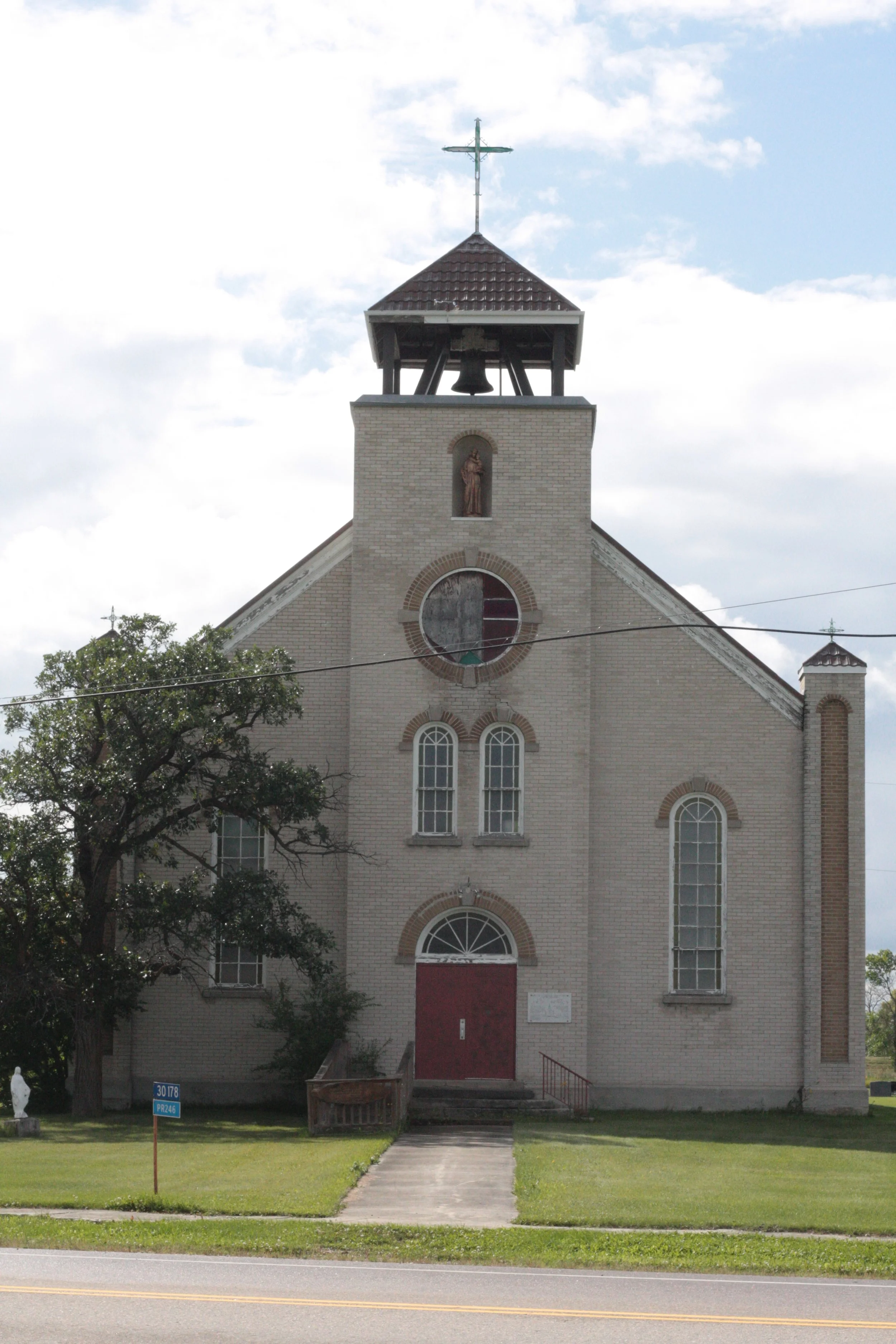
My thesis is a microhistory of the origins of a small parish 55 kilometers south of Winnipeg called Aubigny. Its church, named for saint Antoine (or St. Anthony), opened a registry in December of 1903 soon after the arrival of its first parish priest, Mathias Desrosiers. Part of the introduction to the thesis is dedicated to an examination of registry-keeping in the Catholic church; its origins in France in the 14th century and the method of its propagation in Canada. But forming the basis of the thesis are the questions that arise from Aubigny’s registries themselves. From names recorded at baptisms, burials and marriages emerge families and over time, a genealogy. Where were these families before they came to Aubigny? How did they arrive?
Chapter 1
As family histories stretched back in time, decades before Aubigny’s foundation, it was possible to organize families into groups based on the periods in which they settled within the parish territory. Thus, the first category is dedicated to the Métis families whose names are recorded in the registries. Of the five family names, four have ancestry that can be traced to the fur trade. And while microhistories can, in their tight focus, disconnect individuals from larger historical events, this is not the case for Aubigny’s Métis families. Among them are active participants in the tumultuous years of Louis Riel’s election as minister in the federal government, and a member of parliament during Manitoba’s establishment of a provincial government. Notable in Aubigny’s case is the predominance of one Métis family in particular whose descendants stretch into the 1960’s. Their name persists through decades of registry data which prompted a look at the Métis land question that forced many others to leave the area as well as a brief examination of Métis identity in Canada’s census records between 1870 and 1911. The registries, a memoir, and a local history provide little glimpses of their relationships and integration in the community.
Chapter 2
The second category of families to arrive in the parish are French-Canadian repatriates from the United States. The repatriates’ genealogy shows ancestry in Quebec, migration to the United States and residence in New England cities. Thus families are found working in mills and heads of families as laborers. They are also members of French-American parishes. Encouraging them to leave their life in the United States behind were the efforts of Manitoba’s French Colonisation Society. Le Métis archives provide an overview of the propaganda in this period and the various methods used to convince families to immigrate. It also provides a means of tracing these families’ travel routes in fair detail. Their arrival to Aubigny in the late 1870’s marked the parish’s first French-Canadian pioneers; it also marked the crest of Manitoba’s repatriation movement.
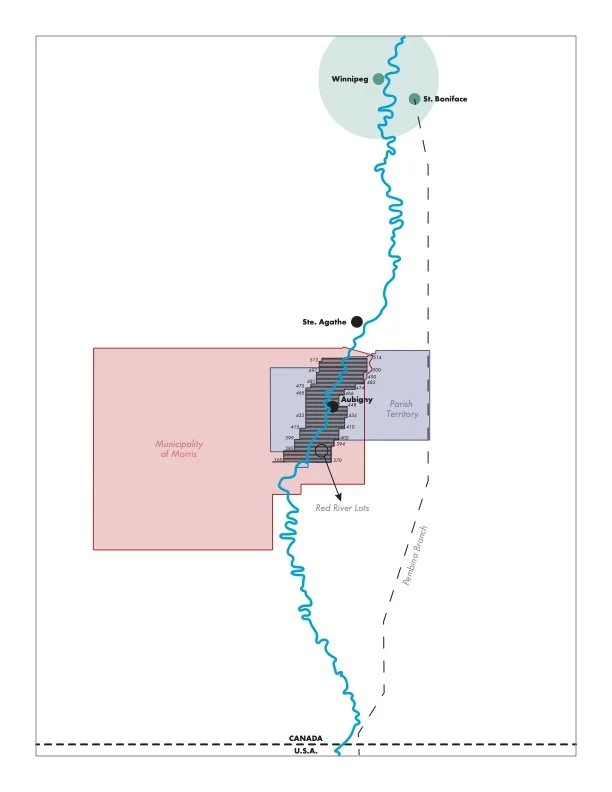
Map credit: Annaleah McAvoy
Chapter 3
Finally, the third category of families, and the largest in this parish’s case, are those who came from Quebec. Of the 19 families, ten came from the region of Lanaudière. Although travel routes were continuously improving in this period, the decision to take up farming in Manitoba was not easily executed. The Colonisation Society’s efforts ebbed and flowed and were constrained by Quebec clergy’s favourability toward the scheme. Correspondence preserved at the Société historique de St-Boniface shows how the priest’s arrival in Aubigny was partly based on a misunderstanding. It is also a window onto the financial challenge of the new parish’s establishment and growth within the St. Boniface diocese.
Chapter 4
As family genealogies filled-in, one feature stood out: a complex web of connections among families which solidified a sense of community. The fourth chapter is therefore dedicated to the ways that a registry uncovers kinship. There are the relationships that facilitate the decision to migrate, for example, and the marriages that occur among settlers to an area. As couples have children baptised, their choice of godparents from among immediate and extended family or from among friends of no apparent relation, flavour the definition of community. The registries having been maintained over a century also offered a chance to analyse families’ persistence in Aubigny.
A few thoughts conclude this thesis: it is an appreciation of pre-existing local histories, a tangible application of information from a variety of archives and databases now available, and a defense of in-depth, tightly-focused research. Perhaps by rendering a higher-definition picture of one French-Canadian parish on the prairies can the endeavour spread and sharpen appreciation for other communities’ particularities and participation in Canada’s history.
The complete thesis can be found here.