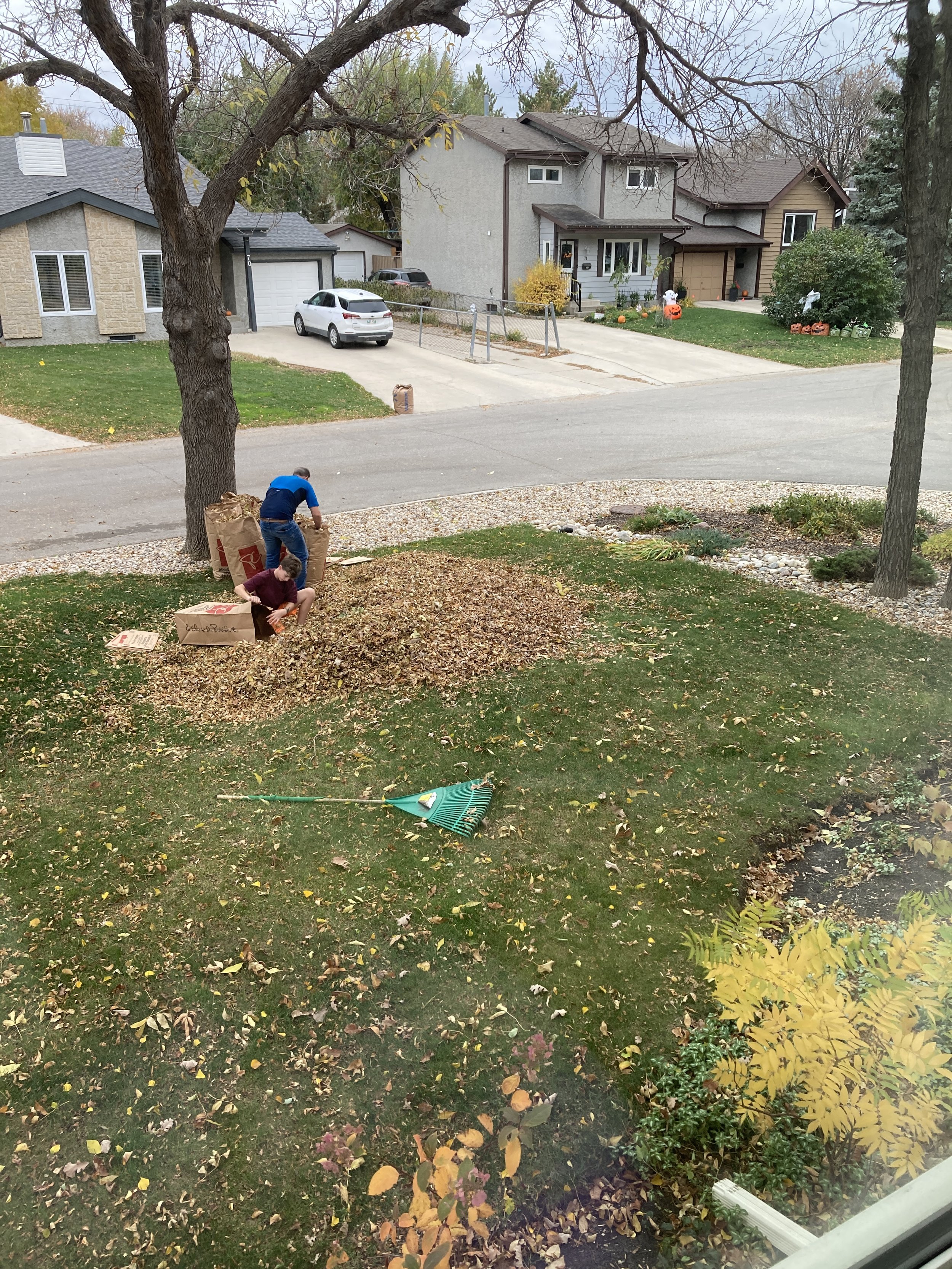
Welcome to a new edition of the various things I found interesting this week. To set the scene, a picture from Friday, when it was so warm, a giant pile of leaves could be bagged in shorts and t-shirts.
Research
To answer the question “who owned the house at 216 La Verandrye” I’ve been going through copies of the Henderson Directory on the Internet Archive. There’s a rumour that this house, which once belonged to my husband’s grandmother, was owned by a religious community, but I haven’t found evidence for this yet. As I’ve been tracking ownership backwards through time, I’ve come across a change in the way houses were numbered on that street, and a short-lived attempt by the city of Winnipeg to change street names between 1891 and 1893. (A 2002 Winnipeg Free Press article by Christian Cassidy contains this plaintive quote by James Gray: “If Winnipeg originally had been laid out by surveyors instead of meandering cows, and if the pioneer urge to erect buildings in the most outlandish places had been squelched, Winnipeg would have little cause to worry about town planning today.”)
I’m ashamed about how slowly I work, how my research seems to rely on laborious methods. At the same time, these tiny discoveries seem more palpable than if I had read Cassidy’s article alone (here). Not all aspects are slow, but this week has been a pleasant plunge back into this kind of data gathering.
World news of an unexpected death
A Catholic priest, Fr. Patricio Sanchez Molinari, died in Ecuador last week and news of his death was relayed everywhere, no doubt because of the apparent irony of its circumstance. (An obit here.) If I give myself permission to imagine this priest, I think of someone sincere, muddling through pastoral life, maybe having visited a sick parishioner, maybe concerned about the effects of social media; either way, having eaten, going to the church, smiling at the people, putting on his robes. He feels inspired to talk about death, and so he does. And what is an accident some minutes later happens to be recorded so that not only is it shocking, but also, the sermon he felt inspired to give doesn’t just leave his mouth for the benefit or the possible ennui of his parishioners. Instead, it takes a leap and becomes a ricochet. What was he talking about? “One day, all of us here will also die, and sometimes the time we have spent on certain things does not hold as much meaning as the time we have spent with God. The quality time we dedicate to God, to our brothers and sisters, to our spouse, to our children, and to our family, that is time spent in the best possible way.” (Source)
The news was about the inauspiciousness. But how often is it that a priest dies and the whole world can hear his last sermon? And furthermore, that their regular sermon can be true to their values and also a fitting testimony? We, as a society, insist on the bad; but it can make us blind to the good.
Baking (sourdough)
Perhaps this sourdough looks good, but learning to make this bread has been an initiation to a world of “crumb”.
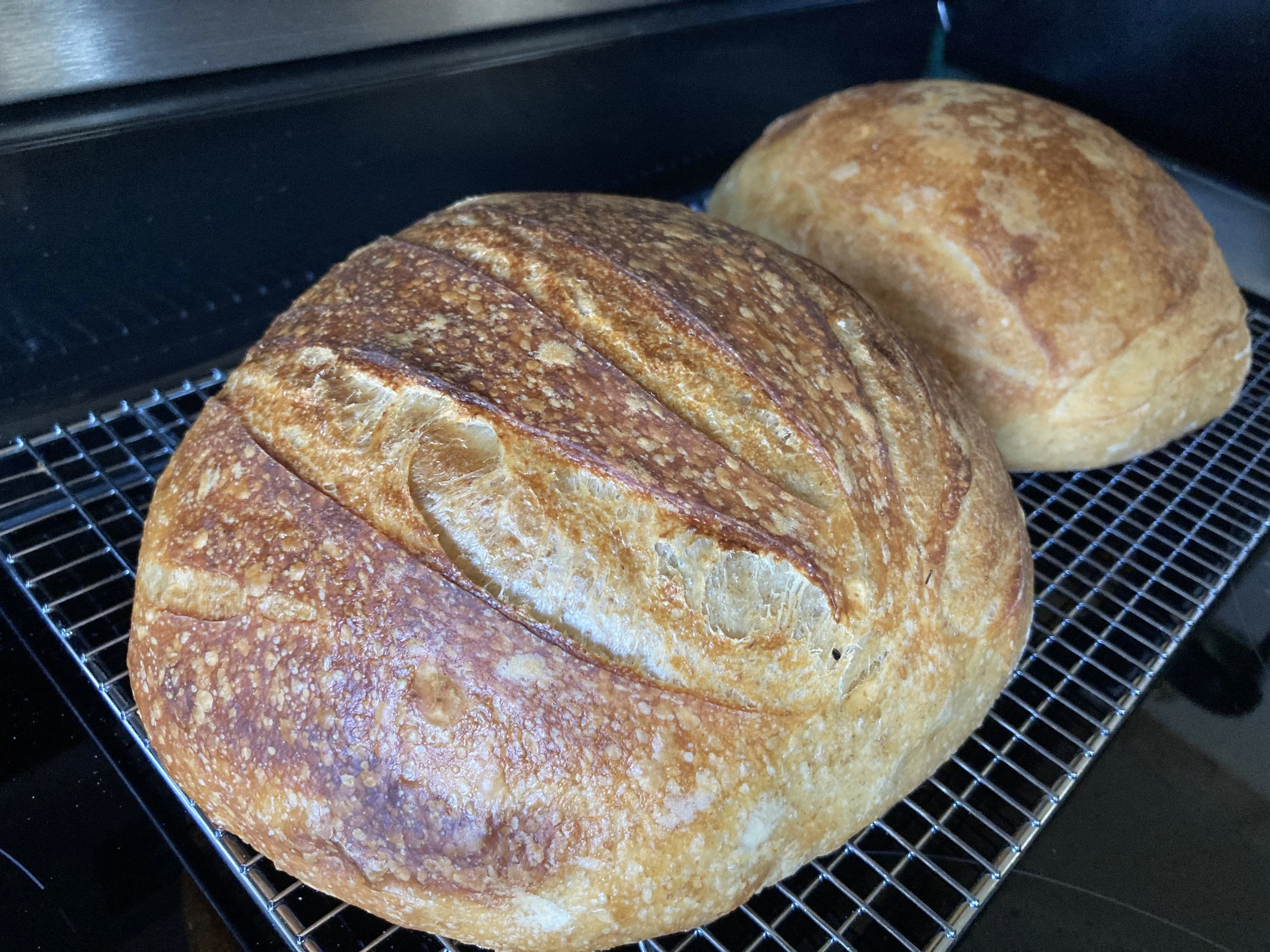
Just as a stylist learns to judge an outfit, I am learning to judge bread texture and study flaws in surface appearance.
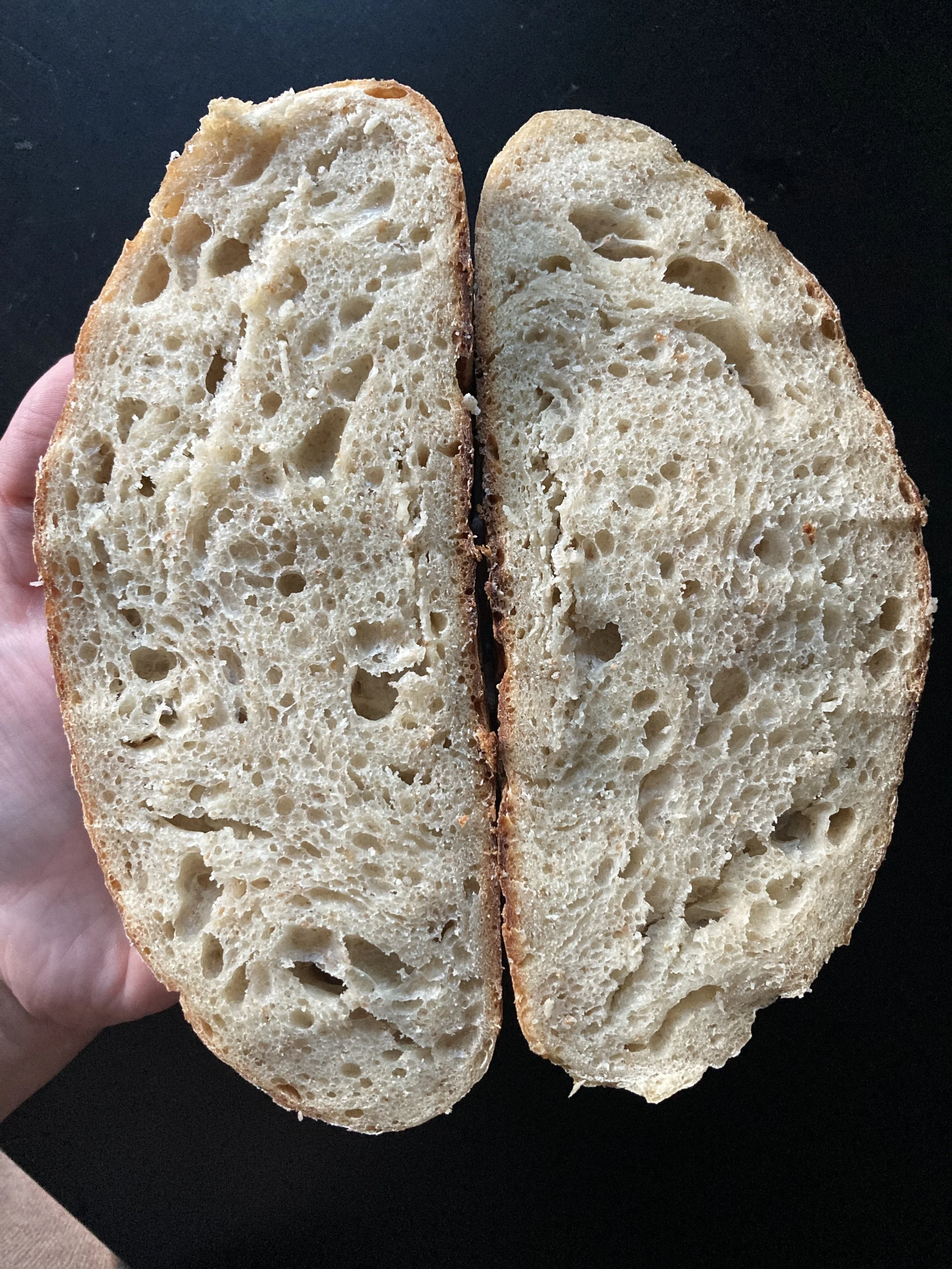
I’d rather get to the successful end of this process before posting the intermediate pictures, open as they could be to the gaze of more successful bakers than myself. Nonetheless… it shows the current preoccupation I have with sourdough. Nothing else I made this week has taken as much space in my head. For this I credit a book by Matthew James Duffy called Bread etc., published last year in Canada.
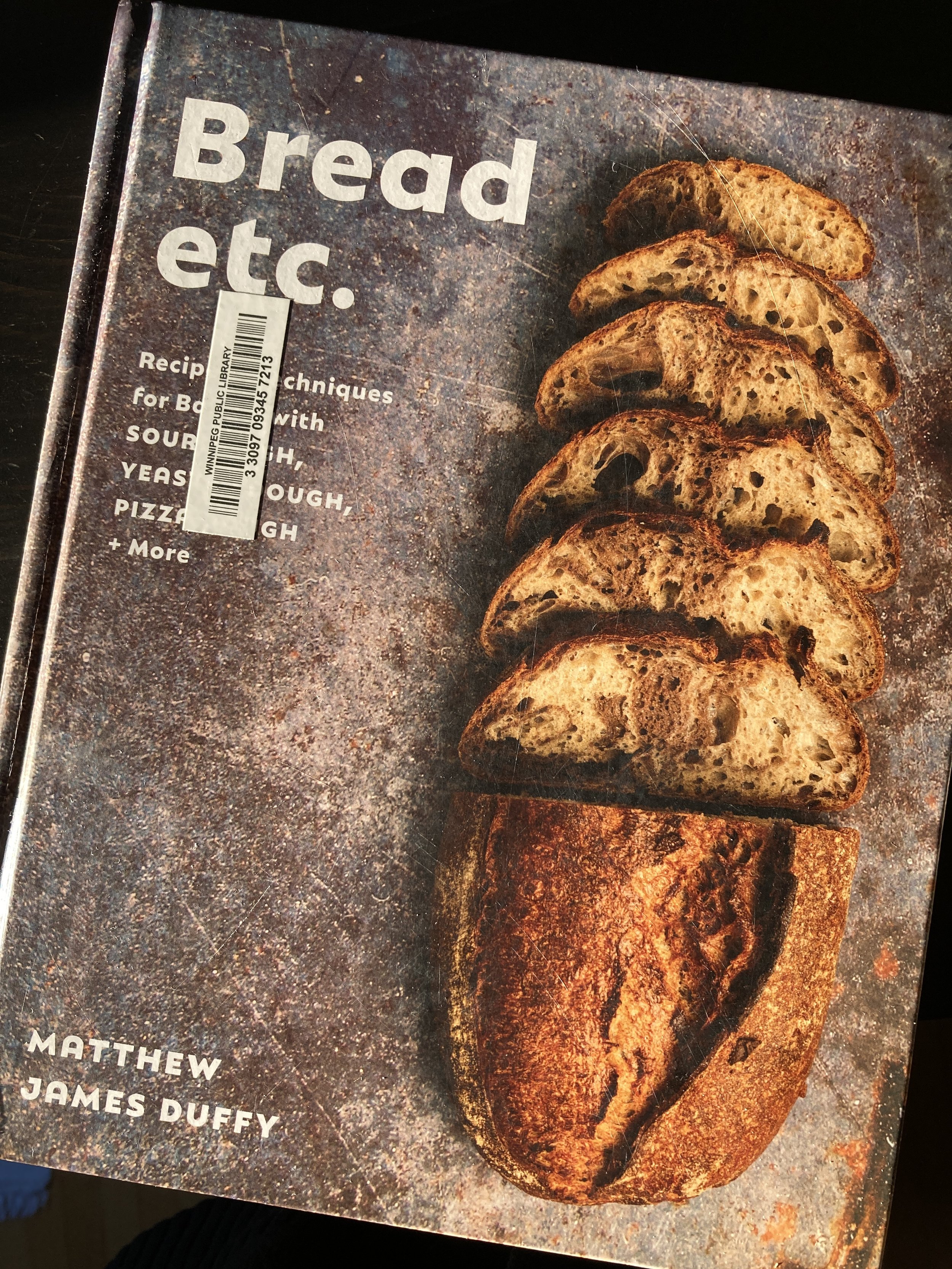
When I mentioned adding this book to a Christmas wishlist, my daughter declared that I didn’t need another book about bread. But there’s a strong case to be made for this one… Duffy’s experience, which he unpretentiously details in the introduction, is wide and varied and his interest in bread has a charming nerdiness to it. Perhaps what is best about this book is its combination of excellent writing, Duffy’s teaching background, and the thoughtful organization. For every step of a basic recipe there is a minimum two-page explanation and accompanying pictures. Reading through the first chapters while my kids were at piano, I got excited about making sourdough. So while the beautiful Big Book of Bread launched this adventure, and Hailee Catalano’s sourdough starter recipe helped me overcome my fear of commitment, Matthew Duffy’s book is exactly the friendly teacher I need in order to learn how to improve.
Enjoying
The “What It’s Like To Be…” podcast is back with a second season, debuting this week with a contortionist. I hadn’t expected to learn so much about contortion, nor have someone in their late twenties have such appreciative points of view. About her mother she says: “she did the best she possibly could to give me all the tools to succeed and […] the road after that was […] in my hands, and it was a lot of work for me. But at the same time, without those tools, you have nothing.” And about how her profession shaped her perspective on the world: “for every tiny niche thing out there, there’s someone with a full breadth of knowledge, top to bottom, and it’s their whole world. It’s really fascinating, and it’s awesome to love in a world where there can be so many diverse interests.” (Here)
I’ve been finding motivation to get on the stationary bike for a bit of cardio if I can watch a few episodes of Design Notes on Netflix. In one episode, House and Garden featured shell artist Mel Campion’s house and studio. Her work is fun to look at (her website has a gallery here) and her house tour exhibited an ideal harmony between artist and environment.
A section on bugs…
My sister celebrated a birthday last week and in the Venn diagram of our interests, hers, in bugs, is one that doesn’t overlap. Nonetheless, her love of bugs has made me consider them with more respect than I would normally. Should I learn more about isopods? Sure! Why not! While not technically an insect (they are a crustacean!) they fall in the general category of “bug” (“any insect or other small anthropod”) and look how many there are! This picture of an isopod’s shed skin fascinated me (see here). (Via)
In the same vein are amphipods, distinguishing themselves from isopods by the fact that they have two kinds of feet. And I only know about these things thanks to the wonderful Geo Rutherford, who every year in October does “spooky lake month” on TikTok (her webpage here). Lake Baikal makes repeat appearances and among its many peculiarities are the larger-than-normal amphipods. (An article from New Scientist here.)
And this week, the Sidedoor podcast featured an episode on beetles (here)! I already knew that the world contains a lot of beetles (“a quarter of all known animal life on Earth”) having read Candace Savage’s book Prairie (mentioned here and here) which featured a memorable, beetle-related, anecdote. She writes: “Asked what he had learned about the Creator from a lifetime spent studying His works, the Scottish biologist J. B. S. Haldane is said to have quipped, ‘He seems to have an inordinate fondness for beetles.’” (p 231) (Wikipedia relays this quote as well, here.) The podcast was an interesting listen.
Walking the dog
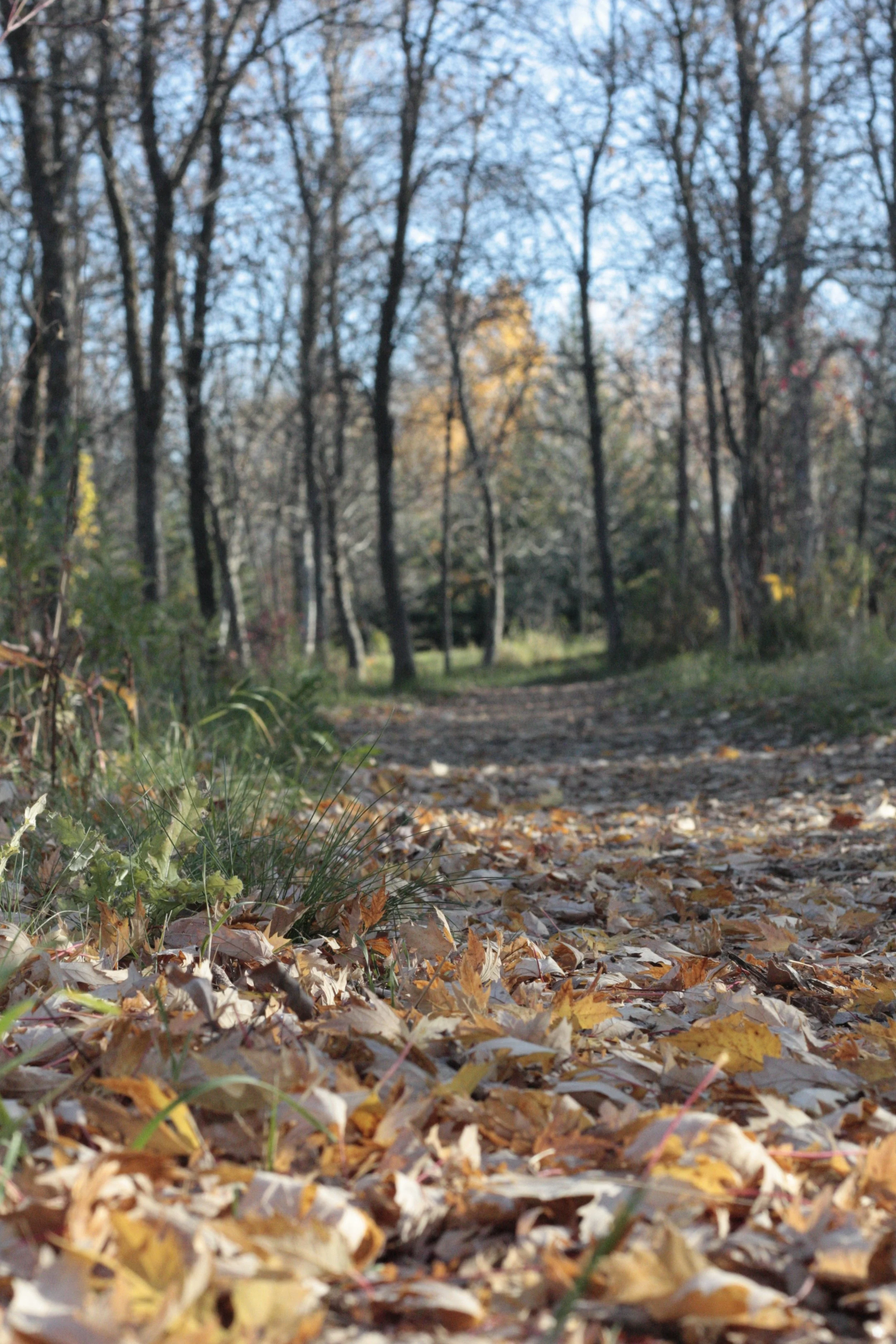
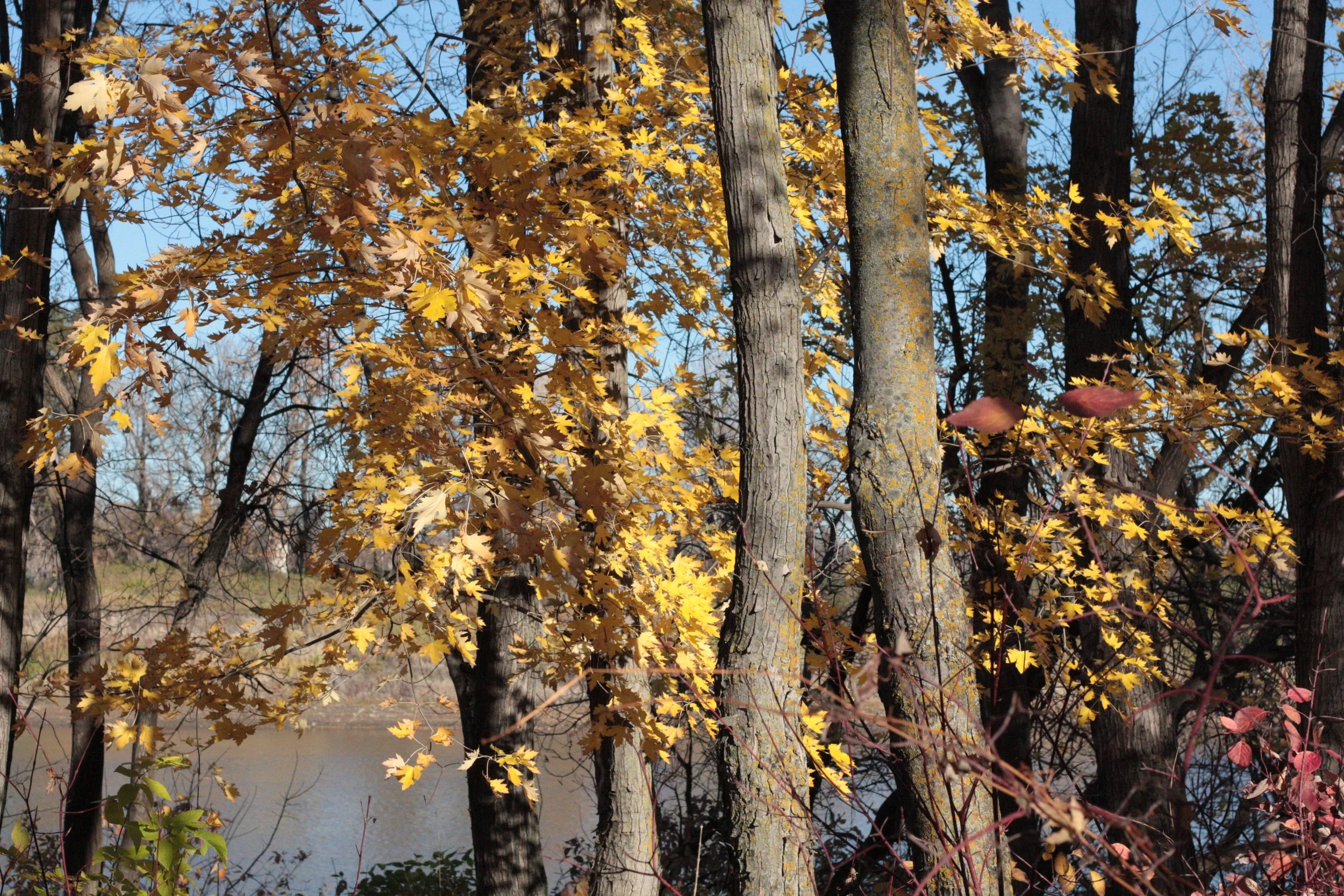
This week, the maple trees are laying a carpet at our feet.
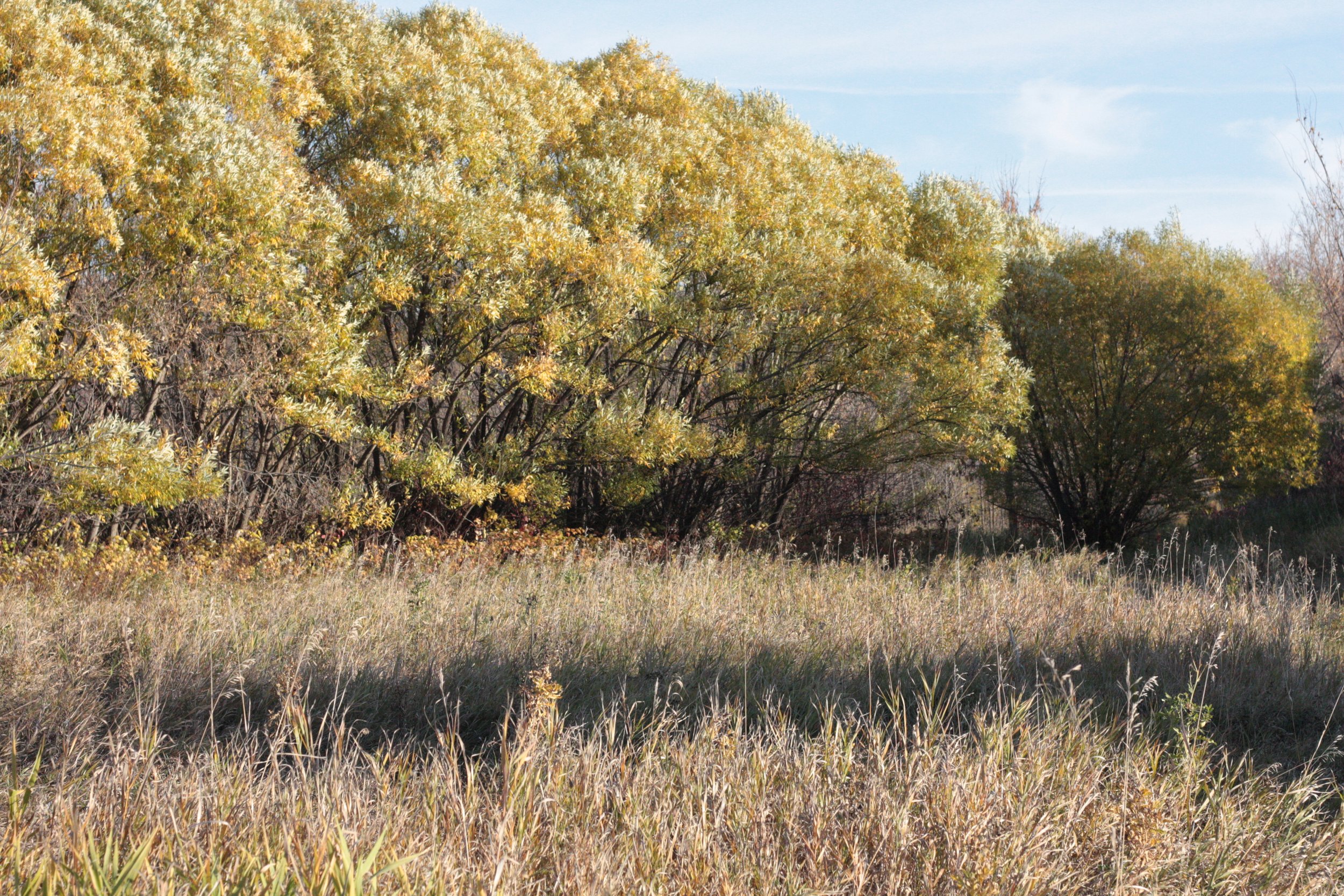
And the line of willow trees look soft from a distance.
Do you think Enzo would make for a good construction worker for Halloween? He’ll stay on the job only so long as the supply of treats doesn’t run out, or an animal make an appearance.


Happy Sunday!