Reading
I recently finished Mussolini and the Pope by David I. Kertzer and enjoyed the product of his historical research. I can only imagine how thrilling it must have been to access the Vatican’s archives for this story. This inside look at Pius XI’s pontificate and Mussolini’s political career grounds the tangential things that have floated past in the last little while… The political unrest in My Brilliant Friend, for example. This online peek at an exhibition of fascist posters. Or Tom Philipps’ comment on Hitler’s organization versus Mussolini’s: “This anniversary card of Hitler’s year-old chancellorship was hot off the press and Hitler makes his first appearance on a stamp. The control exercised over all the semiotics of power, masterminded by Goebbels, already marked Hitler out as in a different league of dictatorship from Mussolini who only made one philatelic appearance in Italy […].” (From Postcard Century, p 172).
But back to Kertzer’s book for a quotation… This one encapsulating the crux of the scandal from those years:
Neither Pacelli nor the pope's two emissaries - the official nuncio and the unofficial Jesuit - had ever uttered a word to challenge the government's decision to treat Jews as a danger to healthy Italian society. For anyone eager for a sign of the Vatican view of the new campaign of persecution, including parish priests and bishops seeking guidance on how to respond to it, the message was clear. The state was finally heeding the warnings that had been appearing in the Vatican daily newspaper and that had been regularly repeated in the Vatican-supervised La Civiltà cattolica and in much of the Italian Catholic press, from weekly diocesan bulletins to major daily newspapers. The recent opening of the Vatican Secret Archives has brought to light a report that makes clear that, as far as the Vatican was concerned, the August 16 [1938] agreement Tacchi Venturi negotiated with Mussolini, promising not to criticize the racial laws in exchange for favorable treatment of Catholic Action, remained in effect. (P 345)
Ideas and the elderly
Reading Gordon S. Wood’s The Purpose of the Past, I came across this passage on the subject of ideas:
These early twentieth-century historians [like Theodore Draper and Lewis Namier] knew that ideas existed, but they tended to dismiss them as propaganda, as manipulated rationalizations covering more deep-lying motives, which were usually economic. Ideas, they said, could not realistically be considered as motives for action, as causes of events.
Even if this realist or materialist position is true, however, ideas are still important for explaining human behaviour. Although ideas may not be motives for our actions, they are nevertheless the constant accompaniment of our actions. There is no human behaviour without ideas. Ideas give meaning to our actions, and there is almost nothing that we humans do that we do not attribute meaning to. We give meaning to even our simplest actions, a wink, for example, and these meanings - our ideas - are part and parcel of our actions. These meanings or ideas are the means by which we perceive, understand, judge, or manipulate our experiences and our lives. They make our behaviour not just comprehensible but possible. We have a human need to make our actions meaningful.
Although we have to give meaning to nearly everything we do, we are not free at any moment to give whatever meaning we wish to our behaviour. The meanings we give to our behaviour are necessarily public ones, and they are defined and delimited by the conventions and language of the culture at that time. It is in this sense that the culture creates behaviour. It does so by forcing us to describe our behaviour in its terms. The definitions and meanings that we seek to give to our behaviour cannot be random or unconstrained, which is why the concept of “propaganda” as freely manipulated meanings is flawed. Our actions thus tend to be circumscribed by the ways we can make them meaningful, and they are meaningful only publicly, only with respect to an inherited system of conventions and values. [Emphasis mine.]
This feels especially pertinent when I think of my 88-year-old mother-in-law. As I am reading through the newspaper archives of her young adulthood in the late 1950’s, I am struck by the social conventions that shaped her and that feel so alien today. If she comments about the number of immigrants she has encountered on an errand, it helps to recall that in 1958, the appearance of a Black student teacher in the French school’s grade 7 class was a newsworthy headline. (See page 4 here.)
Eating
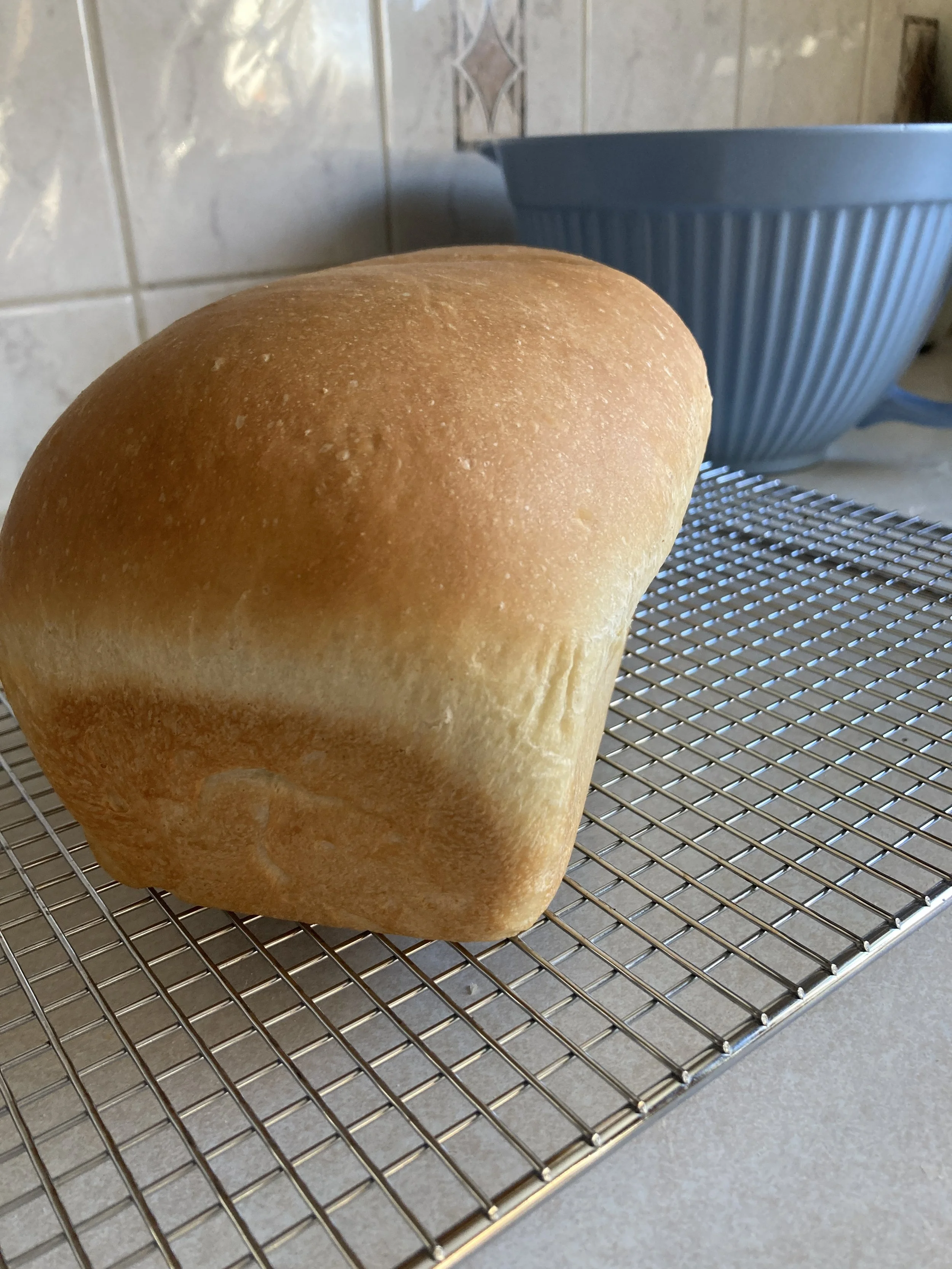
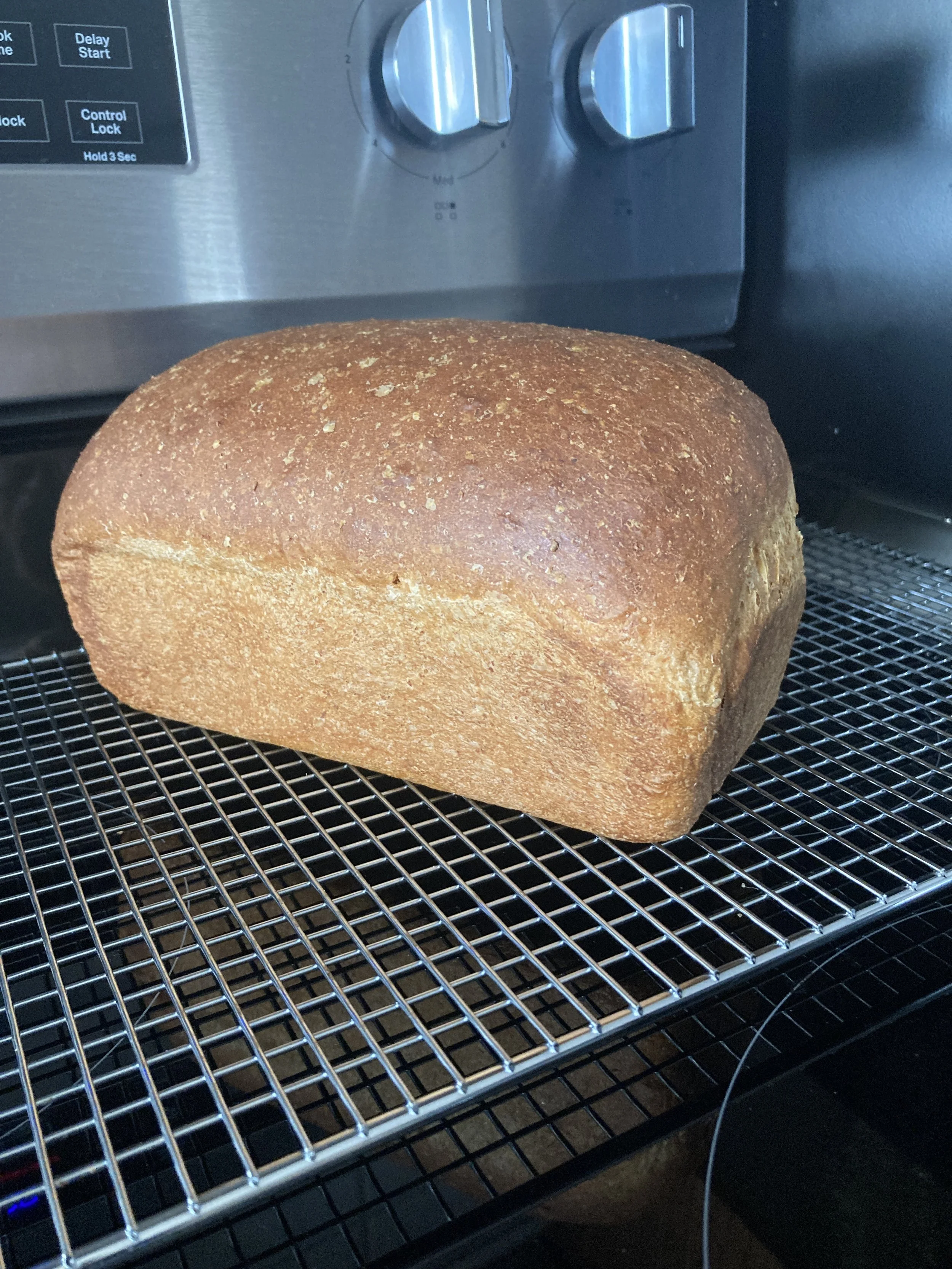
The Big Book of Bread has encouraged me to try making simple loaves… Basic White, and a whole-wheat Everyday Bread. I’m learning about controlling the temperature of the ingredients so that the dough doesn’t overproof. I like the feeling of bread-making as an art.
Postcard
We had three days of frost on the trees, the third being the most impressive…

Happy Sunday!
